Here’s a scenario you’ll recognise. Your organisation rolls out a new tool. The communication was thorough, the training was delivered, the guide is up on the intranet. Week one: nobody uses it. Week two: silence. Then one team starts using it visibly - in meetings, in updates, in their daily conversations. Within a month, adoption spreads across the rest of the organisation like a wave.
Not because of a second training session. Not because of a reminder email. But because people saw their colleagues doing it. And that was enough.
This is social proof at work. And it’s one of the most powerful - and most underrated - mechanisms in behaviour change. Not because you’re a victim of it, but because you can design with it.
Social proof is the tendency to use the behaviour of others as a guide for one’s own behaviour, particularly in situations of uncertainty. Conceptualised by Robert Cialdini in Influence (1984) and confirmed by Solomon Asch’s conformity experiments. In the workplace it determines the adoption of tools, the development of culture and the spread of new behaviours - and it is one of the few biases you can actively deploy as an intervention via the SUE Influence Framework.
What is social proof?
Robert Cialdini described social proof in 1984 as one of the six fundamental principles of influence. The core idea: when people don’t know what to do, they look at what others are doing. That’s not a weakness. It’s an evolutionarily sensible strategy. If everyone in the group is running in the same direction, there’s probably a good reason.[1]
Solomon Asch demonstrated in his famous 1951 conformity experiments just how far this mechanism extends. Participants were asked which of three lines matched a reference line. The correct answer was obvious. But when confederates (actors) gave the wrong answer, more than 75% of participants went along with the group at some point - even when they knew themselves they were wrong.[2]
This is System 1 in action: fast, automatic, and completely below the radar of conscious thought. Your brain doesn’t ask: “What is the right behaviour?” It asks: “What are the people around me doing?” And it copies that answer. In the workplace, this plays out across three dimensions simultaneously.
Observational social proof. You see colleagues doing something and infer that it’s the norm. If half the department is already using a new tool, staying on the outside starts to feel odd.
Descriptive norms. Explicit information about what the majority does. “327 of your colleagues have already signed up.” This works even when you can’t see the behaviour yourself - the number does the work.
Authoritative social proof. When respected peers or leaders display the behaviour, the signal is amplified. Not the masses, but the right people in the right positions.
The question isn’t whether social proof is shaping behaviour in your organisation. It is. The question is whether you’re the one designing it - or whether it’s designing itself.
Three scenarios of social proof at work
The tool nobody used - until everyone did
I know a mid-sized professional services firm that rolled out a new project management tool. For three months: disappointing adoption. IT had communicated clearly. The guide was accessible. The training had been delivered. And yet: most employees kept emailing and maintaining their own spreadsheets.
What changed things? Not a second round of training. Not a mandate. One of the project leads decided to use the tool consistently in team meetings - sharing screens, updating tasks live, making progress visible. His team followed. Their results became visible. Other teams noticed. Within six weeks the active user base had tripled.
This isn’t coincidence. This is social proof in its classic form: behaviour is made visible, and that visible behaviour pulls others along. The training had tried to convince people. The visible early adopter didn’t convince them - he gave them evidence that this behaviour was becoming the norm.
The lesson for change managers: find your early adopters. Give them visibility. Have them do the behaviour in public - in meetings, in updates, in team channels. Not as a showcase, but as evidence. Because adoption doesn’t spread through training. It spreads through observation.
The meeting culture that maintains itself
There is an organisation - I won’t name it, but you’ll recognise the type immediately - where the director reads his email during meetings. Always. His phone sits next to his laptop. Halfway through a presentation he types a message. Nobody says anything.
What do you think happens in that organisation six months later? Exactly. Everyone reads their email during meetings. Not because there’s a policy about it. Not because anyone approved it. But because the visible behaviour of the most influential person in the room has set the implicit norm.
This is the shadow side of social proof: it works even when you don’t want it to. Leaders who arrive late signal that arriving late is acceptable. Managers who never show vulnerability signal that vulnerability isn’t the norm. Directors who never revise a decision signal that revising is a sign of weakness.
The implication is clear and sometimes uncomfortable: if you want to change the culture, you need to change what is visibly done by the people with the most social influence. Not the values on the wall. Not the code of conduct in the handbook. But the daily, visible behaviour of those everyone is watching.
The training that sold itself once you shared the numbers
I’ve seen this play out personally across multiple L&D programmes. An organisation launches a development programme. First announcement: 23 sign-ups. Disheartening, especially for an organisation of 800 people. Then HR sends an update: “327 of your colleagues have already signed up for one of our development programmes this year.”
Sign-ups double within a week. Not because the programme improved. Not because the communication got better. But because the number shifted the perception of the norm. From “this is for the ambitious ones” to “this is what people here do.”
Booking.com is a master of this. “12 other people are looking at this hotel right now.” “Booked 14 times last night.” These are descriptive norms that speak directly to the System 1 brain: if others are doing this, it must be the right choice. Apple plays the same game at every product launch: the queues outside the store are not a bug in their distribution strategy - they’re a feature in their social proof strategy. Those queues say: this is the product people want. And that signal is more powerful than any advertisement.
The lesson: make numbers visible. Not as bragging, but as evidence of norm. “X of your colleagues are already using this.” “Three teams have already made the switch.” “This is the most-used approach in our network.” That framing does more for adoption than ten persuasive arguments.
The Influence Framework: social proof as a Gains intervention
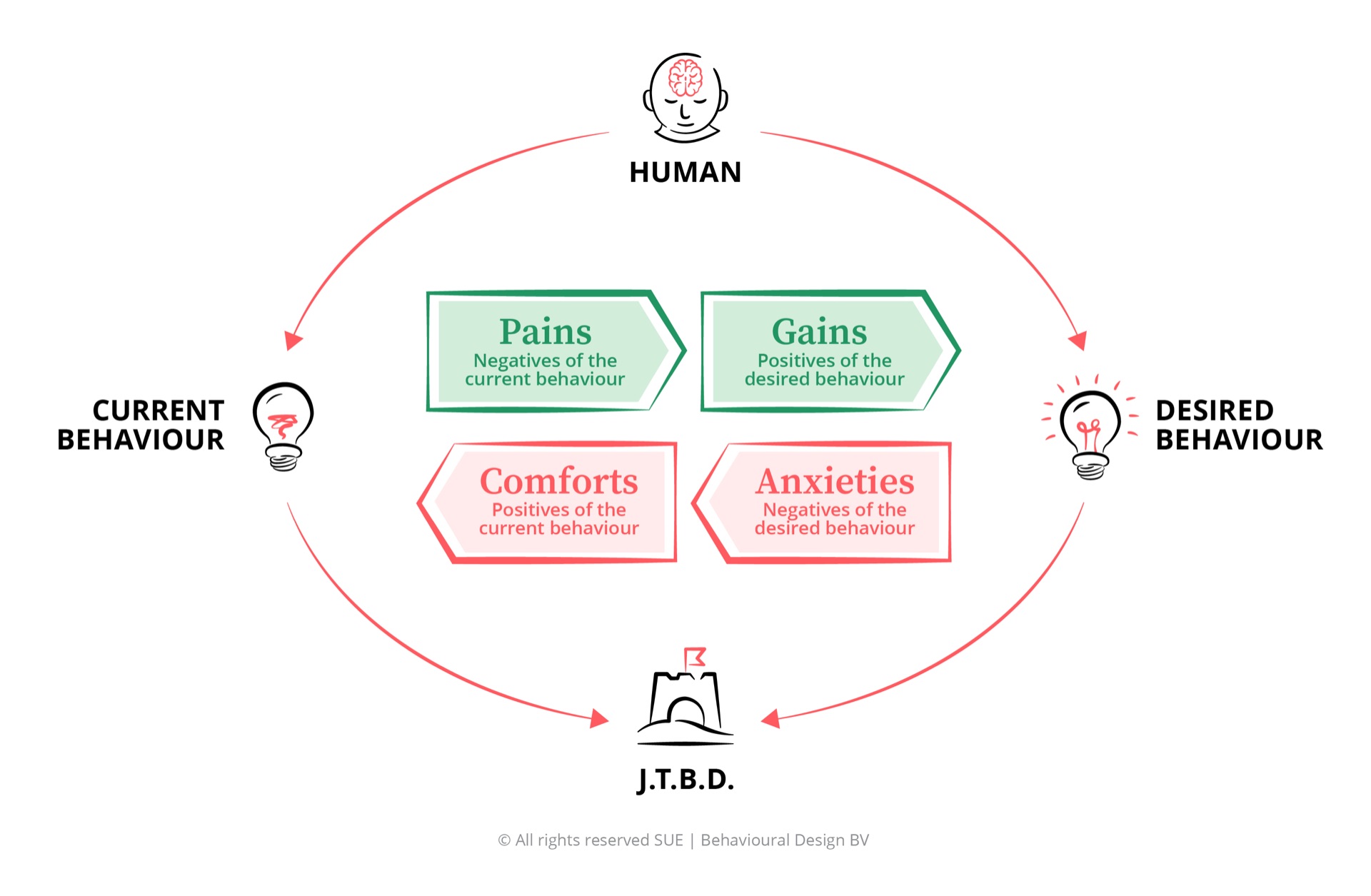
When you analyse social proof using the SUE Influence Framework, something striking emerges. Most cognitive biases in the workplace are primarily blocking forces: they keep people locked in current behaviour, they generate resistance, they make change harder. Social proof is different. It is one of the few psychological mechanisms you can consciously deploy as a driving force - as a Gains intervention that makes new behaviour more attractive.
Pains (what pushes people away from current behaviour): the fear of being left behind. The feeling of being the only one not doing something yet. The social discomfort of being an outsider. These are real pains that social proof can activate - provided you make them subtly visible.
Gains (what pulls people toward new behaviour): and this is where social proof becomes genuinely powerful. When the desired behaviour looks visible, normal and rewarded for others, it creates an attraction that rational persuasion can never match. The Gain isn’t the tool or the training itself. The Gain is belonging. Doing what successful, competent colleagues do.
Comforts (what keeps people in current behaviour): habit, the comfort of the familiar, the certainty of “this is how we do things here.” Social proof weakens these comforts by showing that “how we do things here” is changing. Once enough people display the new behaviour, the comfort zone shifts with it.
Anxieties (what stops people from changing): the fear of getting it wrong, of standing out, of being the only one who doesn’t get it. Social proof neutralises exactly these fears. When you see colleagues you respect already displaying the behaviour, the fear of being conspicuous as the first disappears.
This is what makes social proof unique among cognitive biases: it is bidirectional. You can defend against it (by recognising when you’re following group behaviour without critical reflection), but you can also actively deploy it as a design tool for behaviour change. And that second option is where the real value lies for organisations.
Five ways to design social proof at work
Social proof doesn’t automatically develop in the direction you want. Unmanaged organisations develop their own social norms - and those aren’t always favourable for the behaviour you’re trying to encourage. Here are five concrete interventions for deploying social proof deliberately.
1. Make desired behaviour visible. Behaviour that isn’t seen generates no social proof. If you want people to use a new tool, make sure your early adopters use it in visible contexts: team meetings, all-hands sessions, presentations. Not as mandatory showcase moments, but as organic, visible practice. Visibility is the raw material of social proof.
2. Use peer ambassadors, not authority figures. Social proof works most powerfully when it comes from people like you, not people above you. A CEO saying “this is the future” activates compliance. A colleague from your own team saying “I’ve been using this for three weeks and it works” activates social proof. Build a network of credible peers who display the desired behaviour and speak about it openly.
3. Share numbers, explicitly. Descriptive norms work even without people seeing the behaviour themselves. “68% of teams in our network have held at least one retrospective this quarter.” “More than 200 colleagues have enrolled in a development programme this year.” The numbers do the work. They shift the perception of the norm without requiring you to persuade anyone.
4. Design an early majority, not an early crowd. Adoption curves start with innovators and early adopters - but social proof only finds real traction once the early majority comes on board. Identify who in your organisation are the credible middlers: people not seen as visionaries, but as solid, trustworthy professionals. Once they’re in, the rest follows.
5. Remove anonymity from desired behaviour. Anonymity suppresses social proof. If nobody knows who is using a tool, who has completed a training, who has embraced a new way of working, the mechanism can’t function. Make participation visible - through shoutouts in meetings, names in updates, public dashboards. Not to push people, but to generate evidence of norm.
How social proof interacts with other biases
Social proof rarely operates in isolation. It reinforces and is reinforced by a cluster of related mechanisms that together shape the picture of what “normal” behaviour looks like in the workplace.
The bandwagon effect is the closest relative. Where social proof is about uncertainty - you look to others because you don’t know what to do - the bandwagon effect is about popularity: you join in because it seems like everyone is doing it. In practice the mechanisms are hard to distinguish, but the difference helps when designing interventions.
Confirmation bias plays an amplifying role: once you’re convinced that something is the norm, you selectively look for evidence that confirms that belief. Social proof creates the perception of the norm; confirmation bias keeps that perception alive, even when reality changes.
Status quo bias works in the opposite direction: it keeps people locked in existing behaviour. Social proof is one of the most powerful countervailing forces: when the new behaviour becomes visibly enough the norm, the pull of the status quo weakens. The trick is reaching the tipping point before resistance becomes too strong.
Loss aversion can give social proof an extra dimension. When the desired behaviour is visible enough, the perception of costs and benefits shifts: not joining in starts to feel like a loss - of belonging, of relevance, of competence in others’ eyes. This is a powerful mechanism, but use it consciously. Fear-based framing can generate resistance if people experience it as manipulation.
Frequently asked questions
What is social proof at work?
Social proof at work is the tendency of employees to use the behaviour of colleagues as a guide for their own behaviour. When others use a tool, join a training or adopt a new way of working, that increases the likelihood that you will do the same. This is especially true in situations of uncertainty, when people are unsure what the “right” behaviour is.
How is social proof different from peer pressure?
Peer pressure is explicit and external: someone expects you to do something and you feel that expectation. Social proof is implicit and internal: you see what others do and adjust your behaviour accordingly, without anyone asking you to. Social proof works precisely because it generates no resistance. You arrive at the conclusion yourself that this must be the right behaviour.
Can social proof backfire?
Yes. If you activate social proof around unwanted behaviour, it amplifies that behaviour. The classic example: “Unfortunately, many visitors steal signs from this park.” That’s social proof for theft. The same applies at work: if the visible behaviour in your organisation is people arriving late, being dependent on meetings, or ignoring email, that behaviour spreads just as fast as positive behaviour.
What is the difference between social proof and the bandwagon effect?
Social proof is the psychological mechanism: you look to others to determine what to do. The bandwagon effect is a specific manifestation of it: you join in with something simply because it appears popular or growing. Social proof is broader and also operates in situations that are not about popularity, but about uncertainty regarding the correct behaviour.
How do I make social proof measurable in my organisation?
Look at adoption curves for new tools or ways of working. If adoption accelerates after a first group is visibly on board, you have social proof in action. Other indicators: do colleagues spontaneously become ambassadors? Are new behaviours being picked up by teams that received no formal training? Do sign-ups for programmes increase once participation is made visible?
Conclusion
Social proof is not a trick for marketers. It is one of the most fundamental mechanisms by which people decide what to do - and that applies just as much in the workplace as on a webshop or a social media platform. The difference between a change initiative that is beautifully designed but reaches nobody, and one that spreads organically through an organisation, is often not the quality of the intervention. It is whether people see others already doing it.
Want to learn how to apply social proof and other behavioural insights as a design tool for change? In the Behavioural Design Fundamentals Course you learn to use the Influence Framework and the SWAC Tool to analyse behaviour and redesign environments. As described in The Art of Designing Behaviour - rated 9.7/10 by 5,000+ alumni from 45 countries.
PS
At SUE our mission is to use the superpower of behavioural psychology to help people make positive choices. Social proof is one of the most democratic mechanisms we know: it costs nothing, requires no technology, and works in every organisation, every team, at every level. But it only works if you design it deliberately. Because if you don’t design it, it designs itself. And then you’re not the one deciding which behaviour becomes the norm.