Everyone agrees the current process is broken. There has been a town hall, a strategy day, a new vision. The presentations were compelling. The room was aligned. Six months later, nothing has changed.
Not because people disagreed. Not because the strategy was flawed. But because doing nothing was easier than doing something new. The existing situation had one enormous advantage over every alternative: it already existed.
This is status quo bias at work. The most powerful brake on organisational change I know.
Status quo bias is the systematic preference for the current state, even when alternatives are objectively better. In the workplace, it is the dominant force keeping behaviour in place. In the SUE Influence Framework, it sits under Comforts: the forces that hold people in their existing behaviour. The current situation is comfortable, not because it is good, but simply because it is familiar.
What is status quo bias?
The term was introduced by economists William Samuelson and Richard Zeckhauser in 1988, in an influential paper demonstrating that people systematically prefer the existing state, even when change would leave them objectively better off.[1]
The mechanism is not irrational in the evolutionary sense. When you do not know what a change will deliver, sticking with the familiar is a safe strategy. The brain treats the current situation as the reference point and interprets any deviation from it as a potential loss. This is System 1 at its most effective: fast, automatic and entirely below the level of conscious reasoning.
Status quo bias is intertwined with three other forces that reinforce each other.
Loss aversion. Giving up the current situation feels like a loss, even when the new situation is objectively better. Psychological research consistently shows that losses weigh roughly twice as heavily as equivalent gains. This makes change structurally harder than it should be on paper.
The endowment effect. What you already have is automatically valued more highly than what you do not yet have. The current workflow, the current system, the current supplier: all are considered too good to abandon, not because of their objective quality, but because they are already yours.
The mere exposure effect. Familiarity creates preference. The more often you encounter something, the more you appreciate it. The old way of working has an enormous familiarity advantage over any alternative, purely through repetition.
Together, these three forces ensure that the status quo is not simply a neutral starting position. It is an active magnet holding behaviour in place.
The most dangerous sentence in any organisation: “This is how we do things here.”
Three scenarios where status quo bias does the most damage
AI adoption: the tools are there, but nobody uses them
Imagine an organisation that has made a serious investment in AI. The tools are available. Training has been delivered. Leadership is enthusiastic and has said so publicly. And yet: three months later, the majority of employees are still using the old workflow. Not covertly. Openly, without embarrassment.
The reason is not that the AI tools are poor. The reason is that the old way of working is “good enough.” Good enough is the tagline of status quo bias. It is never an explicit defence of the bad. It is always a defence of the familiar.
Every time an employee considers using an AI tool, they face a micro-decision. Do I invest the effort to learn this, risking that it costs me more time today than it saves? Or do I do it the way I already know? Status quo bias skews the calculation every time: the costs of change are immediate and certain, the benefits are delayed and uncertain.
This is not a motivation problem. This is a design problem. The organisation has made the new way of working available but has not made it the default. That is the crucial difference.
Meeting culture: everyone complains, nobody changes anything
Ask any ten professionals how many of their meetings are genuinely useful and the answer will hover around half. Ask the same ten people how often they have actively changed the meeting structure in their organisation and the answer will be close to zero.
This is status quo bias in its purest form. The complaint is universal, the willingness to break the default is minimal. Because whoever challenges the weekly status meeting risks the conversation about “how we do things here” and the implicit coalition of people who find that way comfortable.
What is striking is that nobody actively chose the current meeting culture. It simply accumulated, meeting by meeting, calendar invite by calendar invite. The status quo needs no designer. It emerges from inertia. And once established, it has all the advantages of the incumbent: it is familiar, it is expected, it is “just how things work.”
Change requires action. And action requires energy. Status quo bias is the creeping force that ensures that energy never materialises.
Supplier relationships: “We’ve always worked with them”
A procurement manager evaluates three suppliers. Supplier A is the current partner. Suppliers B and C are newcomers with better pricing, stronger SLAs and positive references. After an extensive evaluation, the organisation chooses Supplier A. The reasoning: “We know what we’re getting.”
Translated: the uncertainty of the new outweighs the certainty of the known, even when the facts point in a different direction. The endowment effect is in full operation here: Supplier A has the implicit bonus of already being ours. They are the reference point. Everything is measured against them, not against an objective ideal.
This is not an exceptional decision. This is the standard decision in virtually every organisation I know. And it costs more annually than senior leaders realise: in missed quality, higher costs, and the organisational energy that goes into defending choices rather than improving them.
Why Comforts are the dominant force
When you analyse status quo bias through the SUE Influence Framework, something emerges that initially seems paradoxical: the driving forces for change are often stronger than the blocking forces. The pains of the current behaviour are clear. The gains of the new situation are attractive. And yet the change never gets off the ground.
The explanation lies in the Comforts: the forces that hold people in their existing behaviour. And the most powerful Comfort of all is the simple fact that the current situation exists. It is familiar. It has proven that it works, in the sense that you have survived with it until now. It demands nothing new of you.
You know the expression: better the devil you know. That is not a cliché. It is a fairly accurate description of how the brain makes the trade-off. The current situation needs no more evidence. The alternative always needs evidence. And in the meantime, the familiar wins.
This is also the explanation for why change management fails so often. Organisations invest in communicating the benefits of the new situation: the Gains. They make the downsides of the current situation visible: the Pains. But they forget to address the Comforts. They forget that existing behaviour is not defended by rational arguments, but by habits, by inertia, by the simple force of familiarity.
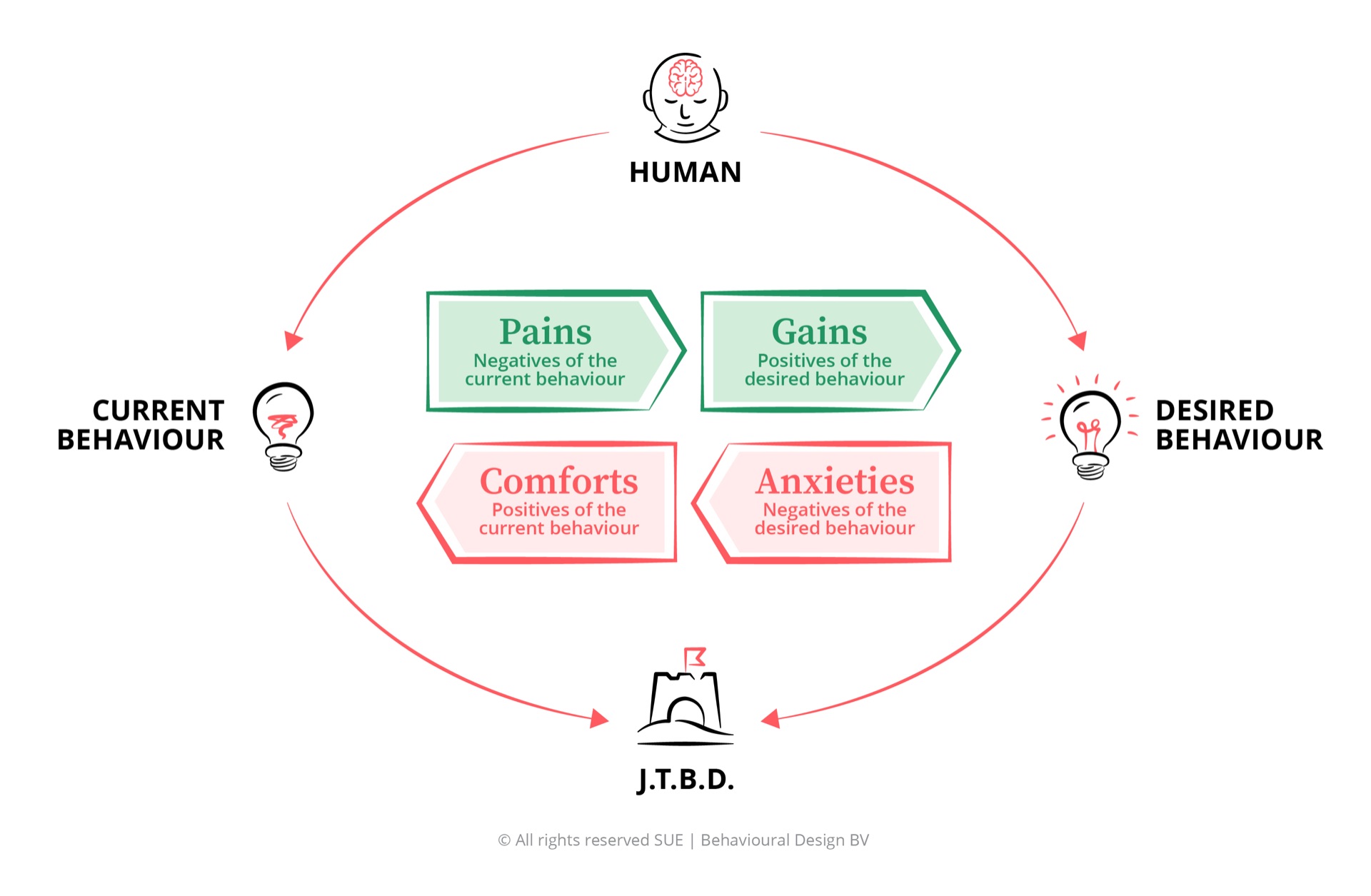
Anxieties reinforce this pattern. The fear of the unknown, the fear of appearing incompetent during a learning process, the fear of making a poor decision that sticks to your name: they work together with the Comforts to make the threshold for change structurally higher than the threshold for standing still.[2]
Five interventions that work
The logical follow-up question is: what do you do about it? The answer from behavioural science is consistent. Not more communication about the benefits of change. Not more training. Not more vision presentations. But designing the environment so that the new way of working becomes the path of least resistance.
1. Change the default. The most powerful intervention is simultaneously the simplest: make the new way of working the standard and the old way of working the exception that requires active choice. If you want employees to use AI tools, ensure they are built into the standard workflow. Not available in a separate portal. Built in. The default always works harder than any communication about it.
2. Offer trial periods. Status quo bias is partly a strategy for reducing uncertainty. If people know they can try something without being permanently committed to it, you dramatically lower the threshold. A trial period makes the switching cost reversible. And reversibility is the antidote to status quo bias.
3. Opt-out instead of opt-in. Research by Thaler and Sunstein consistently shows that the direction of the choice determines what most people do. If the new way of working is the opt-out rather than the opt-in, the balance shifts immediately. People no longer need to actively choose the new. They need to actively choose the old.
4. Make the switching costs of the current behaviour visible. Status quo bias thrives on invisible costs. The costs of the existing situation are rarely measured because they are the norm. Make them concrete and quantitative. How much time is lost per week to a process that could be automated? How much more does the current supplier cost compared to the alternative, on an annual basis? Concrete numbers break the abstraction of “it works well enough.”
5. Create commitment devices. A commitment device is a mechanism by which people make a choice now that steers their future behaviour. Teams that publicly set a goal (“we will be one hundred percent on the new workflow by Q2”) activate social accountability as an additional force against reverting to the status quo. The public commitment increases the psychological cost of not changing.
Related biases
Status quo bias rarely operates alone. In the workplace it reinforces and combines with other cognitive patterns that together complicate the change process.
Loss aversion at work is the deepest root of status quo bias. Every alternative is unconsciously measured against the current situation as the reference point. The switch feels like a loss of certainty, even when the expected outcome is better.
The endowment effect at work causes existing systems, processes and relationships to be automatically valued more highly than their objective quality warrants, purely because they already belong to the organisation.
The sunk cost fallacy at work adds an additional layer: investments in the current way of working justify themselves retroactively. The more that has already been invested in the existing system, the harder status quo bias works to protect it.
Confirmation bias at work closes the circle: once anchored in the status quo, the brain filters information to confirm the existing situation and disqualify alternatives. The cognitive biases reinforce each other in a way that makes it especially difficult to intervene from outside.
Frequently asked questions
What is status quo bias at work?
Status quo bias is the systematic preference for the current state, even when alternatives are objectively better. In the workplace, it manifests as holding on to existing processes, tools and habits, not because they are superior, but because they are familiar. Every deviation from the current path feels like a loss, even when the expected gain is larger.
Why do organisations adopt new AI tools so slowly?
AI adoption stalls not from a lack of tools or training. It stalls because of status quo bias. The old way of working is good enough, the learning curve of something new feels like an investment without guaranteed return, and the threshold to start is always higher than the threshold to continue with what you already know. The solution: make the new way of working the default and reduce switching costs.
How is status quo bias different from loss aversion?
Status quo bias and loss aversion are closely related but not identical. Loss aversion describes the general tendency to weight losses more heavily than equivalent gains. Status quo bias is more specific: the preference for the existing state as the reference point. Status quo bias is partly caused by loss aversion, because giving up the current situation feels like a loss, even when the alternative is objectively better.
What are effective interventions against status quo bias?
The five most powerful interventions are: (1) Change the default, so the new way of working is the standard. (2) Offer trial periods. (3) Use opt-out instead of opt-in. (4) Make the switching costs of the current behaviour visible and quantitative. (5) Create commitment devices that bind teams to new ways of working through public pledges.
When is status quo bias useful?
Status quo bias is not always irrational. In stable environments where proven ways of working are reliable, preferring the familiar is efficient. It becomes problematic when the environment changes but behaviour does not move with it. In organisations navigating technological disruption like AI, status quo bias is an active risk: it protects the current way of working precisely when change is most urgent.
Conclusion
Status quo bias is not a character flaw and not a lack of ambition. It is a structural feature of how the human brain works. That makes it simultaneously more understandable and more dangerous: more understandable because it is a deeply rooted mechanism that affects everyone, more dangerous because it disguises itself as common sense.
The organisations that genuinely implement change are not the ones with the most inspiring visions. They are the organisations that understand that change is a design challenge, not a communication challenge. They change the default. They reduce switching costs. They make the new more familiar than the old, step by step.
Want to learn how to address this systematically in your own organisation? In the Behavioural Design Fundamentals Course you learn to apply the Influence Framework and the SWAC Tool to diagnose and overcome behavioural barriers. Rated 9.7 by 5,000+ alumni from 45 countries.
PS
At SUE, our mission is to harness the superpower of behavioural psychology to help people make positive choices. Status quo bias may be the most underestimated force in organisations, precisely because it has no face. It is not the manager who resists change. It is not the culture that suppresses innovation. It is the simple, quiet preference for what already exists over what is yet to come. And that is what makes it so difficult to address with the usual instruments. You cannot argue it out of existence. You can only design around it.