Picture a scene that probably feels familiar. Your organisation launched an ambitious software project eighteen months ago. The budget has been revised twice. The timeline has slipped repeatedly. The technical debt is piling up. And in the corridors, privately, most people already know: this is not going to become what it was supposed to be.
Yet the next steering committee meeting goes exactly like the last one. The project lead presents a revised plan. Someone mentions how many months the team has put in. Someone else says you cannot possibly stop now. And so the group decides, once again, to continue. Not because the future looks promising. But because the past feels too heavy to abandon.
This is the sunk cost fallacy at work. And it is one of the most expensive cognitive biases I know, precisely because it disguises itself as loyalty, perseverance and a sense of responsibility.
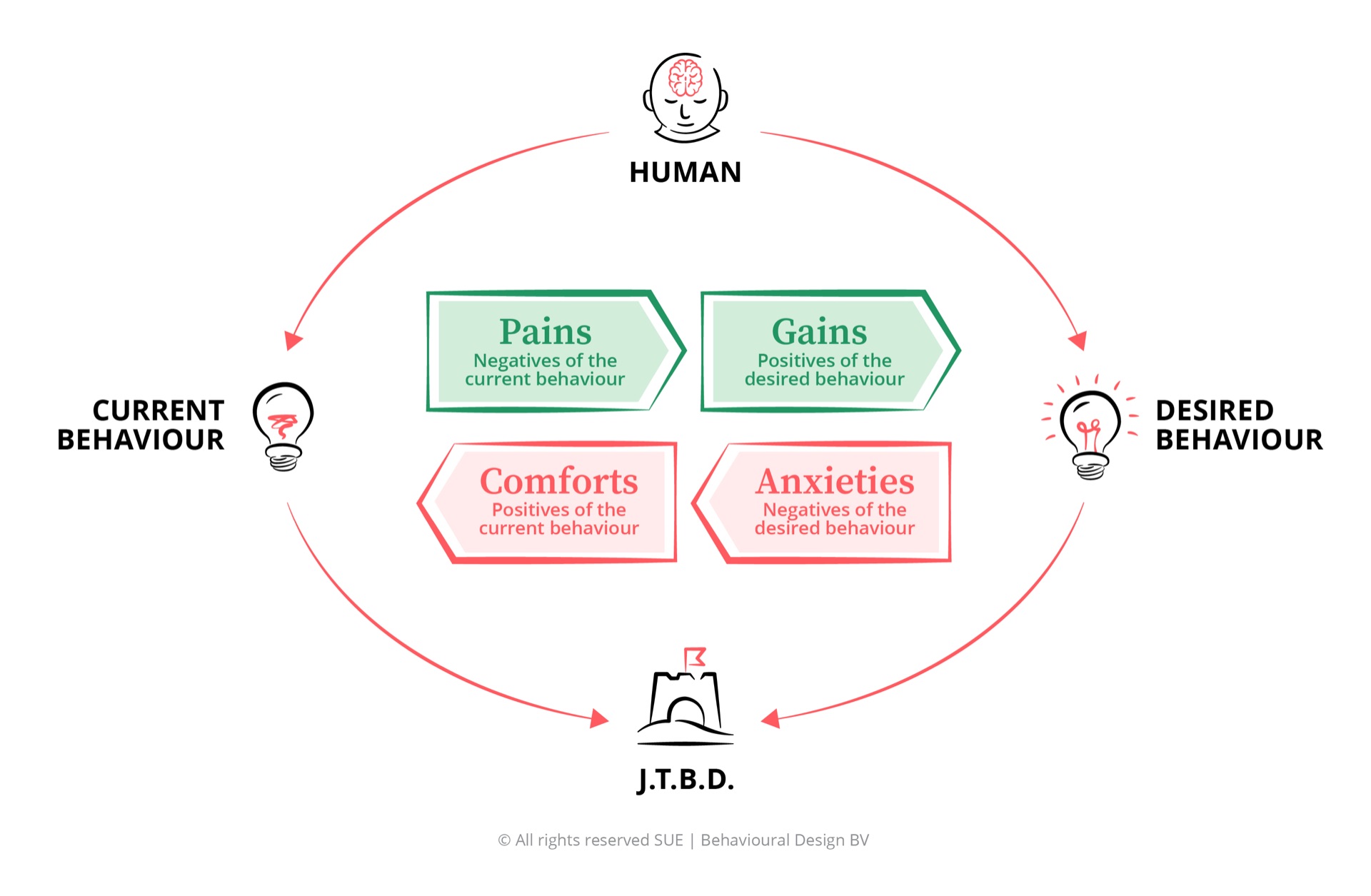
The sunk cost fallacy is the tendency to continue investing time, money or energy into something purely because of what has already been spent - even when stopping is the rational choice. Sunk costs are by definition unrecoverable and should therefore be irrelevant to decisions made today. But our brains do not work that way. In the SUE Influence Framework, the explanation sits in the Anxieties layer: the fear of admitting a loss is so overwhelming that it overrides rational thinking.
What is the sunk cost fallacy?
The term “sunk cost” comes from economics: costs that have already been incurred and cannot be recovered, regardless of what you decide now. Economists agree that sunk costs should be irrelevant to future decisions. Only expected future costs and benefits should drive the choice.
But people are not economists. Arkes and Blumer demonstrated in a landmark 1985 experiment that people systematically become more committed to a course of action the more they have invested in it - even when the rational outlook has not changed.[1] They gave participants scenarios involving ski trips that had already been booked, where the cheaper trip promised to be more enjoyable. Most participants still chose the more expensive trip - purely because they had paid more for it.
The psychological engine behind the sunk cost fallacy is loss aversion, as described by Daniel Kahneman and Amos Tversky in their Prospect Theory.[2] Losses feel roughly twice as painful as equivalent gains feel good. Stopping a project means making the loss concrete and final. Continuing preserves the illusion that the loss can still be recovered. That feeling is powerful enough to override any spreadsheet.
At work, the sunk cost fallacy acquires an additional dimension: accountability. Stopping a project raises uncomfortable questions about who approved it, who let the overruns pass and who pushed for continuing. Carrying on defers that reckoning. And that makes it collectively attractive to maintain the fiction that the project is “almost there”.
Stopping feels like losing. Continuing feels like keeping the chance to win. That feeling beats any rational argument.
Three scenarios you will recognise
The software project that never ships
I know a large organisation that was eighteen months into an ERP implementation when the evidence became undeniable: the chosen vendor could not deliver what had been promised. Integrations were far more complex than estimated, consultants kept rotating and user acceptance scores from the first pilot group were dismal. Every quarterly review ended with the same ritual: revised timeline, adjusted scope, renewed confidence.
The phrases that kept appearing: “We’ve come too far.” “We can’t walk away now.” “We have three million in this already.” Three variations on exactly the same thing: sunk cost reasoning. The question nobody asked was the only one that mattered: if we were starting fresh today, with everything we now know, would we still choose this vendor?
The parallel with the Concorde project is uncomfortably precise. The British and French governments kept investing for decades in a supersonic passenger jet that was never commercially viable, purely because the prior investment was too large to politically abandon. The phrase “Concorde fallacy” has since become a synonym for institutional sunk cost thinking. Nokia clung to its operating system while Android and iOS rewrote the market. Blockbuster defended its retail model while Netflix redefined the rules. The pattern is always the same: the weight of past investment determines the direction of future decisions.
The employee who should have moved on
An HR director once told me about a senior manager who had been consistently underperforming for two years. Feedback had been given, an improvement programme had been completed and still the results were thin. The question had long since shifted from “is he performing?” to “when do we part ways?”
Yet the decision kept being deferred. Every time it came up, the reasoning was the same: “We have genuinely invested in his development. He had three months of executive coaching. We sent him on an expensive leadership programme. Walking away now feels like throwing all of that away.”
This is the sunk cost fallacy in its most human form. The investment in someone’s development becomes a reason to continue, even when the prognosis is poor. Meanwhile the rest of the team pays the price: picking up extra work, accepting lower team standards, growing frustrated at the absence of consequences. The costs of continuing are diffuse and hard to quantify. The costs of stopping are concrete and feel like loss. And so continuing wins.
The irony is that investing in coaching and development is good in principle. But that investment should never be the variable that determines whether you continue. The only relevant question is: what is the most realistic forward-looking expectation, and is it good enough?
The marketing campaign that is not delivering
A marketing team launches a campaign in January with a budget of 200,000 euros. Three months in, the results are poor: cost-per-lead is three times the benchmark, conversion rates are low, and A/B tests consistently point in the wrong direction. The data is unambiguous: this campaign is not working.
But then comes the familiar logic. “We’ve already spent half the budget.” “We can’t pull the plug halfway through.” “The brand awareness we’ve built must be worth something.” And so the second half of the budget goes into a campaign that everyone, privately, knows is not working.
This pattern is painfully common in large organisations. The budget was approved, the campaign was announced, the team has spent months on it. Stopping feels like admitting failure. Continuing feels like giving a chance to something you have already built. But the 100,000 euros already spent are gone. The only real question is: is the best use of the remaining 100,000 euros to continue this campaign, or to do something else?
The Influence Framework: why Anxieties dominate
When I analyse the sunk cost fallacy using the SUE Influence Framework, something immediately stands out: the blocking forces are disproportionately strong. This is why rational arguments rarely make a dent.
Pains (what pushes you away from current behaviour): the reputational damage of a failed project, the wasted resources, the missed alternatives. Real costs. But they are future-oriented and abstract. And they are already partially realised, which makes them feel less urgent as a reason to stop now.
Gains (what draws you toward stopping): freed-up budget for something that works, a clear signal that the organisation learns fast, energy redirected toward better alternatives. Valuable. But also abstract and distant.
Comforts (what keeps you in current behaviour): continuing is familiar. The project has a structure, a team, a well-worn rhythm of steering committees and status updates. Stopping creates uncertainty. What comes next? Who decides? How do you explain this to stakeholders? The comfort of familiar chaos beats the discomfort of unfamiliar emptiness.
Anxieties (what stops you from changing): and here is the heart of it. The fear of making the loss permanent and acknowledged. The fear of accountability: who approved this? Who kept it going? The fear of looking incompetent. The fear that stopping will be read as failure rather than as sharp leadership.
The Anxieties are so dominant that they override every rational argument. Awareness does not help - you cannot think your way out of fear. The solution has to operate at the environmental level: structures that make it safe to stop, and that redistribute the accountability for continuing.
Five interventions at the environmental level
You do not beat the sunk cost fallacy through awareness campaigns. You beat it by redesigning the environment in which decisions are made.
1. Define stop criteria upfront. At the start of every major project, agree on the conditions under which you will stop. Which KPI thresholds, which timeline, which budget ceiling. When the project hits those thresholds, stopping becomes the default - not an exception that needs defending. This removes the emotional weight from the moment of stopping: it was already decided, long before the sunk costs accumulated.
2. Institutionalise the “fresh start” test. In every steering committee meeting for a project that has been running for some time, ask one fixed question: if we were starting completely fresh today, with everything we now know, would we still launch this project? If the answer is no or maybe, that triggers a structured stop review. Build this question into the standing meeting format.
3. Make the cost of continuing explicit. Sunk costs are vivid and feel heavy. The opportunity costs of continuing are abstract and fade into the background. Make them concrete: what does it cost to run this project for another twelve months, in euros, in team capacity and in foregone alternatives? Put that beside the probability of success. That makes the comparison fairer.
4. Bring in an external review at critical thresholds. People inside a project are inherently biased. They have invested in it and feel the sunk cost most acutely. At significant budget overruns or milestone delays, an external reviewer is not a luxury but a necessity. Someone with no sunk costs in the project can ask the question “should we stop?” without the emotional weight.
5. Redefine stopping as a leadership competency. The fear of accountability is partly so powerful because in many organisations, stopping a project is interpreted as failure. But the most effective leaders I know are the ones who stop quickly and clearly when something is not working. If your organisation explicitly signals that failing fast is smart and failing slow is expensive, you change the social norm around stopping. That substantially reduces the Anxiety.
How it connects to other biases
The sunk cost fallacy rarely operates in isolation. At work, it is consistently intertwined with other biases that amplify it and make it harder to diagnose.
Confirmation bias is its most direct partner. When you are deep in a project and unwilling to stop, your brain automatically filters information to justify continuing. Positive signals get amplified; negative signals get rationalised. The sunk cost gives you the motivation to filter; confirmation bias provides the filtering mechanism.
Loss aversion is the psychological foundation. Kahneman and Tversky showed that losses feel roughly twice as painful as equivalent gains feel good. The sunk cost fallacy is loss aversion in action: stopping makes the loss final, while continuing preserves the illusion that the loss can still be recouped.
Status quo bias amplifies the Comforts: the familiar is safe, the unfamiliar is threatening. Continuing with a bad project is the known path. Stopping and starting something new is the unknown. Status quo bias artificially raises the threshold for stopping.
The endowment effect adds another layer: things you own are automatically perceived as more valuable than equivalent things you do not own. A project your team has built feels more valuable than the same project built by someone else. That inflated perceived value makes it harder to let go.
Understanding this has practical value. Interventions that only address the sunk cost fallacy fail because the other biases fill the gap. A system of structural stop thresholds, external reviews and explicit norms around smart stopping works as a set of interlocking safeguards that reinforce each other.
Frequently asked questions
What is the sunk cost fallacy?
The sunk cost fallacy is the tendency to continue with a decision purely because of how much time, money or energy you have already invested - even when the evidence points toward stopping. Sunk costs are by definition unrecoverable. Rationally, they should be irrelevant to decisions about what to do next. But our brains do not work that way: the felt sense of loss from that investment weighs so heavily that it overrides rational thinking.
What are well-known examples of the sunk cost fallacy?
The most famous example is the Concorde project: the British and French governments kept pouring billions into a supersonic passenger jet that was never commercially viable, purely because the prior investment was too large to admit. The same pattern appears at Nokia, which clung to its operating system while Android and iOS reshaped the market, and at Blockbuster, which defended its rental model while Netflix took over.
How do I recognise the sunk cost fallacy in my own decisions?
Ask yourself this test question: if I were starting completely fresh today, with no prior investment, would I still choose this project? If the answer is no, but you are continuing anyway, you are probably operating from the sunk cost fallacy. Also watch for phrases like “we’ve come too far to stop now” or “we can’t turn back at this point” - those are classic signals.
Why is the sunk cost fallacy so hard to overcome?
Because it is not primarily cognitive - it is emotional. Loss aversion means losses feel roughly twice as painful as equivalent gains feel good. Stopping feels like making the loss concrete and final. Continuing preserves the illusion that the loss can still be recovered. On top of that, stopping a project in an organisation raises uncomfortable questions about accountability: who approved this? Who kept it running? The fear of that reckoning keeps people trapped.
What is the difference between the sunk cost fallacy and loss aversion?
Loss aversion is the broader psychological mechanism: the tendency to weight losses more heavily than equivalent gains. The sunk cost fallacy is a specific expression of loss aversion: you continue with an investment because the felt loss of stopping outweighs the rational case for quitting. Loss aversion is the mechanism; the sunk cost fallacy is the behavioural outcome.
Conclusion
The sunk cost fallacy costs organisations more than money. It costs them speed, credibility and the capacity to learn. Every project that runs too long locks up capacity that could have been creating value elsewhere. Every decision deferred because of sunk costs widens the gap between the organisation and reality.
The solution is not harder thinking or more willpower. The solution is designing the decision-making environment so that stopping becomes the right default at the right moment. Criteria set in advance. External reviews at thresholds. A culture in which smart stopping is a mark of leadership, not a sign of failure.
Want to learn how to structurally improve decision-making in your organisation? In the Behavioural Design Fundamentals Course you learn to apply the Influence Framework and the SWAC Tool to diagnose cognitive biases and overcome them. Rated 9.7 by 5,000+ alumni from 45 countries.
PS
At SUE, our mission is to use the superpower of behavioural psychology to help people make better choices. The sunk cost fallacy may be the quietest saboteur of organisational decision-making, precisely because it disguises itself as perseverance and loyalty. The first step is recognising that the past is never a good reason to continue with something that will not work in the future. The second step is to stop trying to instil that insight in individuals, and to start building organisations that are structurally designed to stop smartly. That is what The Art of Designing Behaviour is about.