Most behaviour change efforts fail for a remarkably consistent reason. They are built on the assumption that if people aren't doing what you want, it's because they don't want to badly enough. So you add more communication, more persuasion, more incentives. You make a stronger case for the desired behaviour.
Sometimes that works. Often it doesn't. And the reason it doesn't is hiding in plain sight.
The SWAC tool is a diagnostic framework we use at SUE to figure out exactly why a behaviour isn't happening, and which type of intervention will actually move it. It has four elements, and getting the diagnosis wrong is the single biggest waste of budget in behaviour change programmes.
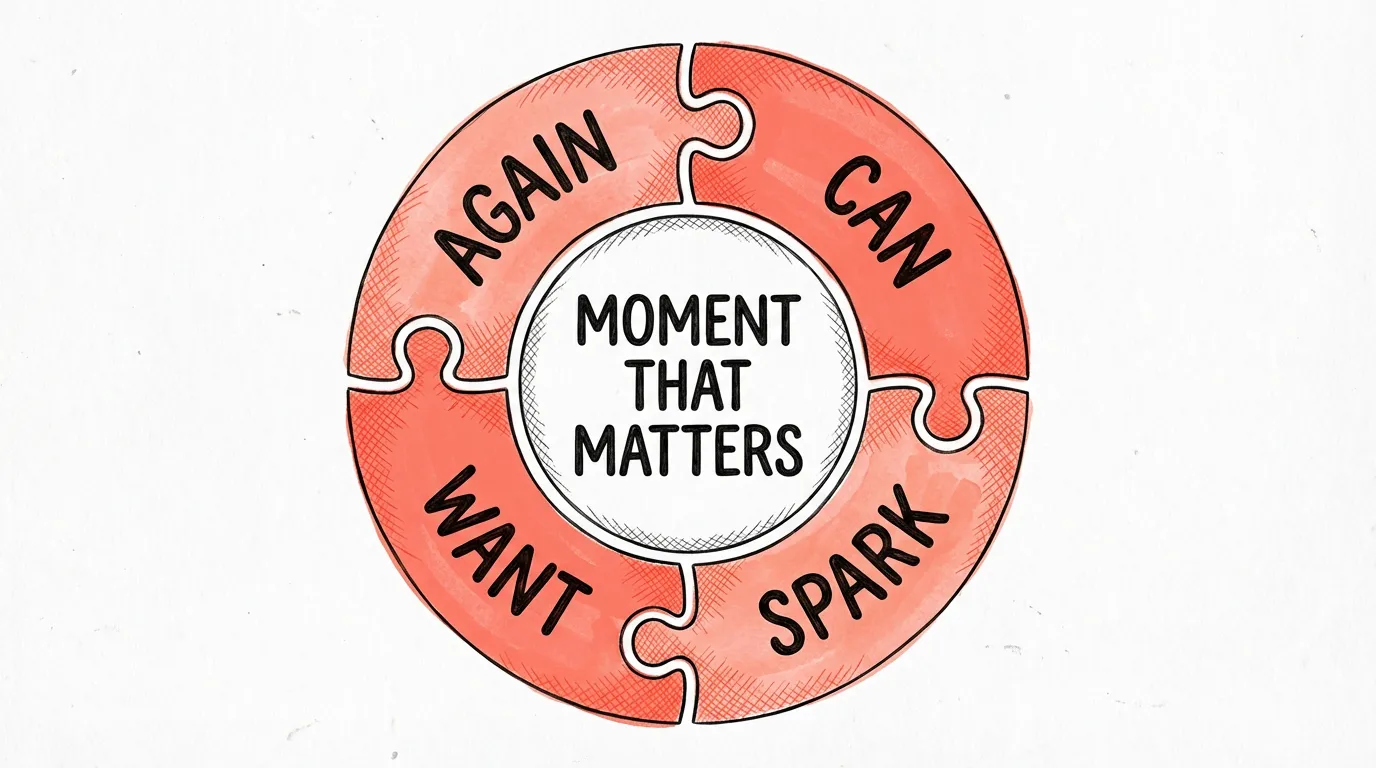
The SWAC formula: Behavioural Change = Spark x Want x Again x Can. If any one of the four elements is absent or close to zero, the behaviour doesn't happen - or doesn't last. SWAC gives you a structured way to diagnose the bottleneck and design the right type of intervention for each element.
Why most behaviour change efforts fail
Think about the last time you tried to change someone's behaviour. Maybe you were running a health campaign, a sustainability initiative, or a digital adoption programme. You probably put most of your effort into making the case: communicating the benefits, explaining why it matters, maybe adding a financial incentive.
This is entirely rational. We are trained, from school onwards, to use the best arguments. We are shaped around motivation. And motivation is real, it matters, and it can move people. The problem is that motivation is a System 2 activity. It requires conscious deliberate thinking, the kind that requires attention and effort, and that fluctuates wildly depending on mood, context, and competing demands on cognitive load.
As Daniel Kahneman once put it: "Humans are to thinking what cats are to swimming. We can do it if we have to. But we much prefer not to."[1]
Relying on motivation to sustain behaviour change is a design decision. And it is often the wrong one.
What the SWAC Tool is
SWAC is a behaviour change design formula. It sounds like "swag," but it stands for: Sparking off Willingness Again and Capability.
The formula reads: Behavioural Change = Spark x Want x Again x Can.
Each element is a multiplier. If one is zero, the product is zero. That means all four need to be present for behaviour change to happen and stick. The formula is multiplicative, not additive - you can't compensate for a missing element by doubling down on another.

When behaviour doesn't happen, or starts and then stops, you can almost always trace it back to one of the four elements being too weak. The diagnostic question is: which one? The answer determines what kind of intervention you need to build. And the right answer is often not the one practitioners expect.
SWAC works alongside the SUE Influence Framework, which maps the forces that drive or block a decision - pains, gains, anxieties, and comforts. The Influence Framework helps you understand demand: what does someone want, and what holds them back? SWAC then guides the design: which type of intervention do you build to move each element?
CAN - the hidden gem
Of the four elements, CAN is the most underused. And it is often the most powerful.
CAN means capability: how hard or easy is it for someone to actually perform the behaviour? Not whether they want to. Not whether they have been persuaded. Whether they physically, cognitively, financially, and socially can do it.
Six factors tend to make behaviour hard: time, money, physical effort, brain cycles, social deviance, and the fact that the behaviour is non-routine. Any one of these can be the real barrier. Most communication campaigns address none of them.
Working on capability means designing for System 1. It means making the desired behaviour the path of least resistance. It means simplicity eats willpower for breakfast.
The cleanest real-world example is Bank of America's "Keep the Change" programme. Every time a customer made a purchase, the transaction was rounded up to the nearest dollar and the difference was automatically transferred to a savings account. Nobody had to decide anything. Nobody had to remember. Nobody had to motivate themselves. The behaviour became automatic.[2]
The results were striking: 12.3 million customers enrolled, $2 billion saved in total, 60% of new customers signed up, and 99% retention. This is what capability design looks like at scale. Not a savings education campaign. Not a motivational poster in the branch. A structural change that made the desired behaviour happen by default.
The best behaviour change ideas are, at their core, capability ideas. They remove the need for willpower altogether.
When you design for CAN, you design for the real human - not the aspirational one who was definitely going to take action after reading your leaflet.
WANT - the willingness wave
WANT is willingness. And willingness doesn't sit still.
It moves in waves. It spikes at particular moments: a health scare, the start of a new year, a frustration peak, a life transition. These are what we call "Moments that Matter" in Behavioural Design. At these moments, someone's willingness is high enough to do hard things. They will sign up, commit, pay, change. But the peak passes. Willingness drops. And when it drops, people will only do easy things.
This has an important design implication. When willingness is high, you can spark harder behaviours: enrolment, commitment, purchase, public declaration. Get the commitment while the wave is up. But if the downstream behaviour requires continued effort, you need capability interventions in place for when the wave comes down again.
The sequencing strategy: at the peak of willingness, trigger the hard behaviours. Then use CAN interventions to keep the behaviour running automatically when willingness drops back to baseline.
Trying to sustain behaviour on willpower alone is a losing game. Willpower is finite, context-sensitive, and depletes through the day. Capability design doesn't deplete. It just works.
SPARK - triggering the behaviour
No behaviour happens spontaneously. Every behaviour needs to be triggered. That's what SPARK is: the cue, prompt, or environmental signal that starts the chain.
A spark must be noticeable, actionable, and sensory. It needs to register, it needs to lead somewhere obvious, and it needs to land in the right moment.
The simplest example: the red fuel warning light in your car. Almost everyone wants to avoid running out of fuel, and almost everyone can fill up easily. But without the spark of that warning light, many more people would run out of fuel. The want and the can are both there. The spark is what closes the gap.
There are three types of sparks. Reminders nudge people who want to do something but keep forgetting. Obstructions slow down unwanted behaviour at the moment it is about to happen. Interruptions break a pattern before the automatic behaviour kicks in.
A famous example of a well-placed spark: a girl scout set up her cookie table outside a marijuana dispensary. Her sign read: "Satisfy your munchies." She sold 300 boxes in six hours. The spark met the moment. The want was already there. The spark made the connection.
Sparks also belong inside choice architecture. You can design the environment so that the right behaviour is prompted automatically, without relying on anyone to remember.
AGAIN - designing for habit
Behaviour that happens once is not behaviour change. AGAIN is the element that converts a behaviour into a habit.
The popular claim is that habits form in 21 days. This number comes from a 1960s plastic surgeon who noticed patients took about three weeks to adjust to their new appearance, and has been repeated so many times that it became accepted as fact. It isn't. A 2010 study by Phillippa Lally at University College London tracked 96 people forming new habits over 12 weeks. The range was 18 to 254 days. The average was 66 days.[3]
Habit formation takes longer than we assume, and it requires consistent sparking over that window. James Clear's two-minute rule offers a practical entry point: when starting a new habit, it should take less than two minutes to begin.[4] Not to complete. To begin. Make the entry so easy that the habit starts before resistance has time to form.
A fitness chain we worked with discovered something telling in their membership data: people who exercised twice a week for three consecutive months almost always became long-term members. Below that threshold, dropout was high. Above it, retention was near-certain.
So they stopped thinking of themselves as a gym and started thinking of themselves as an exercise-routine business. Their interventions shifted accordingly: prompting members to pack their bag the evening before, following up after a missed week, recommending class formats, designing at-home options for when attendance dipped. Every intervention was about keeping the twice-a-week pattern alive long enough for the habit to form. That was the threshold. Everything was designed to get people across it.
How all four work together
Consider someone trying to quit smoking. If they don't want to quit, no spark in the world will do much. WANT is the prerequisite. But here's the part that gets missed.
Even when someone genuinely wants to quit, they need help with CAN, especially at the specific moments when willingness drops. Friday evening, glass of wine in hand, old friends around - that is not a moment of strong willpower. It is a moment when the capability to resist needs to be near-zero effort.
This is exactly what nicotine gum and e-cigarettes do. They don't strengthen willpower. They reduce the capability barrier at the moment that matters. The desire to quit is present. The CAN intervention bridges the gap between that desire and the behaviour at the hardest moment.
The longer someone can sustain the non-smoking behaviour with capability support, the more they start to identify as a non-smoker. The habit threshold shifts. The behaviour becomes the default rather than the effort. At that point, you can reduce the capability scaffolding, because the new identity is now doing some of the work.
This is the SWAC design logic: willingness gets someone started, capability keeps them going, sparks keep the behaviour present, and again determines whether it becomes automatic. All four are necessary. The skill is knowing which one is the bottleneck.
How to use SWAC in practice
SWAC is a diagnostic tool before it is a design tool. When behaviour isn't happening the way you need it to, ask four questions in sequence.
First: is there enough WANT? Do people actually want this behaviour, or are they indifferent, or resistant? If willingness is genuinely absent, you need to address it. But check your assumption here - often practitioners overestimate the want problem.
Second: is there sufficient CAN? Even if someone wants to do the behaviour, what makes it hard? Time? Cognitive load? Social awkwardness? Financial cost? A habit that doesn't fit the existing routine? This is where most design budgets should go - and where most don't.
Third: is there a SPARK? Is there a clear, noticeable, actionable trigger that prompts the behaviour at the right moment? Many behaviours fail not because of want or can, but because nothing ever triggers them.
Fourth: is AGAIN designed for? Is there a plan to sustain the behaviour long enough for a habit to form? Is the capability scaffold durable enough for the 66-day window, not just the launch week?
The portfolio of interventions should address all four. The weight you give each depends on the diagnosis. And the diagnosis often surprises people - particularly when it reveals that a campaign built entirely on motivation was addressing the wrong problem all along.
For nudging to work at its best, it needs the full SWAC architecture behind it. A nudge is often a capability or spark intervention. But without want and again, even the best nudge won't produce lasting change.
Frequently asked questions
What does SWAC stand for?
SWAC stands for Spark, Want, Again, and Can. It is a diagnostic formula developed by SUE Behavioural Design: Behavioural Change = Spark x Want x Again x Can. If any one of the four elements is absent or close to zero, the behaviour won't happen or won't persist. The name sounds like "swag" and stands for Sparking off Willingness Again and Capability.
What's the difference between SWAC and the Influence Framework?
The SUE Influence Framework maps the forces that drive or block a decision: pains, gains, anxieties, and comforts. It is a demand-side diagnostic - it helps you understand what someone wants and what holds them back. SWAC is a supply-side design tool: once you understand demand, SWAC tells you which type of intervention to build. They work together. The Influence Framework explains the "why." SWAC guides the "how."
Why start with CAN instead of WANT?
Because most behaviour change programmes already overinvest in motivation. They assume people aren't doing the desired behaviour because they don't want to enough. But often people do want to - they just find it too hard, too time-consuming, socially awkward, or cognitively demanding. Capability interventions work on System 1: they remove friction and make the behaviour nearly automatic. When you design for CAN, you don't need to fight willpower. You sidestep it.
How long does it take for behaviour change to stick?
The popular 21-day rule is a myth. A study by Phillippa Lally at University College London found that habit formation took between 18 and 254 days, with an average of 66 days. The AGAIN element of SWAC is designed with this reality in mind: behaviour needs to be sparked repeatedly, and capability interventions need to remain in place long enough for the habit to take hold.
References
- [1] Kahneman, D. (2011). Thinking, Fast and Slow. Farrar, Straus and Giroux.
- [2] Thaler, R. H., & Sunstein, C. R. (2008). Nudge: Improving Decisions About Health, Wealth, and Happiness. Yale University Press.
- [3] Lally, P., van Jaarsveld, C. H. M., Potts, H. W. W., & Wardle, J. (2010). How are habits formed: Modelling habit formation in the real world. European Journal of Social Psychology, 40(6), 998-1009.
- [4] Clear, J. (2018). Atomic Habits: An Easy and Proven Way to Build Good Habits and Break Bad Ones. Avery.