You are standing in the outfield. The ball is coming towards you. You catch it. You did not think about the angle, the velocity or the wind direction. You just caught it. Now I ask you: what is 17 times 24? Suddenly it is different. You can feel your brain shifting into another gear. You calculate, structure, search. The answer takes a moment.
This difference in how you think is the core of what Daniel Kahneman described in his landmark book Thinking, Fast and Slow. And it is probably the most influential insight in behavioural science of the past half century. Not because it is new, but because it explains what is really happening behind almost every human decision.
System 1 and System 2 are Kahneman’s metaphor for two modes of thinking. System 1 is fast, automatic and unconscious: it recognises faces, reacts to danger and makes the vast majority of your daily decisions without you noticing. System 2 is slow, deliberate and analytical: it calculates, considers and checks. The problem is that System 2 is lazy and only does the work when it genuinely has to. The result is that almost all your decisions are made by System 1 - including the ones where you thought you were thinking carefully.
What are System 1 and System 2?
In 2011, Daniel Kahneman published Thinking, Fast and Slow, a book that brought behavioural science to a mass audience.[1] Kahneman built on the work of psychologists Keith Stanovich and Richard West, who were the first to use the terms System 1 and System 2 to describe two types of cognitive process.[2]
One thing to get clear from the start: System 1 and System 2 are not two physical brain systems. You cannot point to them on an MRI scan. They are metaphors for two modes of thinking, shorthand for what neuroscientists describe as implicit versus explicit cognitive processes. The terms are useful because they describe something complex in an understandable way. But they are not anatomy.
System 1 is everything your brain does automatically. You recognise an angry facial expression in a fraction of a second. You drive a familiar route without consciously thinking. You have a gut feeling about a candidate before they have sat down. System 1 is lightning fast, runs in parallel with everything else you are doing, and requires almost no mental energy. It is evolutionarily ancient and was built to respond quickly to opportunities and threats.
System 2 is everything that requires mental effort. Filing your tax return. Reading a contract clause. Solving a chess problem. System 2 is sequential, slow and energy-intensive. It is also what people mean when they say they “thought it through carefully”. The problem is that this is rarely true.
We think we are making decisions. In reality, System 1 has already laid the conclusion on the table before System 2 has even opened the meeting.
How System 1 and System 2 interact at work
Kahneman describes System 2 as lazy. That sounds like a criticism, but it is actually a smart evolutionary strategy. Deliberate thinking consumes glucose and cognitive capacity. If you had to engage System 2 for every decision, you would be completely exhausted within an hour. So your brain lets System 1 handle most decisions. Estimates vary, but behavioural scientists generally assume that 90 to 95 percent of all decisions happen automatically.
In the workplace, this has profound consequences. Consider the three most common situations.
Hiring decisions you make in seconds
A candidate walks into your office. In the first thirty seconds, System 1 has already reached a verdict. Energetic, confident, well-dressed, pleasant voice. Positive. Or the opposite. Everything that follows in the interview is largely System 2 rationalising System 1’s conclusion.
Questions become unconsciously softer if you already like the candidate. Ambiguous answers get interpreted favourably. Red flags receive little weight. And at the end of the conversation you feel as though you have arrived at a considered judgement, when System 1 made that judgement in the first thirty seconds.
This is the halo effect in action: a positive first impression colours all the information that follows. And it is entirely a System 1 phenomenon. System 2 could have corrected it. It just was not invited.
Assessing risk on gut feeling
Your team presents a new project. The deck is polished, the people are enthusiastic, the narrative hangs together. System 1 registers: confidence, energy, competence. You feel it is going to work. And so you approve it.
But what did System 2 do? Did it look seriously at the assumptions behind the financial projections? Did it ask which scenarios were not in the presentation? Did it ask a red team to argue why the project would fail?
Rarely. System 2 is satisfied when System 1 says it feels right. And so the project gets the green light based on presentation quality, not on substantive quality. This is not stupidity. It is neurology.
Strategy meetings that feel like thinking but are not
One of the most dangerous illusions in the workplace is the strategy meeting. People sit together for three hours. Slides are discussed. Debate happens. It feels thorough. But what is largely going on in that room is that System 1 in every participant is steering towards consensus: everyone wants to agree, nobody wants to be the one who disrupts the atmosphere, and the team converges on the position of the loudest or most senior voice in the room.
Kahneman calls this what you see is all there is: System 1 builds its judgement on what is right in front of it and systematically ignores what is absent. In a strategy meeting, it is precisely the things that are absent - data that was not collected, alternatives that were not considered, risks that were not named - that matter most.
All cognitive biases are System 1 shortcuts
This may be the most fundamental insight the System 1 / System 2 framework yields: all cognitive biases are expressions of System 1 shortcuts.
Confirmation bias is System 1 only looking for information that confirms what it already thinks it knows. It costs less energy than genuinely considering alternatives.
Loss aversion is System 1 making a loss of £100 feel far more painful than a gain of £100. Evolutionarily useful; rationally speaking, a distortion.
The anchoring effect is System 1 letting its judgement be influenced too heavily by the first piece of information it receives.
The halo effect is System 1 allowing one positive trait to radiate across an entire judgement of a person or situation.
None of these biases results from stupidity or inattentiveness. They are built in. They are the price we pay for System 1 being so fast and efficient. And they are the reason why awareness alone does not fix them. If you know you are prone to confirmation bias, you are still prone to confirmation bias. The operating system just keeps running.
The Influence Framework and the two systems
At SUE we work with the Influence Framework to analyse and change behaviour. And the System 1 / System 2 distinction is the foundation on which that framework rests.
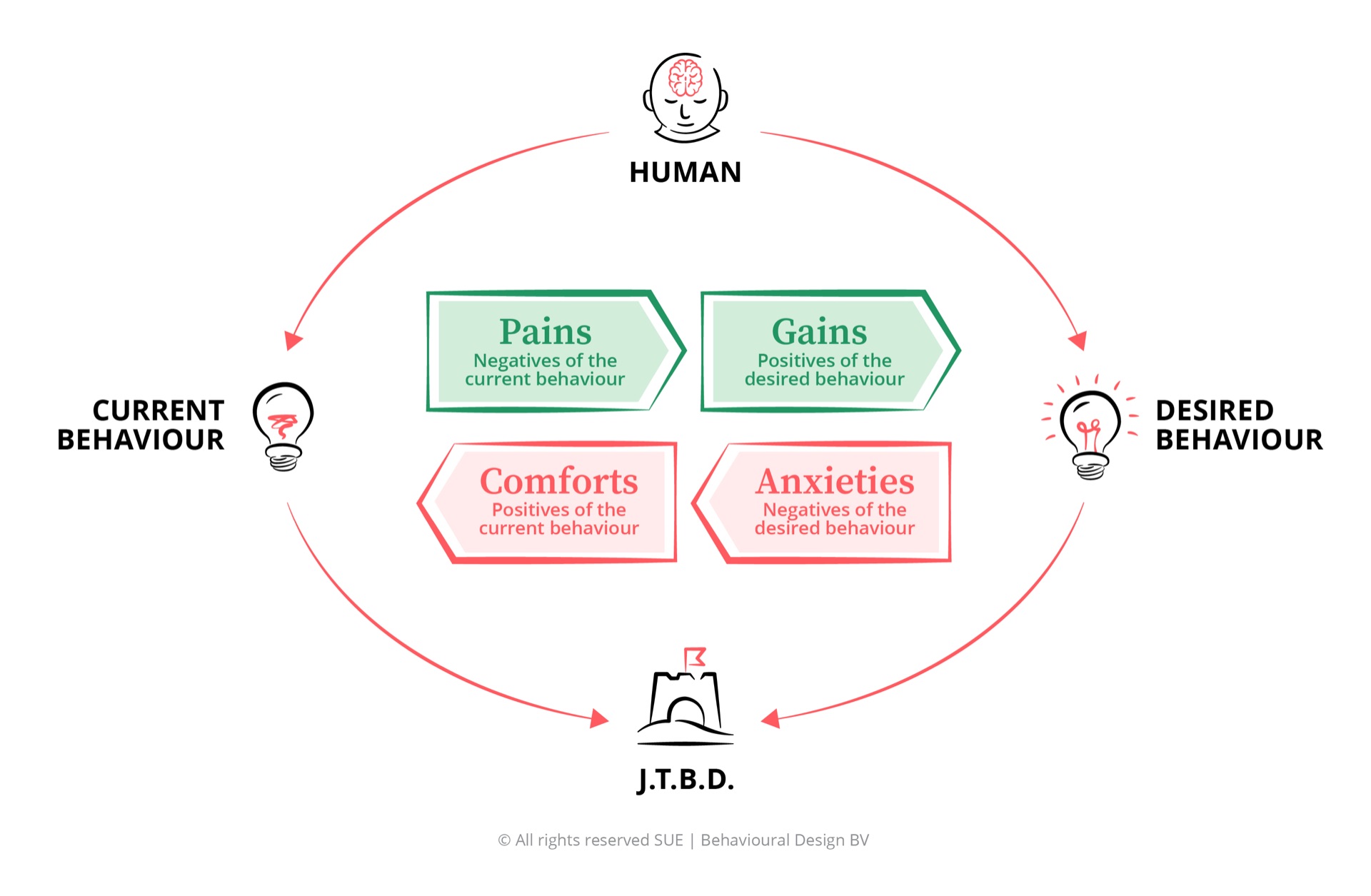
The Influence Framework asks: what are the Pains, Gains, Comforts and Anxieties that determine why people do what they do? The interesting thing is that all four of these forces are primarily System 1 phenomena. People are not driven by rational cost-benefit analyses. They are driven by emotions, habits, fears and desires - all System 1.
If you want to change behaviour, it does little good to address System 2 with information, arguments and awareness campaigns. System 2 is rarely present. Effective behaviour change targets System 1: adapting the environment, changing defaults, adding emotional triggers, removing or adding friction at the right moments.
This is also why communication that only provides facts rarely works. Facts are System 2 material. But your audience is in System 1. If you want people to remember, believe or do something, your communication must address System 1: concrete, visual, emotional, recognisable and simple.
What you can do with this
The System 1 / System 2 framework is not an excuse to accept poor decisions. It is a map that shows where the pitfalls are, so you can design environments that activate System 2 at the moments when it truly matters.
Structure decision points. Structured interviews, pre-defined evaluation criteria, blind CV review: these are all ways of making System 2 do the work that System 1 would otherwise take over. They are environmental interventions, not mindset interventions.
Slow down at the wrong moments. Big decisions need a cooling-off period. System 1 delivers its verdict immediately. Delay committing that verdict. Sleep on it. Ask a colleague to challenge the decision. These are activation mechanisms for System 2.
Use pre-mortems. Before a major decision, ask your team: “Imagine it is a year from now and this has failed. What went wrong?” This forces System 2 to actively search for what System 1 skipped. It is one of the most powerful tools in behavioural science for better decision-making.
Design for System 1 when you want people to act. If you want employees to adopt a particular behaviour - filling in a form, following a procedure, submitting a report - make it the easiest, most natural choice. Set it as the default. Remove friction. Make the desired action the path of least resistance. That is getting System 1 on your side.
Frequently asked questions
What is the difference between System 1 and System 2 thinking?
System 1 is fast, automatic and unconscious. It recognises patterns, responds to emotions and makes most decisions without you noticing. System 2 is slow, deliberate and analytical. It calculates, weighs options and overrides System 1 when activated. The problem is that System 2 is lazy: you only engage it when you genuinely have to think.
Are System 1 and System 2 real brain systems?
No. System 1 and System 2 are not anatomical structures in the brain. They are metaphors for two modes of thinking, introduced by Stanovich and West and popularised by Kahneman. The terms are useful shorthand for what neuroscientists describe as implicit versus explicit cognitive processes.
Which system makes most decisions?
System 1. Estimates vary, but behavioural scientists believe that 90 to 95 percent of all decisions happen automatically and unconsciously through System 1. From what you order for lunch to how you evaluate a job candidate: System 1 is running the show.
How do cognitive biases relate to System 1?
All cognitive biases are System 1 shortcuts. Confirmation bias, loss aversion, the halo effect, anchoring: they all result from System 1 jumping to conclusions based on incomplete information. System 2 can theoretically correct these, but rarely does because it is too slow and too lazy to stand guard constantly.
How do I use System 1 and System 2 in my communications?
Effective communication speaks to System 1: concrete images, emotional stories, familiar situations, simple language. If you want people to remember something or take action, reach them through System 1. You activate System 2 only when you want someone to work through a complex problem or make a deliberate trade-off.
Conclusion
Kahneman gave us a lens with System 1 and System 2 that makes human behaviour considerably sharper to read. Not to call people irrational. But to understand that rational information rarely produces rational behaviour, because the recipient is in System 1 and you are addressing them in the language of System 2.
In the Behavioural Design Fundamentals Course you learn how to translate this insight into concrete tools: the Influence Framework, the SWAC Tool and behavioural interventions that get System 1 working in the right direction. Rated 9.7 by more than 10,000 alumni from 45 countries.
PS
The most beautiful and simultaneously most unsettling implication of this framework is what it means for yourself. You too are running in System 1 all day. You too think you are deliberating carefully while System 1 has already set the course. The only honest response to that insight is not self-criticism but humility: the willingness to question your own conclusions, to build structures that protect you from your own shortcuts, and to take the design of your environment more seriously than the content of your intentions. That is not weakness. That is exactly what behavioural design is.
See also The Art of Designing Behaviour for a practical guide to applying this in your work.