At SUE we sometimes receive multiple unsolicited applications in a single day. They land in the same inbox that already holds fifty other emails competing for attention. Which means every application gets roughly ten to twenty seconds before I decide whether to read further, or move on.
Most applications don't make it past those twenty seconds. Not because the person is unqualified. But because the application was designed for a different reviewer than the one who actually exists.
That gap, between how applications are built and how hiring decisions actually happen, is a classic behavioural design problem. And it has a straightforward explanation once you understand how the brain makes decisions under time pressure.
Applying for a job is a choice problem. With limited information and limited time, a hiring manager must decide whether to invest more attention in you. Most candidates design for System 2: a rational, careful reader who weighs credentials methodically. But the decision is made by System 1, fast, automatic, pattern-matching. Your application needs to work for the brain that is actually doing the reading.
The brain doing the reading
Daniel Kahneman's research on System 1 and System 2 thinking is the best framework for understanding why applications succeed or fail.[1] System 2 is the rational, deliberate part of the brain. It can evaluate credentials, weigh experience, compare candidates against a set of criteria. But it only activates when the faster system has already decided to pay attention.
System 1 is doing the first pass. It works on pattern recognition, social signals, familiarity, and emotional resonance. It decides in seconds whether something is worth further thought. And it does not run on CVs or cover letters written in the passive voice.
This means the real challenge in a job application is not proving your qualifications. It is triggering curiosity before the window closes. Qualifications come second. Curiosity comes first.
You are not competing with other candidates. You are competing with fifty emails and a brain that has been deciding all morning.
What the hiring manager is actually trying to do
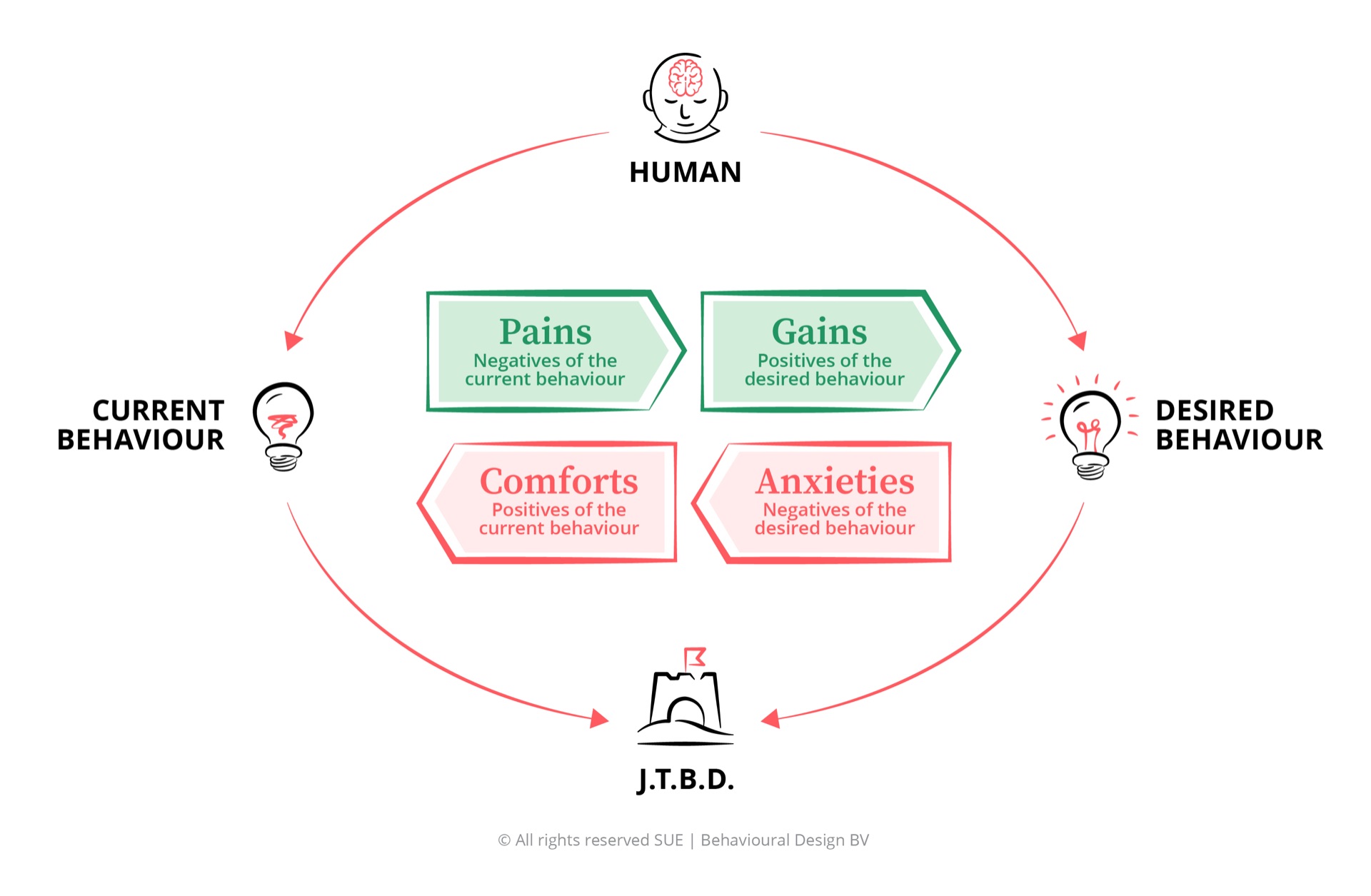
One of the core concepts in the SUE Influence Framework is the Job-to-be-Done: the progress that someone is trying to make in a given situation. A hiring manager is not hiring a person. They are hiring a solution to a specific problem, something that is making their work harder, slower, or riskier.
That job might be: reduce the workload on a stretched team. It might be: bring in a capability we don't have. Or: replace someone who left and took institutional knowledge with them. Whatever it is, the application that names the job directly will always outperform the application that lists credentials hoping someone connects the dots.
Most candidates write about themselves. Strong candidates write about the problem they solve.
Alongside the Job-to-be-Done, four forces shape the hiring decision. Understanding them is more useful than any cover letter template.
The four forces behind a hiring decision
Pains and gains: the driving forces
Pains are what makes the status quo uncomfortable. A hiring manager dealing with an understaffed team feels a specific kind of pressure. A founder carrying work that should belong to someone else feels it differently. If your application doesn't speak to that pain, if it arrives as a generic document that could have been sent anywhere, you are asking someone in pain to do extra work to see if you might help. They won't.
Gains are not benefits. A gain is progress toward the Job-to-be-Done. "I have five years of experience in content marketing" is a benefit. "In my last role I rebuilt the content function from scratch and grew organic traffic by 180% in eighteen months" is a gain. The difference is specificity and consequence. Gains make the future feel real and achievable. Benefits make the CV look full.[2]
Anxieties and comforts: the blocking forces
Anxieties are what stops someone from hiring you even when they think you might be right. The most common one is the fear of a wrong hire. A bad hire costs time, money, credibility, and team morale. It is a visible mistake. So hiring managers default to safe choices: people they know, people who come recommended, profiles that look like the last person who succeeded in the role.
This is not irrational. It is a rational response to uncertainty. Your application is unknown. Unknown equals risk. Without resolving that anxiety, all your qualifications are fighting uphill.
Comforts explain why referrals work so powerfully. When a hiring manager already trusts someone's judgement, and that person vouches for you, the biggest anxiety is resolved before the first conversation. You have borrowed credibility. You are now known rather than unknown. The comfort of the existing relationship transfers to you.
This is why getting introduced by someone inside the organisation is the single highest-leverage thing a candidate can do. It is not networking for networking's sake. It is resolving an anxiety that no cover letter can reach.
Five design principles for your application
Viewed through the Influence Framework, an application is a series of behavioural design decisions. Here is what those decisions look like in practice.
1. Earn attention before you apply
A cold application is the hardest version of this challenge. If you have followed the people you want to work with, engaged with their thinking, and built a small footprint in their professional world before you apply, the application arrives to a warmer context. Hiring decisions feel less risky when the person is already somewhat familiar.
This is not about being strategic in a calculating way. It is about genuine engagement over time. The application is the end of a process, not the beginning.
2. Get a referral if you possibly can
A referral does not guarantee a job. But it transforms the first impression from "unknown risk" to "vouched-for candidate." That shift resolves the primary anxiety before the first email is opened. If you know someone inside the organisation, or someone who knows someone, that introduction is worth more than any revision to your CV.
3. Show past behaviour, not future intentions
Hiring managers are reading for signals of future performance. The most reliable signal is past behaviour. Not "I am passionate about product development" but "I led a product sprint that reduced user drop-off by 40% in six weeks." The past is factual. It is System 1 evidence. Intentions are noise.
Pick two or three things you have done, specific, consequence-showing things, and build your application around them. Everything else is supporting detail.
4. Signal effort and specificity
Effort is itself a signal of quality. An application that is clearly written for this specific organisation, one that refers to their work, their challenges, their specific context, communicates something generic applications cannot: that you actually want this job, not just a job.
We once received a handwritten letter from a candidate explaining when she first encountered SUE's work and why it mattered to her. We hired her on the spot. The letter was short. But the specificity and effort it represented told us more about her judgement and character than ten pages of CV could have.
5. Name the job you are solving
Before you write a word, ask yourself: what problem is this organisation trying to solve right now? What is the specific pain behind this vacancy? Then write your application as the answer to that question, not as a summary of your career, but as a solution to their problem.
The format of your application matters far less than whether it speaks directly to why they are hiring.
The other side of the design challenge
If this article is useful for candidates, it is equally relevant for HR professionals, because everything described above runs in both directions.
The application process you design is itself a behavioural artefact. A form with twenty fields, a vague job description, an automated rejection three months after submission: these are design decisions that signal your culture before anyone joins. They create friction. And friction, as behavioural design consistently shows, screens out people who value their own time.
The candidates who push through a painful application process are not necessarily the best ones. They are the ones with the highest tolerance for friction, or the fewest alternatives. That is a very different selection mechanism than the one most organisations think they are running.
Designing a better application process means mapping the candidate's pains and anxieties as carefully as the employer's. Where does the process feel opaque? Where does it ask for unnecessary effort? Where does it communicate "we don't really value your time"? Removing those frictions is not just a candidate experience improvement. It changes who applies.
The best application process is the one that makes it easy for the right people to say yes, and hard for the wrong ones to fake it.
Summary: think outside-in
Whether you are a candidate or an HR professional, the core principle is the same: think outside-in. Start with the human on the other side of the process, their Job-to-be-Done, their anxieties, their comforts, and work backward from there.
For candidates: your application is not a document about you. It is a design intervention. Its job is to resolve uncertainty, create curiosity, and make the case that hiring you reduces the hiring manager's specific pain and creates gains they can almost see.
For HR teams: your application process is not a filter. It is a signal. What it says about how you treat people who haven't joined yet will reach the people who have.
References
- [1] Kahneman, D. (2011). Thinking, Fast and Slow. Farrar, Straus and Giroux.
- [2] Christensen, C. M., Hall, T., Dillon, K., & Duncan, D. S. (2016). Competing Against Luck: The Story of Innovation and Customer Choice. Harper Business.