
Most organisations design behaviour change at one level. They build a better product, run a smarter campaign, or train people in a new skill. Then they wait for things to shift.
Sometimes it works. More often it doesn't, and nobody quite knows why. The product was good. The message was clear. The training was well-received. And yet behaviour stayed exactly where it was.
What's usually missing is an understanding of where behaviour actually comes from. Because it isn't just shaped by the person in front of you and the choice you've put in front of them. It's shaped at three levels simultaneously, and missing any one of them is enough to make the whole effort stall.
Behaviour change operates at three layers: macro forces (the trends and currents in the world around people), meso forces (the deep desires that motivate human action), and micro forces (the biases and contextual triggers that determine whether action happens right now). An effective behaviour change strategy works at all three.
Three layers, one behaviour change strategy
Think about what it actually takes to get someone to do something different. Not just once, in a lab, with an incentive and a researcher watching. But durably, in real life, when they have other things on their mind and plenty of reasons to stay where they are.
At the broadest level, behaviour is shaped by the world people live in. The infrastructure, the technology, the social norms, the economic conditions. These are macro forces. You cannot control them, but you can read them, and if you're designing behaviour change, knowing which macro currents are flowing in your direction can make the difference between swimming with the tide and against it.
At the middle level, behaviour is driven by desire. People move toward things that give them love, status, safety, competence, connection, meaning. These are meso forces. And unless your behaviour change effort connects to something people already want, you're asking them to change for reasons that don't feel like reasons at all.
At the closest level, behaviour is triggered, or blocked, in specific moments. This is where behavioural design and the Influence Framework operate. The micro forces: the biases, the friction, the anxiety, the social signals that either clear the path or put a wall across it.
Most change efforts work at only one of these. The ones that work tend to operate at all three.
Macro forces: riding the trends
In 2007, the iPhone arrived. Not as a phone, but as a device that put the internet in everyone's pocket and made on-demand everything seem obvious. Within a few years, behaviour that would have been impossible before, ordering a stranger's car with a tap, renting someone's flat for a weekend, reading peer reviews before every purchase, became utterly normal.
Carsharing companies like Sharenow didn't just launch a service. They launched at a moment when urban populations were growing, smartphone adoption was near-universal, and environmental awareness was shifting consumer identity. The macro forces were moving in their direction. That mattered enormously.
COVID accelerated dozens of these currents at once. Remote work, which corporations had resisted for years, became the default in six weeks. E-bike sales surged as people moved out of cities. Telemedicine went from a niche to a mainstream expectation almost overnight. None of these were new ideas. The macro conditions just changed, and suddenly the behaviour was easy.
Good timing is not luck. It's understanding which macro currents your behaviour change effort can ride, and positioning yourself in the right flow.
If you're designing behaviour change and you haven't asked "what trends are working in our favour right now?", you're missing the most powerful force of all. You don't create these currents. You find them and use them.
The judo metaphor fits here precisely. As Tom De Bruyne has put it: "Influence is far more judo than karate. In judo, you work with the force of your opponent. You take the force that comes at you, and you try to turn it in a way that will work in your favour." At the macro level, the force is the world itself. The question is whether you're working with it.
Meso forces: the desire layer
BMW doesn't sell cars. It sells the feeling of being someone who drives a BMW. The social signal, the implied competence, the status projection onto the road. Volvo sells safety, specifically the deep parental desire to know your family won't get hurt. Beer brands sell friendship and the warm belonging of a shared evening. Business schools sell competence and the social passport that comes with a recognisable degree.
None of these connect to the functional features of what they're selling. They connect to deeply rooted human desires: the meso forces that sit below the surface of every purchase, every commitment, every behaviour.
There's a useful saying from Silicon Valley that captures the idea with unusual directness: every successful tech company taps into one of the seven deadly sins. Pride, envy, lust, greed, sloth, gluttony, wrath. The successful ones don't invent new motivations. They find an existing desire, one that's already there and already powerful, and they give it a new home.
The framework for thinking about this precisely is the Job-to-be-Done, a concept central to the SUE Influence Framework. The question is not "what does this person do?" but "what progress are they trying to make?" What's the deeper outcome they're moving toward? What would success feel like?
If your behaviour change effort doesn't connect to an existing desire, it's asking people to be motivated by things they're not actually motivated by. The information is correct. The logic is sound. The behaviour doesn't change. This is why inform-and-convince campaigns so rarely work: they assume that if people understand something intellectually, they'll feel moved to act on it. They usually don't.
Understanding the meso layer means doing research that goes below the stated. Not "what do you want?" but "what does that give you?" Not "what do you think about this?" but "what does success actually feel like for you?" The desire is the fuel. Without it, nothing moves.
Micro forces: the trigger layer
Even when the timing is right and the desire is real, behaviour still has to happen. In a specific moment. In a specific context. With a specific person, who has other things on their mind, limited attention, and dozens of competing pulls on their time.
This is where the SWAC tool and the Influence Framework come in. The micro forces are the levers that determine whether a motivated person, in a favourable environment, actually takes the next step.
Take the example of a company trying to get fleet managers to switch their vans to electric. The macro conditions are moving in the right direction: urban emission zones are expanding, fuel costs are rising, corporate sustainability targets are tightening. The desire is real: fleet managers want to do the smart thing for their organisation and they don't want to be behind the curve.
But the behaviour stalls. Because at the micro level, there are anxieties everywhere. What if the charging infrastructure isn't there? What if drivers won't adapt? What if the range isn't enough for longer routes? What if something goes wrong and there's no support?
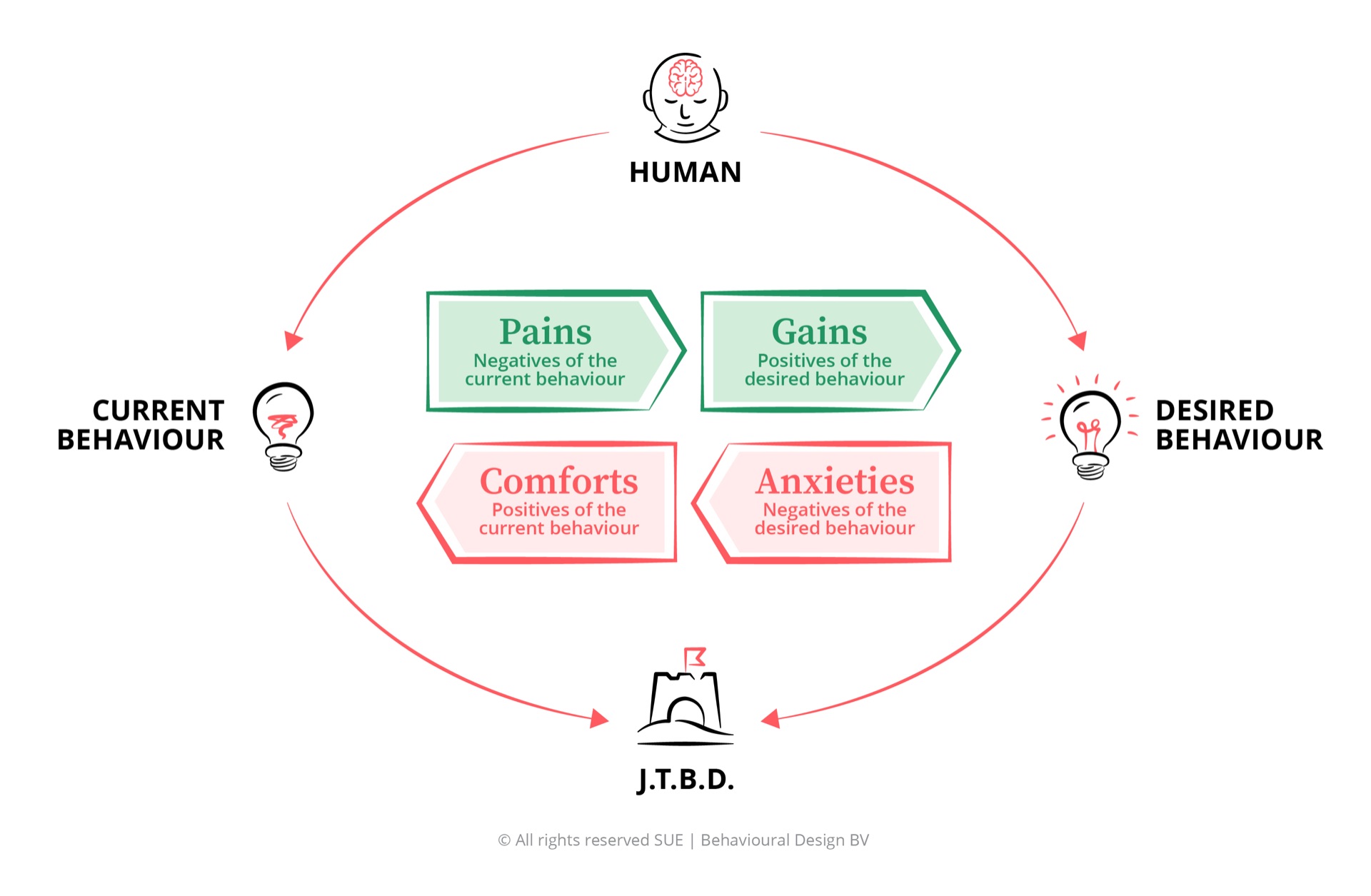
The SWAC response works at each anxiety specifically. Social proof from other fleet managers who've made the switch boosts motivation to try (WANT). Demo videos and 24-hour roadside support reduce the fear of getting it wrong (CAN). Billboards near congested urban roads, placed where the frustration of fossil fuel traffic is palpable, catch people at the moment when escapism from their current situation is already present (SPARK).
None of this requires changing what people fundamentally want. It requires reading what's blocking them and removing those blocks precisely, one by one. This is what nudging at its best looks like: not manipulation, but the removal of unnecessary friction and the amplification of existing motivation.
How the three layers work together
The three-layer model is most useful not as a taxonomy but as a checklist. Before designing any behaviour change effort, ask yourself three questions.
First: which macro currents are in play? What trends, technological shifts, cultural changes, or economic conditions are already moving in the direction you want? Is there a wave you can ride, or are you going against the current? If you're going against it, know that you're making the job significantly harder than it needs to be.
Second: what desire does this connect to? What is the Job-to-be-Done for the person you're trying to move? What do they actually want, below the level of the stated preference? If you can't name the desire, you haven't found the fuel yet.
Third: what's blocking action at the micro level? What anxieties, habits, and frictions stand between desire and behaviour? Which of the four forces in the Influence Framework are working against you? Where does the path need to be cleared?
Missing the macro layer means launching at the wrong moment or fighting a headwind you didn't need to fight. Missing the meso layer means running campaigns that feel logical but produce nothing because they don't connect to what people actually care about. Missing the micro layer means leaving motivated people stranded in the gap between intention and action.
Most organisations are sophisticated about one of these. A few are good at two. The ones that consistently change behaviour well tend to work all three layers at once, which is what a genuinely strategic approach to the Influence Framework actually looks like in practice.
You need to be in the right current, speak to the right desire, and design the right trigger. Miss one, and motivated people stay exactly where they are.
The good news is that the three layers are learnable. They aren't abstract theory. They're a structured way of looking at any behaviour change challenge and asking the right questions in the right order. Once you can see all three, it's genuinely difficult to go back to designing for only one of them.
Frequently asked questions
What are the three forces that shape behaviour change?
Behaviour change is shaped at three levels. Macro forces are the large-scale trends, demographic, technological, economic, cultural, that open or close windows of opportunity for behaviour change. Meso forces are the deeply rooted human desires and motivations that make someone want to change in the first place, what researchers call Jobs-to-be-Done. Micro forces are the biases, friction points, and contextual triggers that determine whether a motivated person actually takes action at the specific moment that matters. Missing any one of these three levels is the most common reason well-designed interventions fail.
Why do behaviour change initiatives fail even when the product is good?
Most initiatives fail because they only address one level of the three-layer model. A product might tap into a real human desire but launch in the wrong cultural moment, or it might be perfectly timed and genuinely desired but never trigger action because the micro-level anxieties and friction are never addressed. Knowing that people want something is not enough. You also need to know whether the timing is right and whether the path to action is clear enough for people to actually take it.
How do macro forces connect to individual behaviour?
Macro forces shape the context in which individual decisions happen. When large-scale trends change the environment people live in, they also change what behaviours are possible, appealing, and socially acceptable. A carsharing service that would have struggled in 2005 could thrive after the smartphone made on-demand services normal. COVID accelerated remote work adoption that would otherwise have taken a decade. Good behaviour change strategy does not create these currents. It identifies them and positions the desired behaviour so it flows with them rather than against them.