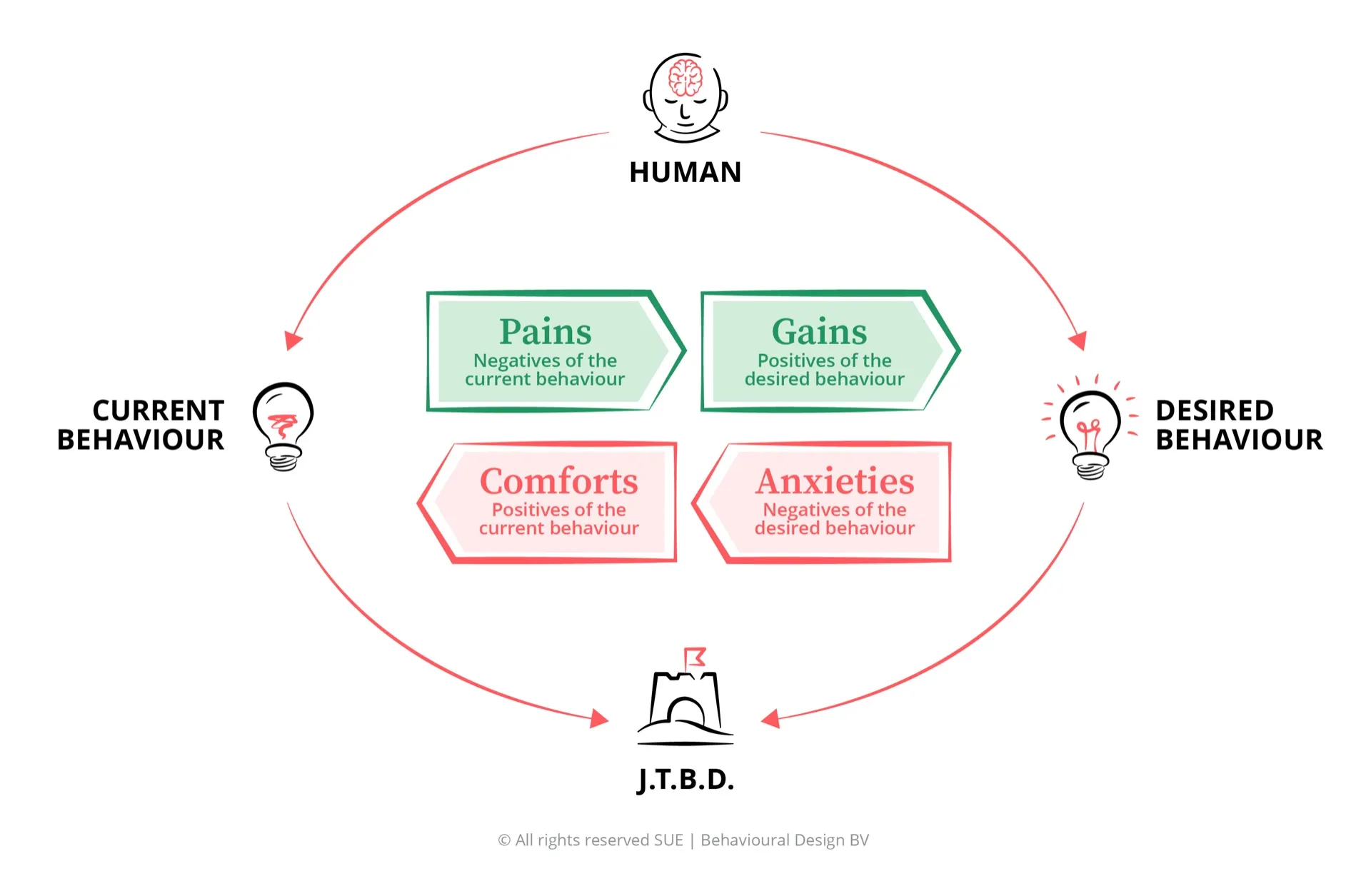
The Influence Framework™ developed by SUE is a powerful mental model for understanding what you need to act on to influence someone's behaviour. In this blog post we explain the framework step by step - from the three components of behaviour change to the four forces that determine whether people take action.
How does influence work?
For a complete overview of what behaviour change is, I refer to the blog post "What is Behavioural Design". For this post it suffices to understand that you need three elements for behaviour change:
- Understanding how people think and make decisions (choice psychology)
- Understanding how to analyse the unconscious forces that drive people's behaviour (SUE Influence Framework™)
- Understanding how to design behavioural interventions (BJ Fogg and the science of influence)
The biggest misunderstanding about behavioural design is that it is too often limited to the third point. Think of all the persuasion design tricks and techniques used in the UX world to stimulate buying behaviour. Techniques that Booking.com has elevated to an art form.
But without understanding what is going on inside our brains, you can throw as many techniques at people as you like - the chance that you will influence behaviour is negligible.
An example: You can deploy scarcity, authority and social proof to convince me that NOW is the moment to book my next city trip with a Flixbus. But as long as you have not first removed my (irrational) prejudice that such a bus trip is a social nightmare full of nuisance and unpleasant people, my mind is closed to any behavioural intervention you throw at me.

Analysing the unconscious
You should therefore understand the SUE Influence Framework™ as a tool for analysing the unconscious forces that explain people's behaviour. With the Influence Framework™ you gather insights into how people unconsciously think and why they do what they do and what holds them back from displaying different behaviour.
Understanding the forces that motivate people to do something or that hold them back helps you spot opportunities for influence. Only then do you apply your influence techniques to these opportunities.
To stay with the example above: only once you understand that it is fear, doubt and prejudice that hold me back from travelling by bus, will you take this opportunity for influence as your starting point when thinking about behavioural interventions. The question you will then try to answer is: How could we remove the prejudice that cheap bus travel is a (social) ordeal?
To design a successful intervention for behaviour change, you must always work outside-in. You start by understanding what is going on inside people's brains, and then calibrate your behavioural interventions accordingly.
The SUE Influence Framework™ consists of 3 components with a total of 7 elements. We work through these three components below one by one.
- Current and desired behaviour
- The Job-to-be-Done
- Pains, Gains, Comforts and Anxieties
Component 1: Current and desired behaviour
The best way to look at behaviour change is that you want to get people (or yourself) from current to desired behaviour. What makes this so challenging is that people first need to stop something and start something else. And stopping is hard. Because current behaviour is full of ease. We don't need to think hard and it is often governed by stubborn habits that are difficult to control. Moreover, there are also all kinds of difficulties attached to the new behaviour. Can I do it, do I want to do it, do I trust it, do I understand it?
When you want to get someone from A to B, you immediately feel that there are all kinds of forces at work that hold us in current behaviour and prevent us from moving to desired behaviour.
The SUE Influence Framework is nothing more than a way to expose these forces.
Component 2: The Job-to-be-Done
If you want to understand why people do what they do, Clayton Christensen's Job-to-be-Done framework is an indispensable tool. Christensen argues in a famous Harvard Business Review paper that people "hire" products and services for a job they have in their life. Understanding that "job" or "task" is the key to understanding what motivates people to display certain behaviour.
If you want to understand how to increase milkshake sales in a fast food restaurant, first try to understand the Job-to-be-Done for which people hire a milkshake. In Christensen's famous example, he shows that people at a fast food restaurant primarily hire the milkshake because they have a long car journey ahead of them. And a milkshake is the best way to satisfy your hunger while driving.
Job-to-be-Done thinking requires you to immerse yourself deeply in the person behind the customer. In this way we recently discovered in a Behavioural Design Sprint that the Job-to-be-Done of people who have diabetes actually consists of leading as normal a life as possible. Without themselves - and their environment - being constantly reminded that they are actually ill. All products and services are weighed against this Job-to-be-Done.
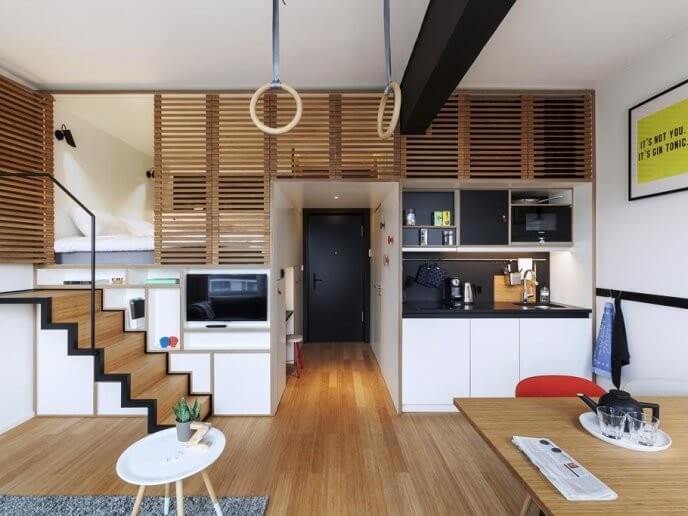
Case: Zoku Amsterdam
Zoku Amsterdam gave itself 2 years before launch to try to find out how it could design the best possible hotel experience for people who need to stay in a city a little longer for work.
The Job-to-be-Done insight from which Zoku departed is that professionals also want to feel at home in the place where they stay for an extended period. They want the feeling of being somewhat at home and belonging in the city. And that is precisely what hotels do not give you. In normal hotels you are reminded in every way that you are a visitor and a passing stranger.
To connect with this Job-to-be-Done of the business traveller, every room at Zoku is designed around a dining/work table rather than the bed. You have lunch and dinner together at a long table. You can receive clients there and every day there are fun activities you can participate in.
Component 3: The forces diagram
We now know that the biggest problem with behaviour change is that people first need to stop their current behaviour and experience the uncertainty of choosing new behaviour. We also now know that the best way to understand how to motivate them to embrace the new behaviour is to connect with the goals and tasks (Job-to-be-Dones) they have in their lives.
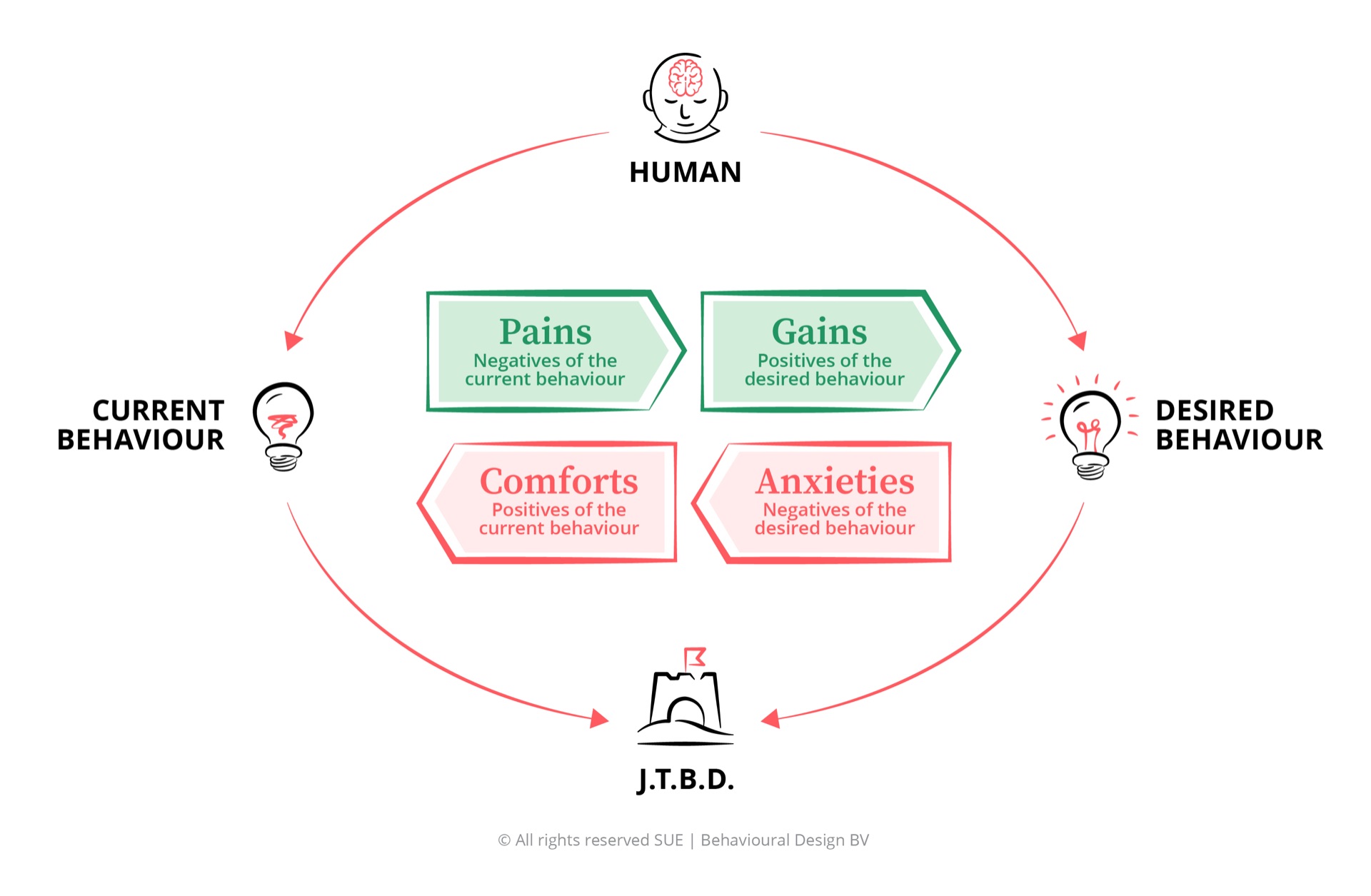
The third and final component of the SUE Influence Framework™ is a set of four forces that hold people in their current behaviour, prevent them from displaying new behaviour, or push them towards the desired behaviour. We distinguish four forces:
- Pains in current behaviour
- Gains of new behaviour
- Anxieties, doubts and other barriers towards new behaviour
- Comforts in current behaviour
Force 1: Pains
Pains are what people experience as shortcomings and frustrations in their current behaviour. Pain points are often the problem for which you can offer a solution with your behavioural design. Pain and frustration create willingness to change. The greater you can make the pain feel, the more willingness to change emerges.
Another advantage of connecting with pain is that as a behaviour changer you demonstrate that you understand very well what is going on in the target group's world. Every populist in the world knows that people want to hear that you understand them or that you say what they feel. That is much more interesting than the solution, because that actually doesn't interest them that much.
Force 2: Gains
Gains are the positive consequences of the desired behaviour. These are the benefits. When I stay at Zoku I can at least work in my room for a day. I can eat healthily without having to go outside. I can hang around with my laptop in a living-room-like co-working environment. These are all gains that staying at Zoku delivers.
But these gains only have value because you experience them in relation to your Job-to-be-Done. You appreciate the gain of the work room, the shared breakfast area, the nice kitchen and the living room with sofas only because they contribute to your Job-to-be-Done to feel at home while you are abroad for work.
Pains and Gains are always in relation to the Job-to-be-Done.
An example: I often have to go to Belgium. I increasingly take the train because my Job-to-be-Done is to spend my time as productively as possible. From this Job-to-be-Done the pain of driving is clear. I can't work through emails or produce texts, I'm exhausted after 6 hours of driving, of which 2 hours are spent in traffic. The Gain of the train is now also very clear: travel time is work time. I can read, write, clear emails.
Force 3: Comforts
Comforts are habits that keep people in their current behaviour. I would quite like to exercise more and in principle I also have time in the morning to go to the gym around the corner, but a number of habits are in the way. I want to wake up slowly. I need to have breakfast. I still need to get the kid ready for school. By the time I've finally got through everything, my "window of opportunity" to still go and exercise has closed.
In principle I have everything in order to exercise. I feel the need to get through the day full of energy (JTBD). I feel the pain of not being fit (pain). I know how good it feels to have exercised (gain). And I only need to walk 200 metres to the gym, so nothing is in the way (no anxieties). I just find it very difficult to break my comfort.
What does help nowadays is that my gym does an ab workout every hour. That helps me break my comfort. I simply know that after dropping the kid off at childcare, I still have time to make the ab session. From there it is much easier to stay a bit longer.
Force 4: Anxieties
Anxieties are fears, doubts, prejudices and other barriers towards the desired behaviour. Anxiety is everything that holds you back from saying yes to the desired behaviour. This can concern properties of:
- The desired behaviour itself: too difficult, too complicated, socially undesirable
- The provider: untrustworthy
- Myself: I don't know if I can do it, it doesn't match how I see myself
- My environment: I don't know what my environment will think of it
Although anxieties are often underestimated in changing behaviour, they often form a crucial piece of the puzzle. Sometimes removing an anxiety is the final piece needed to make an influence strategy a success.
As I described above about Flixbus: removing my prejudices against bus travel is the single most important influence force to address.
Case: The Porsche Pitch
In The Perfect Pitch, a book by advertising legend Jon Steel on the art of pitching, the author tells the story of a pitch for the Porsche account that his agency once won. The killer insight with which they won the pitch was that you no longer need to convince Porsche drivers, but rather that you need to convince non-drivers that Porsche drivers don't necessarily have to be men with a midlife crisis.
Removing fear, doubts and prejudices towards Porsche drivers turned out to be the most brilliant advertising strategy the brand had ever executed.
How to get started with the Influence Framework
With six interviews with your target group you can reliably surface these forces. Our Behavioural Design Sprints always begin there. And we use a very simple rule of thumb for this:
Past behaviour never lies.
When we interview we always try to map "human journeys". Human Journeys relate to Customer Journeys as human-centred thinking relates to customer-centric thinking. Instead of an ideal abstract customer journey, we are looking for the real decision-making process: What did a successful journey look like? And a failed one? What are the stories people tell themselves about their behaviour? What made them uncertain? What held them back from doing the right thing?
With these 6 interviews you will reliably surface the real Job-to-be-Dones, the Pains and Comforts in current behaviour, and the Gains and Anxieties of the desired behaviour. Interviewing extreme users can also teach you a great deal there. From people who have tried to start exercising dozens of times but keep failing, you can learn a great deal about comforts and anxieties. From people who are addicted to exercise you can learn an enormous amount about gains and Job-to-be-Dones.
When you have mapped these forces, you find opportunities for influence by asking yourself five questions:
- How can we help people realise their goals? (Job-to-be-Done)
- Are we able to offer a solution to frustration or pain that people actually experience? (Pains)
- Can we ride on a habit? Or is there a stubborn habit we need to break? (Comforts)
- What fears, doubts, prejudices and other barriers do we need to remove? (Anxieties)
- What is the psychological value we can create for people? (Gains)
A few examples
The success of Uber and Lyft is best understood because they removed all the Pains from the taxi experience. Not knowing when your car is coming, not being 100% able to trust the driver and having to negotiate the price. They also help you realise your Job-to-be-Done to move through the city worry-free in a brilliant way. A Gain of Uber is that you therefore never have to think when you go out: you simply call an Uber when you roll out of the club and 5 minutes later you are in a car.
AirBnB is a much more intense way to discover a new destination. That is the Job-to-be-Done of travellers. The Pain that goes with hotels is that it is anonymous and you always feel like an outsider. The Gain of AirBnB literally sits in their value proposition: Feel Home Abroad.
The Anxieties that AirBnB needs to remove are the uncertainty about whether the place is as nice as advertised, whether the owner is trustworthy and how you eventually get access. A fairly new Anxiety is also the uncertainty of whether the local neighbourhood is entirely comfortable with AirBnB tourists - something the company has brought upon itself in many major cities.
Conclusion
We have argued that a successful strategy for behaviour change consists of three components:
- Understanding choice psychology
- Understanding what forces are at play on the inside that trigger or prevent behaviour
- Using principles of influence to specifically address these forces
The SUE Influence Framework™ is a powerful tool to make the field of forces on the inside visible.
The SUE Influence Framework™ is therefore what makes every behaviour change human-centred. For the simple reason that behavioural designers always think about how to help people succeed, remove their frustrations, help them over bad habits or remove barriers and uncertainty for them.
This does not mean that this knowledge cannot also be misused to manipulate people, but we as an independent agency have committed ourselves to designing positive choices.
PS
SUE's mission is to use the superpower of behavioural psychology to help people make positive choices in work, life and play. Based on this mission we take on assignments, but sometimes we decline them too. The dark knowledge of influence is out in the open and it is our conviction that those who master this knowledge best generally do the worst things with it. In everything we do we try to enthuse people to use the knowledge to design positive behaviour.