Most leadership training programmes fail because they work on the person, not the context. Behavioural science shows that 96% of human behaviour is automatic and situational. Lasting leadership development starts with designing the environment, not changing the mindset.
I see it regularly in our training programmes: a participant who has already completed three leadership journeys. Fully aware of the theory. Could recite Situational Leadership in their sleep. Knows exactly what psychological safety is. And yet back in the team, very little changes.
That is not a coincidence. And it is not a character flaw in that leader.
It is a design flaw in the training itself.
The problem with most leadership training programmes
The leadership training industry runs on an assumption that is scientifically incorrect: that you can change behaviour by increasing insight. Give someone the right knowledge, the right models, and the behaviour will follow.
That sounds logical. It also does not work.
Daniel Kahneman's research shows that 96% of our decisions are driven by System 1: the fast, automatic, unconscious system. That system operates on habits, patterns and context, not on theoretical insights learned three weeks ago in a training room. Your System 2, the conscious and rational thinking, is involved in perhaps 4% of what you do in a day.
A two-day leadership training fills your System 2 nicely. On Monday, back at work, System 1 takes over again.
That is not a failure of the participant. It is simply how the brain works.
The mindset trap: why awareness alone is not enough
At SUE we call this the "design for disappointment" approach. You design an intervention that sounds logical but fundamentally misunderstands human behaviour. Providing information does not change behaviour. Creating awareness does not change behaviour. An inspiring session with a charismatic trainer does not change behaviour, unless you also change the situation the person returns to.
Think about smoking. Every smoker knows that smoking is bad for them. Every one of them has probably heard a motivating talk about quitting. But that insight stands almost independently of the actual smoking behaviour, which is driven by automatic habit patterns, social situations, moments of stress and context.
Leadership works in exactly the same way.
A manager who knows they delegate too little, who acknowledges this, who genuinely wants to do something about it, will still automatically fall back into their usual pattern in their first meeting the next morning. Not because they lack motivation. But because their System 1 has already reached a decision long before their System 2 has caught up.
Knowledge does not change behaviour. Behaviour changes behaviour.
What actually happens in a team
Imagine a management team member who consistently dominates conversations in meetings. Others disengage. Psychological safety drops. After the leadership training, this person realises they have this pattern. They are motivated to break it. In the first two meetings they do, with visible effort.
And then, three weeks later, they are in a stressful discussion about a file they care deeply about. System 1 takes the wheel. The old pattern is back.
In behavioural science, this is known as the "intention-action gap": the gap between what someone intends to do and what they actually do. This gap is one of the most robust findings in behavioural psychology.
Knowles and colleagues showed in research on management training that behaviour change following a one-off training had disappeared in more than 85% of cases after six months. Participants had reverted to their old behavioural patterns, precisely because the environment had remained unchanged.
The real cause: context, not character
This is the core of the problem. Traditional leadership training treats leadership behaviour as a matter of character. Someone is either a good leader or not. Or they need to change their mindset to become a better leader.
Behavioural science asks a very different question: what in the context is causing this person to behave this way?
This is known as the "Fundamental Attribution Error": the human tendency to attribute behaviour to personality, while the situation is almost always the strongest determinant of behaviour. Scientist Lee Ross, who first described this concept, showed that we systematically overestimate how much behaviour is determined by character, and systematically underestimate how much is determined by the situation.
A manager who micromanages does not do so because they are by definition a micromanager. They do it because their environment pushes them there, too little trust in the measurability of results, a company culture that punishes mistakes, insufficient clarity around roles. Change the environment and you change the behaviour.
That is not a soft insight. It is a scientifically well-supported claim about how leadership actually works.
How the SUE Influence Framework analyses leadership
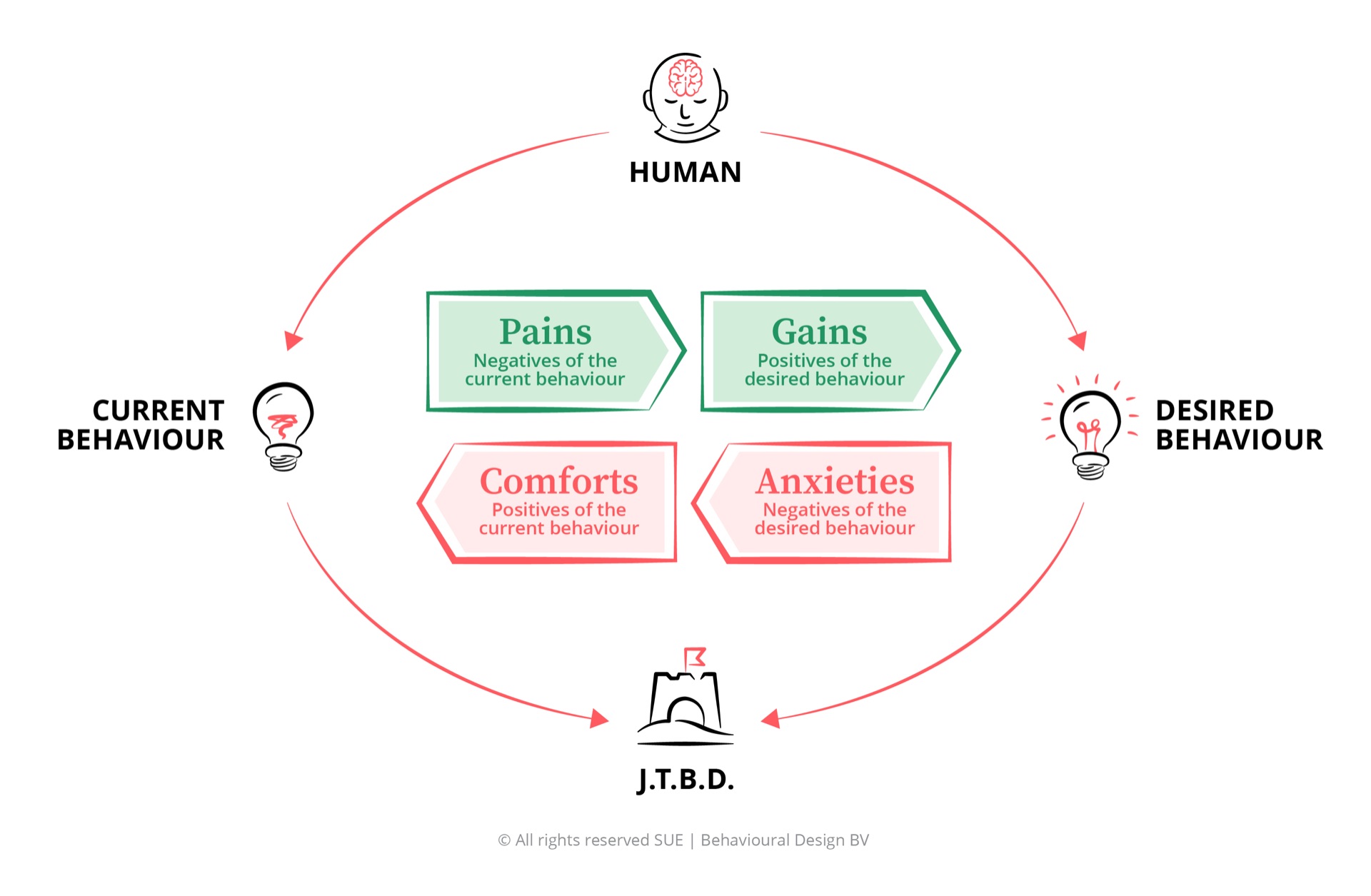
At SUE we use the SUE Influence Framework to map this systematically. The framework asks: which forces keep someone locked into current behaviour, and which forces move them toward new behaviour?
Take a management team that struggles with ownership. Everyone agrees people should take more initiative. The leadership training focuses on empowerment and delegation. And yet nothing changes.
When you apply the Influence Framework, you can see why. The Comforts of current behaviour are powerful: the manager is fast and effective when they make decisions themselves. That feels familiar. The Anxieties of new behaviour are also present: what if someone makes a mistake and you are held accountable? The Pains of current behaviour, the overload, the bottleneck you have become, may not feel acute enough to prompt movement.
A leadership training that does not address this force field has little chance of success. Not because the trainer falls short. But because the problem is not in the knowledge, it is in the situation.
The intervention that does work changes the environment. Make mistakes safe by normalising them in retrospectives. Build decision-making authority with explicit mandate frameworks. Make the pain of current behaviour tangible with data on throughput times and quality. Only then does behaviour begin to move.
What actually works in leadership development
Effective leadership training has three characteristics that most programmes lack.
First: it works on the situation, not just the person. That means participants do not only learn what good leadership is, but also how to design their own environment so that desired behaviour becomes the easiest option. Ownership is designed by making mandates clear and making mistakes safe, not by telling people to take more ownership.
Second: it works over a longer period. Phillippa Lally's research at University College London shows that it takes an average of 66 days to turn a new behaviour into an automatism. A two-day training gives people insights. A well-designed programme of three to six months gives them the space to practise those insights, fail, adjust and automate them.
Third: it measures behaviour, not satisfaction. Most leadership training programmes are evaluated via a satisfaction form at the end of day two. That measures inspiration, not behaviour change. Effective programmes measure what changes in the leader's behaviour and in the team's results, three months later.
You cannot install leadership in two days. But in two days you can lay the foundation for a behaviour change that lasts months.
Leadership training as behavioural design
That is precisely the approach we use at SUE in the Influential Leadership training. We do not treat leadership as a set of competencies to be learned, but as a behavioural design challenge.
How do you, as a leader, design a context in which your team naturally exhibits the desired behaviour? How do you use insights from behavioural science to build psychological safety, stimulate ownership and make feedback a habit?
Participants in our training learn to use the SUE Influence Framework, not just for customers and products, but for the most complex behavioural challenge every leader knows: their own team.
Because the question is not: "How do I become a better leader?" The question is: "How do I design an environment in which my team brings out the best in itself?"
That is a fundamentally different question. And it leads to fundamentally different interventions.
Summary
Most leadership training programmes fail because they operate on a proven false assumption: that insight leads to behaviour change. Behavioural science compellingly shows that behaviour is determined by situation, not mindset. Effective leadership development works on context, lasts long enough for habits to form, and measures behaviour rather than satisfaction.
A leader who understands this asks themselves different questions. Not "How do I motivate my team?" but "What in my environment is causing my team to behave this way?" That is the question that sets change in motion.
Frequently asked questions about leadership training
Why do most leadership training programmes not work?
Most leadership training programmes focus on building insight and changing mindset. But behavioural science shows that knowledge and good intentions rarely lead to lasting behaviour change. Existing behaviour is driven by context, habits and environment, not by insight alone. An effective leadership training works on the situation, not just the person.
What makes an effective leadership training programme?
An effective leadership training programme combines behavioural science insights with practical exercises in participants' own work situations. It helps leaders understand the forces driving their team members' behaviour, and gives them concrete tools to design the context so that desired behaviour follows naturally. Not through more pressure, but through smarter environments.
How long does leadership training take before it has an effect?
Research by Phillippa Lally (University College London) shows it takes an average of 66 days to turn a new behaviour into a habit. A leadership training that stops after two days gives participants too little time to automate new behaviour. Effective programmes work with guidance and feedback over a period of at least 3 months.
What is the difference between a leadership training and a leadership development programme?
A leadership training is typically a one-off programme of one or two days. A leadership development programme is a longer-term programme that combines insights with practice, feedback and behaviour change in daily work. For lasting change, a programme is more effective than a standalone training.
Design leadership, don't just practice it
In the Influential Leadership training you learn, as a leader, how to use behavioural science tools to help your team bring out the best in itself. Rated 9.7 by more than 10,000 professionals.

1.5 minutes of Influence
Every week I notice something: a hospital sign, a supermarket shelf, a sentence in a meeting. Always something that shows exactly how context drives behaviour. I write it down. Every Thursday morning you get it in your inbox. In 90 seconds.
Read by 10,000+ professionals · Free · Unsubscribe any time