This article is part of our series on behaviour change.
Most organisations that start working with behavioural design invest significant time and money into behavioural interventions that ultimately change nothing. This is not because behavioural science does not work. It is because they are doing the wrong things, in the wrong order, for the wrong reasons. This article is an intellectually honest analysis of the most common mistakes, written from nearly two decades of experience designing behaviour change in organisations of all shapes and sizes.
Let us be honest: most behavioural interventions fail. That is not pessimistic - that is realistic. And it is not a catastrophe, as long as you understand why. Failure is the most valuable school in behaviour change, provided you draw the right lessons.
The Five Most Common Reasons Why Behavioural Interventions Fail
Across nearly two decades of behavioural design, we see the same patterns recurring. Five mistakes made again and again, in the public sector, in business and in non-profits. Here they are.
Reason 1: Wrong Diagnosis
The most fundamental mistake: starting with the solution instead of the problem. Organisations choose an intervention - a poster, a campaign, an app - before they truly understand why the current behaviour exists. That is like writing a prescription before examining the patient.
Behaviour always exists for a reason. People do not eat unhealthily because they do not know that vegetables are good for them. Employees do not file their expense reports on time, not because they are lazy. Consumers did not choose your more sustainable alternative, not because they do not care about the environment. In every case there is an underlying force - a habit, a fear, a trade-off - that keeps the current behaviour in place.
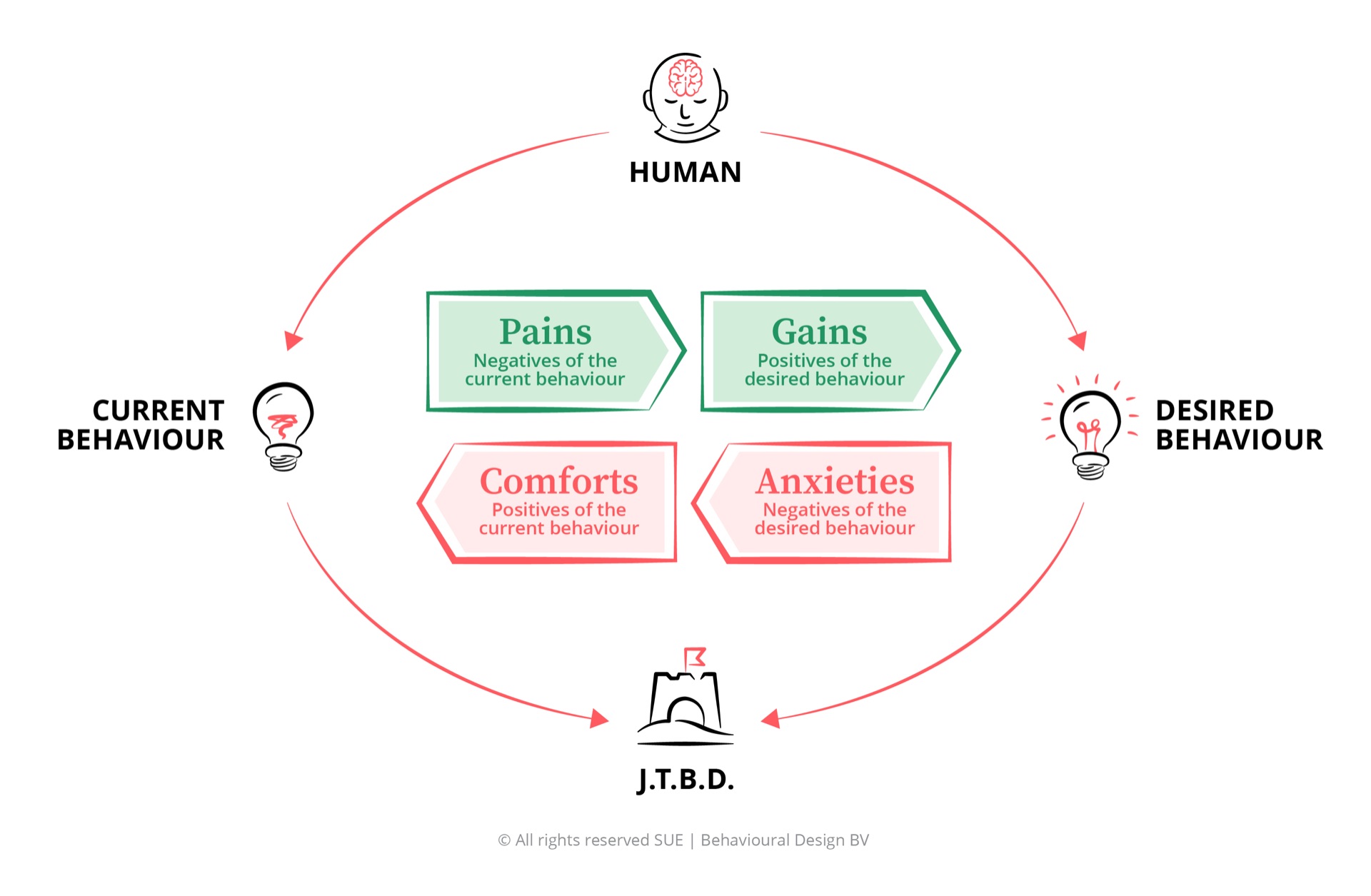
The SUE | Influence Framework always places diagnosis as the first step. What are the Pains, Gains, Comforts and Anxieties of the target group? What is the Job-to-be-Done that the current behaviour fulfils? Only once you have answered those questions do you know which force to address.
A nudge aimed at the wrong behaviour is not a nudge - it is noise.
We have learned at SUE that six good interviews with the target group yields more than a month of internal brainstorming sessions. Past behaviour never lies. By asking people about concrete situations, about moments when they almost displayed the desired behaviour but did not, you track down the real barriers.
Reason 2: Informing Instead of Designing
The second major mistake is the information paradox: the assumption that people will change their behaviour if you give them enough information. Leaflets, emails, awareness campaigns, information sessions. These are all attempts to reach System 2 - the conscious, rational part of the brain.
The problem is that behaviour is largely driven by System 1: the fast, automatic, unconscious system that governs approximately 98 per cent of our decisions. And System 1 is not persuaded by arguments. It responds to context, emotion, ease and habit.
People know they should exercise more. They know they should eat less meat. They know they should submit their reports on time. The knowledge is there. The behaviour does not change. Not because information is missing, but because the environment has not been designed to support the desired behaviour.
Effective behavioural interventions work through nudging, through environmental design, through adjusting defaults, through reducing friction on the path towards the desired behaviour. They target System 1, not System 2.
A concrete example: a large insurer wanted employees to take the stairs more often instead of the lift. They placed posters with information about the health benefits of stair climbing. No result. They then hung inspiring images in the stairwell and made the staircase doors more visible than the lift button. Stair usage rose by 45 per cent. The information had changed nothing. The environment had.
Reason 3: Single-Nudge Thinking
The third pitfall is the illusion of the magic intervention. The one nudge that solves everything. The one campaign that tips behaviour. It does not exist.
Behaviour change is not a one-off intervention - it is a system. Effective behavioural design works on multiple levels simultaneously: increasing motivation (addressing Pains and Gains), reducing barriers (removing Anxieties), breaking habits (circumventing Comforts) and making the desired behaviour as easy as possible (reducing friction).
In practice we see organisations launch a single nudge, conclude a month later that it "does not work", and then either abandon behavioural design entirely or try another isolated intervention. That is precisely the wrong approach.
There is no silver bullet in behavioural design. Anyone who promises one is lying.
What does work is a layered approach in which you simultaneously increase motivation, adjust the environment and remove barriers. Sometimes that means five small interventions that together produce a large impact. The power lies in the combination, not in the size of the individual measure.
An analogy: if you want to heat a house, you do not just turn on the radiator while the windows are still open. You close the windows, insulate the walls, and then turn on the heating. Behaviour change works the same way. Every isolated intervention leaks away if the surrounding factors are not aligned.
Reason 4: No Measurement, No Learning
Interventions without a measurement plan are flying blind. Yet it is the exception rather than the rule that organisations establish a clear baseline in advance, choose a measurement method and define criteria for success or failure.
The most common measurement mistake is confusing output with behaviour change. "We sent 10,000 emails" is not evidence that behaviour has changed. "We had 300 attendees at the kick-off" is not evidence that anyone will do anything differently. Measuring output gives you a false sense of progress.
What you want to measure is the concrete behaviour you want to change, ideally before, during and after the intervention. How many people displayed the desired behaviour before the intervention? How many afterwards? And does that hold up after three months? Those are the relevant questions.
Good behavioural intervention projects start with baselining. What is the current behaviour, in measurable terms? Then you define what success looks like: not "more awareness", but "25 per cent more people completing form X before the deadline". And then you measure whether you get there, preferably via an A/B test or a quasi-experimental design comparing a control group with an intervention group.
The science supports this explicitly. Michie et al. (2011) demonstrate in the Behaviour Change Wheel that the absence of proper evaluation is one of the strongest predictors of failing intervention programmes.[1] Without measurement you learn nothing, and without learning you improve nothing.
Reason 5: Ethics as an Afterthought
The fifth mistake is less technical but equally important: treating ethics as a loose end. The question "are we actually allowed to do this?" is asked when an intervention is nearly finished, rather than at the start of the design process.
That creates problems. Not just moral problems, but practical ones too. Nudges that damage people's trust not only reverse behaviour change - they make future interventions more difficult too. Once people feel they have been manipulated, every subsequent initiative is received with extra suspicion.
The difference between influence and manipulation lies in transparency and in whose interests are served. An ethical behavioural intervention helps people display behaviour that aligns with their own goals and values. A manipulative intervention serves the sender's interests at the expense of the recipient's.
For those who want to explore this distinction further: we wrote previously about why change initiatives fail when ethics are not embedded in the design process from the start. Ethics is not a constraint on good behavioural design. It is a component of it.
What Actually Works
If the five mistakes above describe the problem, what is the solution? The core is simple, even if the execution rarely is: follow the right sequence.
Step 1: Diagnosis. Understand the behaviour before you try to change it. Conduct interviews, analyse the force field with the SUE | Influence Framework, map Pains, Gains, Comforts and Anxieties. Identify the dominant force that is blocking the desired behaviour.
Step 2: Intervention. Design a layered approach that responds to the forces you have uncovered. Work on multiple levels: motivation, environment, barriers. Use proven techniques from behavioural science, but calibrate them to the specific context of your target group.
Step 3: Measurement. Establish a baseline, define what success looks like in behavioural terms, and choose a measurement method before you start. Not afterwards.
Step 4: Iteration. Start with a pilot. Learn what works and what does not. Adjust. Scale what works. Discard what does not. Repeat.
Starting small is not weakness - it is intelligence. An eight-week pilot with a hundred people gives you more actionable insight than a national campaign you can no longer adjust after the fact.
Organisations that are good at behaviour change treat failure as data. An intervention that does not work is not a wasted investment. It is an experiment that has taught you something. That mindset - of pilot logic and iterative learning - is what distinguishes best practice from failure. For those who want to go deeper: our complete guide to behaviour change provides an extensive overview of the scientific grounding.
How SUE Approaches Behavioural Interventions
At SUE we refuse shortcuts. Not out of principle, but because shortcuts do not work. We begin every project with a thorough behavioural diagnosis. We interview the target group. We map the force field. Only then do we design interventions.
We also distinguish between what people say and what they do. Past behaviour is the best predictor of future behaviour. People rationalise after the fact, not before it. Good behavioural interviews are about concrete situations from the past, not hypothetical future intentions.
Our approach is evidence-based but not mechanical. Behavioural science gives you principles, not plug-and-play solutions. The craft lies in translating those principles into the specific context of your target group, your organisation, your challenge. That requires understanding of the science and of human reality.
One of the most valuable things we do is build interventions that do not depend on the conscious co-operation of the target group. The best behavioural intervention is one where people display the desired behaviour without consciously thinking about it. That is the power of environmental design, of smart defaults, of commitment devices and of well-placed friction or the removal of it.
If you want to understand more about how change initiatives fail and what lessons you can draw from that, we recommend that article too. Many of the patterns we see in change management are directly traceable to inadequate behavioural diagnosis. And for those who want to understand the role of decision making as the foundation of behavioural intervention design: that foundation is indispensable for effective work.
Conclusion
Behavioural interventions do not fail because behavioural science does not work. They fail because implementation is poor: wrong diagnosis, informing instead of designing, the illusion of the single nudge, no measurement plan, and ethics as an afterthought.
The good news is that all of these mistakes are avoidable. They require no extra budget, no more expensive agency and no more complex interventions. They require the discipline to follow the right sequence: first understand, then design, then measure, then learn.
Honesty about failure is the first step towards better interventions. Organisations that dare to say "this did not work, and here is what we learned from it" are the organisations that are most effective at behaviour change in the long run. Failure is not an endpoint. It is part of the process.
Frequently Asked Questions
Why don't nudges always work?
Nudges do not always work because they are often deployed without a thorough diagnosis of the behaviour you want to change. A nudge that addresses the wrong barrier solves nothing. If someone is not displaying a certain behaviour because of a deep anxiety, adjusting a default or sending a reminder will not help. Effective nudges start with an analysis of the dominant force blocking or reinforcing behaviour, via the SUE | Influence Framework or a comparable diagnostic model.
How do you prevent a behavioural intervention from failing?
By following the right sequence: first diagnose, then intervene, always with a measurement plan. Establish a baseline, define what success looks like in concrete behavioural terms, start with a pilot, and learn from the results before scaling up. Resist the temptation to start with the solution instead of the problem. And ensure ethical review at the start of the design process, not at the end.
What is the difference between a nudge and manipulation?
The difference lies in transparency and in whose interests are served. A nudge helps people display behaviour that aligns with their own goals and values, without removing freedom of choice. Manipulation serves the interests of the sender at the expense of the recipient, using misleading or hidden techniques. Ethical behavioural design is transparent, respects the autonomy of the target group, and is aimed at creating value - not extracting it.