Change management fails because it focuses on rational persuasion - communication plans, stakeholder workshops, training sessions - while ignoring the psychological forces that keep people anchored to existing habits. The SUE | Influence Framework©, developed by SUE Behavioural Design and described in my book The Art of Designing Behaviour (2024), reveals that change always competes with four forces: the Pains and Gains that drive people forward, and the Comforts and Anxieties that hold them in place. Because blocking forces operate at System 1 speed - automatically, below awareness - rational arguments alone cannot overcome them. Only environment design can.
The Numbers Behind the Failure
The change programme has a clear rationale. The business case is compelling. The leadership team is aligned. The communication plan is professional and well-executed. Town halls are held, FAQs are published, a dedicated intranet page goes live. And six months later, nothing has really changed. People are still working the same way they did before the programme started. The initiative is technically still running - it just isn’t producing results.
This is not an unusual story. It is the standard story. Seventy percent of change initiatives fail to achieve their stated goals. The question worth asking is not “what went wrong in this particular case?” but “what is the structural cause that appears in 70% of all cases?”
I give the answer in my book The Art of Designing Behaviour (2024). The structural cause is always the same: de missende laag - the missing layer. The layer that every communication plan, every Kotter model, every ADKAR framework leaves out. The behavioural layer. The layer that governs what people actually do on a Tuesday afternoon, as distinct from what they agree to in a workshop.
What Standard Change Management Gets Wrong
The most widely used change management frameworks - Kotter’s 8-step model, ADKAR, Lewin’s freeze-unfreeze-refreeze - share a common assumption: that if people understand why change is necessary and feel supported through it, they will change their behaviour. This assumption is wrong. Not completely wrong. Just incomplete in a way that produces systematic failure.
Understanding why something needs to change does not translate into changing behaviour. Smokers understand why they should stop. Dieters understand why they should eat less. Employees understand why the new CRM system is better than the old one. Understanding and behaviour are governed by different cognitive systems. Understanding is System 2 - deliberate, rational, slow. Behaviour is mostly System 1 - automatic, habitual, operating below the level of conscious choice.
Standard change management addresses System 2. It communicates, explains, trains, and persuades. It creates understanding. What it does not do is address the System 1 forces - the habits, the comforts, the automatic patterns - that govern actual behaviour. And since actual behaviour is what organisations need to change, this is a structural gap.
Telling people why they need to change does not change how they behave. It only changes what they say when asked.
The SUE | Influence Framework©: What Is Actually Blocking Change
The Influence Framework© - developed at SUE Behavioural Design and described in The Art of Designing Behaviour (2024) - provides a structured diagnosis of the four forces that determine whether people change their behaviour. Applied to change management, it reveals a consistent pattern: the driving forces are addressed, the blocking forces are not.
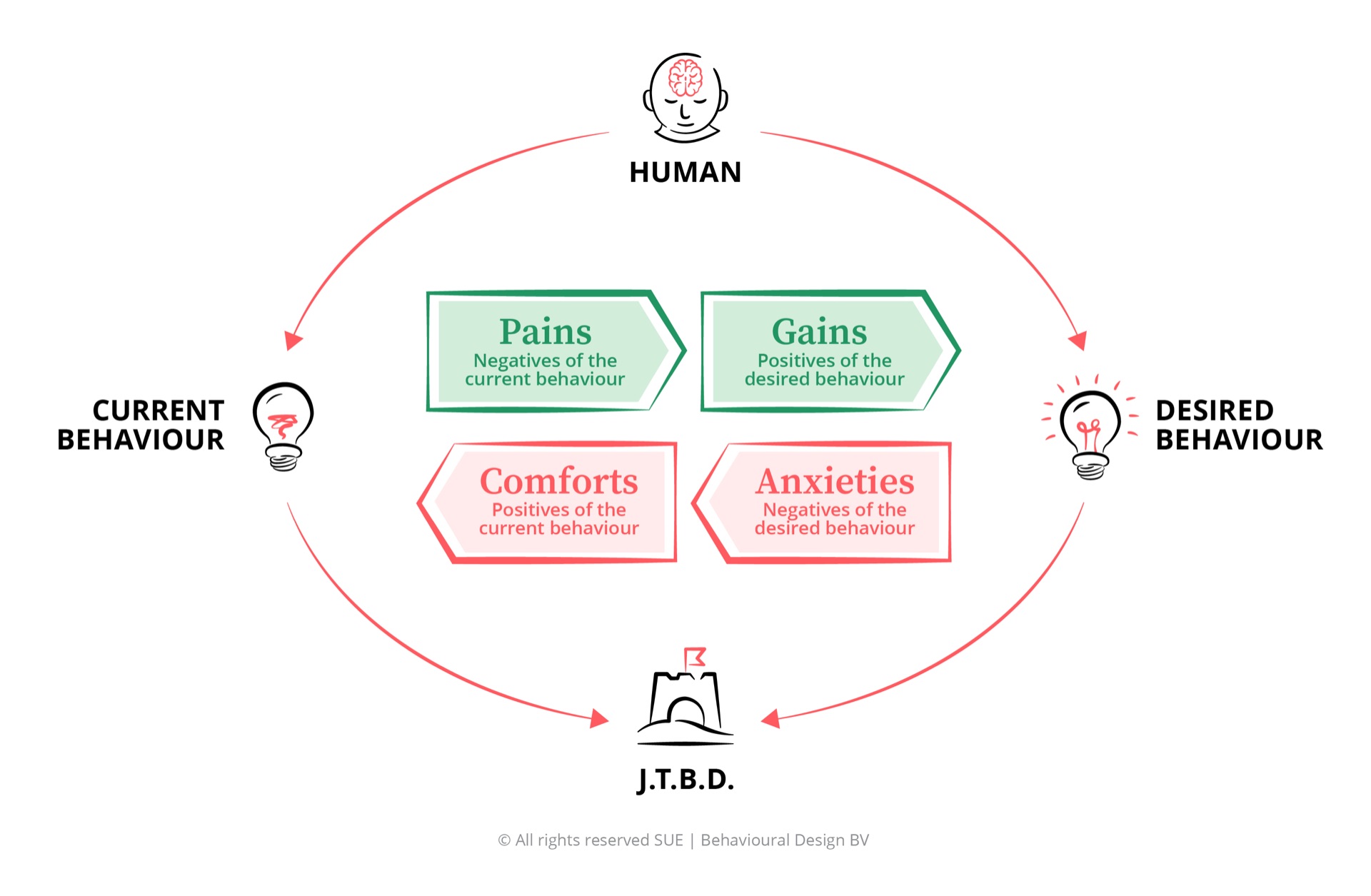
Why change management programmes stall despite good intentions
Standard change management addresses the driving forces. It communicates the Pains and promises the Gains. What it systematically ignores are the Comforts and Anxieties - the blocking forces that operate below the level of rational argument and determine whether anyone actually behaves differently.
The status quo is visibly costly: People can see that the current way of working is creating problems - inefficiency, missed opportunities, customer complaints. The burning platform is clear. It just doesn’t burn hotly enough to override habit.
External pressure: Regulatory requirements, competitive dynamics, or leadership mandates create real urgency. People acknowledge the need to change. They just don’t change how they behave on a daily basis.
Personal dissatisfaction: Many people are genuinely frustrated with how things currently work. They want things to be different. The wanting is real. The behaviour change is absent.
The promised benefit is real but distant: The new system will save time. The new process will reduce errors. The new culture will improve collaboration. These are real gains - but they are abstract, future-oriented, and require sustained behaviour change before they materialise.
Career and recognition: Being seen as someone who embraces change can be professionally advantageous. This is a genuine motivator for some people, particularly early adopters.
Reduced friction in daily work: If the new way of working is genuinely easier, this becomes a powerful ongoing motivator - once people have actually experienced it.
Existing habits are automatic and effortless: The old way of doing things requires no thought. It is deeply embedded. Every deviation from it requires deliberate effort - and deliberate effort is unsustainable over time.
“We already did change”: The organisation went through a major change programme two years ago. And three years before that. There is a genuine comfort in the belief that the current situation represents stability earned through previous disruption.
Social anchoring: If the people around you are not changing, not changing feels safe and appropriate. The social norm is one of the most powerful behavioural anchors. Change programmes rarely address this directly.
Competence anxiety: The new system, process, or way of working requires new skills. The anxiety about being visibly incompetent - in front of colleagues, managers, customers - is a significant and usually unacknowledged barrier.
“This too shall pass”: People who have lived through multiple change programmes develop a strategic immunity. They know that if they wait long enough, the initiative will lose momentum. This is not cynicism. It is accurate pattern recognition.
Loss of identity: The current role, expertise, or way of working is part of how people see themselves. Change that requires leaving that behind triggers identity-level resistance that no communication plan can address rationally.
The key insight: Standard change management exhausts most of its effort on the driving forces - explaining the Pains, promising the Gains, building the business case. The blocking forces - the Comforts and Anxieties that operate at System 1 - receive a communication campaign. That is not sufficient. Comforts and Anxieties are not overcome by arguments. They are overcome by designing environments where the new behaviour is easier, less socially risky, and more immediately rewarding than the old one.
Three Patterns That Explain 70% of Failures
Scenario 1: The Communication Campaign That Exhausted Itself
A large insurance company launches a major process transformation. The change team produces an excellent communication package: launch video, manager talking points, FAQ document, a series of all-hands sessions. Engagement survey data shows high awareness and stated support. Six months into implementation, actual process compliance sits at 31%. The change team ramps up communication. Compliance does not move.
The campaign created understanding. It did not create new habits. The old processes were deeply embedded in daily work rhythms. No one redesigned those rhythms. No one changed the defaults. The new process required conscious effort every single time - and conscious effort is not sustainable. The communication campaign addressed System 2. The actual behaviour lived in System 1.
Scenario 2: The Pilot That Didn’t Scale
A financial services firm runs a successful pilot of a new customer interaction model in one regional office. The pilot team is enthusiastic, the results are strong, the client satisfaction scores improve significantly. Leadership decides to roll out the model across the organisation. Eighteen months later, only one of the twelve offices has fully adopted the new model. The others have reverted to their previous approach.
The pilot succeeded because it was embedded in a specific team with specific managers and a specific social environment that made the new behaviour feel natural and supported. The rollout treated adoption as a communication and training challenge. It didn’t ask: what was it about the pilot environment that made the behaviour change stick? And what would need to be true about each of the other twelve environments for the same thing to happen there?
Scenario 3: The Leadership Alignment That Didn’t Translate
A professional services firm gets full executive alignment on a new way-of-working model. Every member of the leadership team is publicly committed. The strategy is sound, the case is clear, the executive roadshow delivers the message consistently and credibly. Then nothing happens at the team level. Managers are supportive in principle and unchanged in practice. Their teams follow the managers, not the strategy.
Leadership alignment is a necessary condition for change. It is not a sufficient one. The behaviour gap sits between the executive endorsement and the daily work environment of every team. Managers are the critical variable - but their behaviour is also governed by the same forces as everyone else’s. They have their own comforts and anxieties. Their own habits to break. And no one designed an environment that made the new management behaviours easier for them specifically.
Five Behavioural Interventions That Change Management Misses
-
Run an Influence Framework Diagnostic Before Planning
Before designing a single communication or training session, map the four forces for the specific change and audience: What Pains are driving the need? What Gains are promised? What Comforts make the status quo feel safe? What Anxieties make change feel risky? Without this diagnosis, the change plan is addressing symptoms, not causes. The diagnosis takes a day. The change programme takes months. The ratio is worth examining.
-
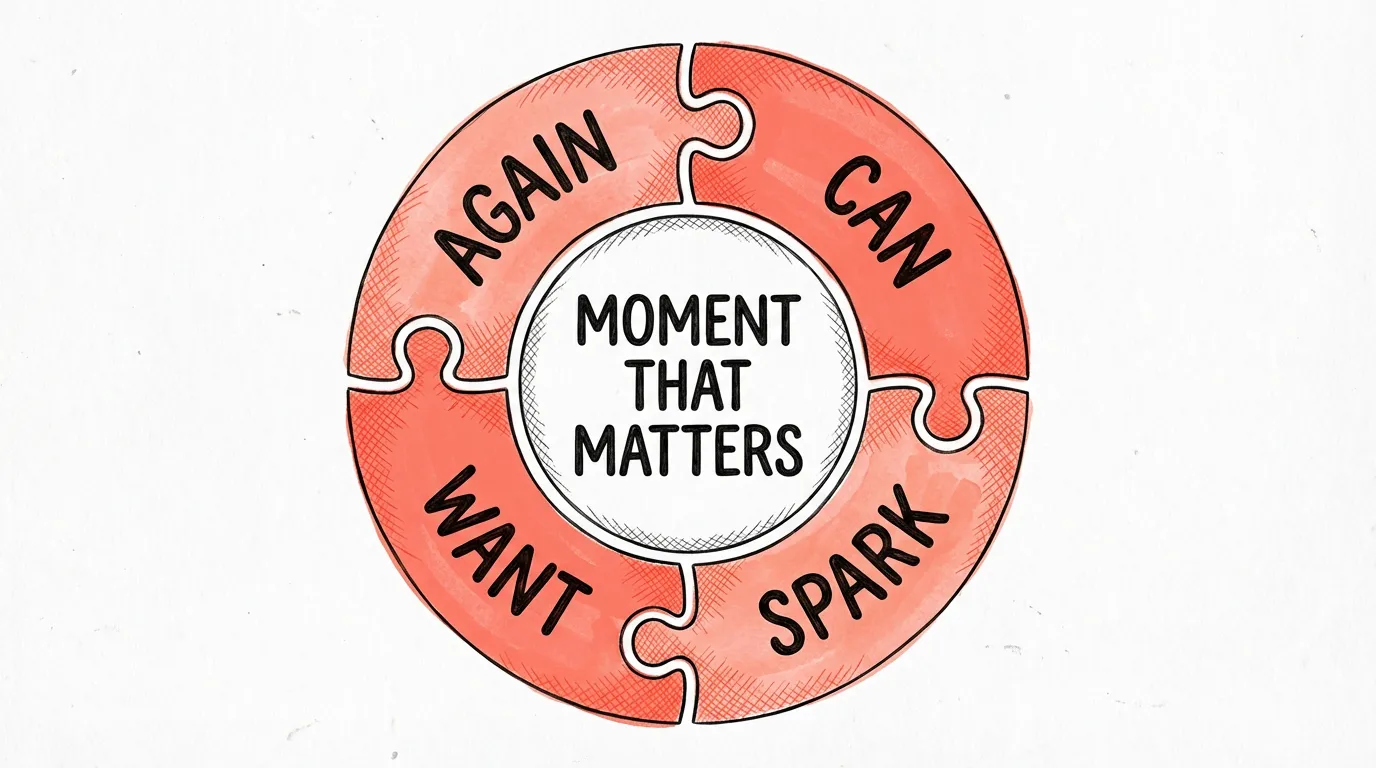
Design the Moments That Matter (SPARK)
Identify the three to five specific moments in the working day where the old behaviour is most deeply embedded, and where a new trigger would make the most difference. Then redesign those moments - change the default in the system, modify the physical or digital environment, alter the social context. The behaviour will follow the environment. The environment does not follow the communication plan.
-
Address the Competence Anxiety Directly (CAN)
Competence anxiety - the fear of being visibly incompetent in front of colleagues - is among the most powerful and least acknowledged blockers in change management. Design psychologically safe spaces for failure: sessions where errors are expected and normalised, where the new behaviour is practised without consequences, where being a beginner is explicitly endorsed. This is not soft management. It is the removal of a barrier that is currently blocking behaviour change.
-
Make the New Social Norm Visible (WANT)
Human behaviour is powerfully shaped by what we observe others doing. If the people around me are not changing, not changing feels appropriate. Change programmes that focus on individual motivation while ignoring social norms are fighting the wrong battle. Make the new behaviour visible: celebrate early adopters publicly, create spaces where the new approach is the demonstrated norm, ensure managers visibly model the behaviours they are asking for.
-
Build Repetition Into the System (AGAIN)
Behaviour becomes habit through repetition in a consistent context. A one-time training session is not repetition. A weekly team ritual is. A redesigned default in a system is. A monthly recognition of new-behaviour examples is. Design for repetition from the start - not as a reinforcement campaign, but as a structural feature of how work gets done. The question to ask: what will cause this new behaviour to happen again next Tuesday without anyone having to remember to do it?
Frequently Asked Questions
Why does change management fail so often?
Change management fails because it focuses on rational persuasion - communication plans, training sessions, stakeholder workshops - while ignoring the psychological forces that keep people anchored to existing behaviour. The SUE Influence Framework identifies four forces: the Pains and Gains that drive people towards change, and the Comforts and Anxieties that pull them back. In most change initiatives, the blocking forces dominate because they operate at System 1 speed - automatically, emotionally, below conscious decision-making. Rational communication cannot override this. Environment design can.
What is the failure rate of change management initiatives?
Research consistently shows that 70% of organisational change initiatives fail to achieve their stated goals. McKinsey has reported this figure repeatedly across decades. I cite it in my book The Art of Designing Behaviour (2024) as evidence that the problem is structural, not situational - and that the structural cause is always the same missing layer: behaviour.
What does the SUE Influence Framework say about change management?
The SUE | Influence Framework©, which I developed at SUE Behavioural Design and described in my book The Art of Designing Behaviour (2024), provides a diagnostic map of the four forces that determine whether behaviour changes. Applied to change management, it reveals that the standard toolkit - communication, training, leadership alignment - primarily addresses the driving forces while ignoring the restricting forces. Because restricting forces operate at the automatic, System 1 level, rational arguments do not neutralise them. Only environment design does.
What is the difference between change management and behavioural design?
Change management focuses on planning, communication, and stakeholder alignment - primarily rational, System 2 processes. Behavioural design focuses on the environment: the defaults, moments, social contexts, and friction levels that determine what people actually do, regardless of what they think or intend. Behavioural design provides what change management currently lacks: a rigorous account of why people behave as they do, and what to design to shift that behaviour structurally.
How can the SWAC Tool© make change management succeed?
The SWAC Tool© is a SUE Behavioural Design instrument for designing interventions at Moments that Matter. SWAC stands for Spark (a trigger that initiates the desired behaviour at the right moment), Want (making the behaviour intrinsically motivating or socially reinforced), Again (building repetition so behaviour becomes habit), and Can (removing barriers so the behaviour is actually possible). In change management contexts, SWAC shifts the intervention from the announcement phase to the daily work environment - designing the specific moments where new behaviours need to be triggered, reinforced, and made frictionless.
PS
Every change programme I’ve ever seen has good intentions and a solid business case. The failure is never in the strategy. It’s in the assumption that understanding produces behaviour. It doesn’t. Behaviour requires designed environments, specific moments, and systems that make the new way easier than the old way. This is the core of what we teach in the SUE Fundamentals course - and it is the core of what I describe in The Art of Designing Behaviour (2024). If you’re running a change programme right now, the Influence Framework diagnosis is where I’d start. It will save you six months of communication campaigns that produce understanding but not change.