Workplace wellbeing programme: why most fail and how to design one that works
Somewhere in your organisation there is a slide with a fruit basket on it. Next to it: a mindfulness app licence, a resilience workshop, a step challenge, a wellbeing week with a chair massage in the lobby. Underneath, a participation figure that looks respectable.
And somewhere else in the same organisation, someone is answering emails at half past ten at night because there is no other hour left in the day.
Both of those things are true at once, in almost every company that has a wellbeing programme. That is not a coincidence or a failure of execution. It is what happens when a programme is designed to help people cope with their job instead of changing the job.
A workplace wellbeing programme is the set of measures an organisation uses to protect and improve employees' health, energy and mental wellbeing. Research by William Fleming across more than 46,000 UK employees found that programmes built from individual offers, such as apps, mindfulness and resilience training, produced no measurable benefit. Programmes that change job design, meaning workload, control and support, do. More on designing employee happiness →
What a wellbeing programme usually is, and what it should be
Ask ten HR teams what their workplace wellbeing programme consists of and you get roughly the same list: an employee assistance line, a mental health app, some training on resilience or stress, a health check, a set of physical perks, and an annual engagement survey to see how everyone is holding up.
Look at that list again and notice what every item has in common. Each one asks the employee to do something differently. None of them changes what the employee is being asked to do.
That is the whole problem in one sentence, and it is why so many programmes score well on satisfaction and nothing on wellbeing. If you want the underlying thinking errors, we have written those up separately in three misconceptions about employee happiness. This article is about the build: what actually goes into the programme, in what order, and how you know whether it worked.
A programme that helps people cope with a workload is not a wellbeing programme. It is a subsidy for the workload.
The evidence: individual interventions barely move anything
For years the honest answer to "does this work?" was that nobody had measured it at scale. Then, in 2024, William Fleming at the University of Oxford's Wellbeing Research Centre did.
Fleming used survey data covering more than 46,000 employees across 233 organisations in Britain, and compared people who had taken part in individual-level wellbeing interventions with people in the same organisations who had not. The interventions were the familiar catalogue: mindfulness, resilience and stress management training, wellbeing apps, coaching, relaxation classes.
The result: participants reported no better wellbeing than non-participants. Across mental health, life satisfaction and job satisfaction, the differences were absent or inconsistent. The single exception was volunteering opportunities, which showed some positive association.[1]
It is worth being precise about what that does and does not mean. It is cross-sectional data, so it cannot prove that these interventions never help any individual. What it does show is that as a strategy for a workforce, this catalogue does not deliver. Which is a serious finding, because for most organisations this catalogue is the wellbeing programme.
Why the job itself is the exposure
The reason individual interventions underperform is not that people are unwilling. It is that the thing making them ill is still there on Monday.
Jeffrey Pfeffer at Stanford made this argument in Dying for a Paycheck, and the numbers behind it are hard to walk past. In a study with Joel Goh and Stefanos Zenios, he estimated that workplace stressors in the United States are associated with roughly 120,000 deaths a year and between five and eight per cent of annual healthcare spending.[2] Pfeffer's conclusion is that we treat the workplace as a health hazard in the way we once treated smoking: as an unfortunate personal habit, rather than an exposure that management decisions create and management decisions can remove.[3]
What in the job does the damage is well established. Robert Karasek showed in 1979 that psychological strain is not caused by demands alone. It is caused by high demands combined with low decision latitude: a lot being asked, and very little say over how you meet it.[4] Demanding work with real control over it is energising. The same demands without control are corrosive.
The Whitehall studies then showed how far that reaches. Michael Marmot and colleagues followed British civil servants and found that low job control predicted the incidence of coronary heart disease, and explained a substantial part of why people in lower grades became ill more often than those above them.[5] Not lifestyle. Not personality. Control.
No app addresses that. It cannot, because the exposure is not in the employee's head. It is in the design of their week.
The three levers that actually move wellbeing
If the job is the exposure, then the programme has to be about the job. Three levers, in this order.
Demands: an actual ceiling
Arnold Bakker and Evangelia Demerouti's job demands-resources model describes what happens when demands stay high: they drain energy, and sustained draining ends in exhaustion, regardless of how motivated somebody is.[6] Resources such as autonomy, feedback and support buffer that, but they do not cancel it.
So the first component of a serious programme is a limit that somebody owns. Not an aspiration in a policy document. A rule with a name attached: a cap on concurrent projects per team, a hard stop on meetings after a certain hour, a rule that new work arrives with a decision about what comes off the list. The test is simple. If nothing ever gets removed, you do not have a ceiling.
The largest recent field trial of exactly this is the UK four-day week pilot, coordinated by researchers including Juliet Schor. Across the participating organisations, 71 per cent of employees reported lower levels of burnout, and 56 of the 61 organisations carried on with the arrangement after the trial ended.[7] You do not have to adopt a four-day week to take the lesson. Reducing the exposure did what a decade of apps did not.
Control: decision latitude where it is cheap to give
Karasek's finding gives you the second component: give people more say over how, when and in what order work happens. Self-determination theory tells you why it lands. Edward Deci and Richard Ryan's work identifies autonomy, competence and relatedness as basic psychological needs, and autonomy is the one most routinely stripped out by well-meant process design.[8]
Most organisations have more of this to give than they think. Who sets the agenda for the team meeting. Who decides which requests are urgent. Whether someone can move a deadline by a day without escalating. None of that costs money. All of it moves decision latitude.
Support: managers who can act, not just listen
The third lever is the one closest to daily experience. Support only counts as a resource when raising a problem produces a change. Amy Edmondson's research on psychological safety describes the precondition: the shared belief that speaking up will not be punished.[9] We have written more on how to build that in psychological safety at work.
The practical consequence for your programme is uncomfortable but clear. Training managers to spot signs of stress, without giving them the authority to reduce anyone's workload, produces sympathetic conversations and no relief. Give them the mandate first. Then the training.

Why the fruit basket survives anyway
None of the above is secret. Most HR directors could recite it. So why does the perk programme keep winning the budget? Map the forces with the SUE | Influence Framework and it becomes obvious.[10]
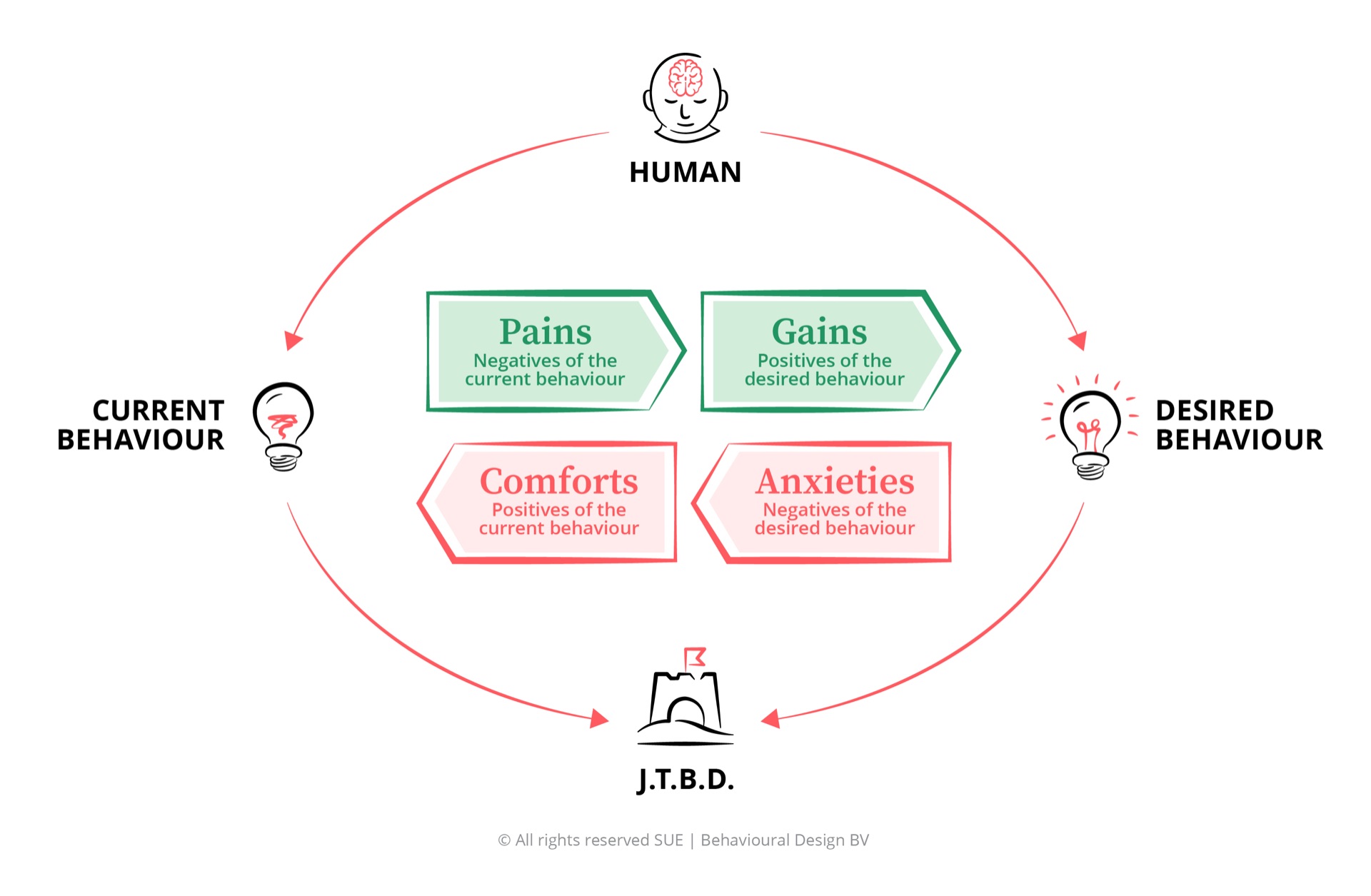
The pains are unevenly distributed. Employees feel the workload. The people deciding the programme feel a rising absence figure, which is the same problem arriving one year late and one step removed.
The gains of a perk programme are immediate and visible: something to announce, a participation number, a line in the annual report. The gains of cutting demands are invisible by design. Nobody thanks you for the burnout that did not happen.
The anxieties are the real blocker. Reducing workload means admitting the workload was too high, which raises questions about targets, headcount and last year's promises. An app raises no questions at all.
And the comforts keep it all in place. The perk programme is cheap, quick, uncontroversial and owned by one department. Redesigning demand and control is slow, political and belongs to line management. Of course the fruit basket wins. It is the path of least resistance for everyone with a say.
Which means the first job is not to design better interventions. It is to make the invisible pain visible to the people who decide.
How to design your programme: five steps
1. Diagnose the exposure, not the mood
Before you buy anything, measure demands and control. Hours worked beyond contract, meeting load per role, how fragmented a working week is, how often people can decide their own schedule, how often a request for help changed something. This takes a fortnight and tells you more than an annual engagement survey, because it describes the job rather than the feeling about the job.
2. Pick the one team where it hurts most
Organisation-wide launches are how good ideas get diluted into announcements. Choose the team with the worst exposure numbers and design there. A visible result in one team creates more internal support than a policy covering everyone.
3. Change one thing about the work
One demand removed or one degree of control returned. Cancel a recurring meeting, cap concurrent projects, hand scheduling to the team, protect two mornings a week from interruption. One change, so you can see what it did.
4. Run it as an experiment with a date on it
Baseline, a fixed period, a specific measure, a review moment agreed in advance. Behavioural design lives or dies on this: a change without a measurement is an opinion, and opinions lose budget conversations.
5. Keep the individual services, demote them
The counselling line, the assistance programme, the coaching: keep them. People in trouble need them, and Fleming's finding is about their effect as a strategy, not their value to an individual in a bad month. Just stop calling them the wellbeing programme. They are the safety net underneath it.
Frequently asked questions about workplace wellbeing programmes
What should a workplace wellbeing programme include?
Start with the three factors that predict strain: workload, control and support. That means a real limit on demands, decision latitude over how and when work is done, and a manager population trained and mandated to act. Individual services such as counselling or an employee assistance programme belong in it as a safety net, but they are the floor, not the strategy.
Do wellbeing apps and mindfulness training work?
On the available evidence, not at the level of a whole workforce. William Fleming analysed survey data from more than 46,000 employees across 233 UK organisations and found that participants in individual interventions, including mindfulness, resilience training, wellbeing apps and stress management, reported no better wellbeing than non-participants. Volunteering opportunities were the one exception.
How do you measure a workplace wellbeing programme?
Measure exposure and behaviour, not satisfaction with the programme. Useful indicators: hours worked beyond contract, meeting load, share of the week without fragmentation, how often people can set their own schedule, and whether asking for help leads to a change. Participation rates tell you how popular something is, not whether it worked.
How long before a wellbeing programme shows results?
Changes in workload and autonomy show up in energy and sleep within weeks, because you have removed an exposure rather than added a coping skill. Sickness absence and turnover move more slowly and noisily, typically over two to four quarters. Run each change as a dated experiment on one team so you can attribute an effect at all.
Conclusion
The uncomfortable implication of Fleming's data is not that wellbeing is unachievable. It is that most of what we spend on it is aimed at the wrong target. We keep offering people better ways to absorb a workload, and then treat it as a mystery when absorption fails.
The alternative is less photogenic. Fewer demands, more control, managers who can actually do something. No launch event, no app, no participation figure to report. Just a job people can do without it costing them their evenings.
Want to design that in your own teams? The full method, from diagnosis to measurement, is what you learn in The Art of Influence© online, at your own pace. Rated 9.3/10 by 10,000+ professionals from 45+ countries.