AI adoption strategy: a five-step behavioural blueprint
Open the document called "AI adoption strategy" in your organisation. There is a good chance it contains a tool selection, a licence count, a security review, a training calendar and a communication plan.
All of that is necessary. None of it is a strategy for adoption. It is a strategy for availability.
The gap between the two is where most AI programmes quietly stall. The tools arrive. The webinars run. And a quarter later, a small group of enthusiasts is doing remarkable things while everyone else has gone back to the way they worked in January.
An AI adoption strategy is the plan that decides which people will do which work differently with AI, and what has to change in their context for that to happen. That is not the same as an implementation plan, which covers tooling, licences, security and integration. Implementation delivers capability. Adoption delivers changed behaviour, and the second never follows automatically from the first. Why AI adoption fails →
Strategy for availability, strategy for behaviour
Start with the thing that makes this worth the effort. In a study of more than 5,000 customer support agents, Erik Brynjolfsson, Danielle Li and Lindsey Raymond found that access to a generative AI assistant raised issues resolved per hour by around 14 per cent on average, with the largest gains among the least experienced workers.[1] The prize is real, and it is unevenly distributed.
Which is precisely the problem. The value only appears where the behaviour changes. Every organisation currently paying for seats that nobody opens has already bought the capability and none of the benefit.
So the first strategic decision is not which model to buy. It is which behaviour you are trying to move, in which group, and what is currently in its way. Everything else is procurement.
Rolling out a tool is a project. Changing how people work is a design problem.
The rest of this article is a five-step blueprint for the second one. It assumes the tools are already there, or will be shortly, and that your problem is human rather than technical. If you want the diagnosis of why programmes stall in the first place, we wrote that separately in why AI adoption fails and in AI adoption in organisations. This piece is about what to build instead.
Step 1. Define the behaviour, not the tool
Almost every AI adoption goal is written at a level where nobody can act on it. "Everyone works with AI by the end of the year." "We become an AI-first organisation." Those are aspirations. They describe a state, not an act.
Rewrite the goal as a sentence a colleague could film. Who, doing what, when, instead of what.
An example from the kind of work most teams recognise: account managers draft the first version of every client update with the assistant, on Friday morning, instead of starting from a blank document. That sentence tells you who to talk to, which moment to redesign, which current habit you are competing with, and how you would know whether it happened.
Note what the sentence does not contain: the word "use". Usage is not a behaviour, it is a category. And a strategy aimed at a category cannot be designed, only communicated.
One more discipline here. Name the behaviour it replaces. Every new behaviour has to beat an incumbent, and the incumbent already works. This is where John Gourville's analysis of new product adoption is useful: because people overvalue what they already have and undervalue what they do not, and developers do the reverse, innovations tend to be overrated by their makers by roughly a factor of nine.[2] Assume your AI use case is subject to the same distortion, and design accordingly.
Step 2. Diagnose the forces before you design anything
The instinct at this point is to jump to interventions. Resist it for a week. Every intervention you design without a diagnosis is a guess dressed up as a plan.
At SUE we map the forces around a behaviour with the SUE | Influence Framework: the pains and gains that push someone towards the new behaviour, and the anxieties and comforts that hold them in the old one.[3]
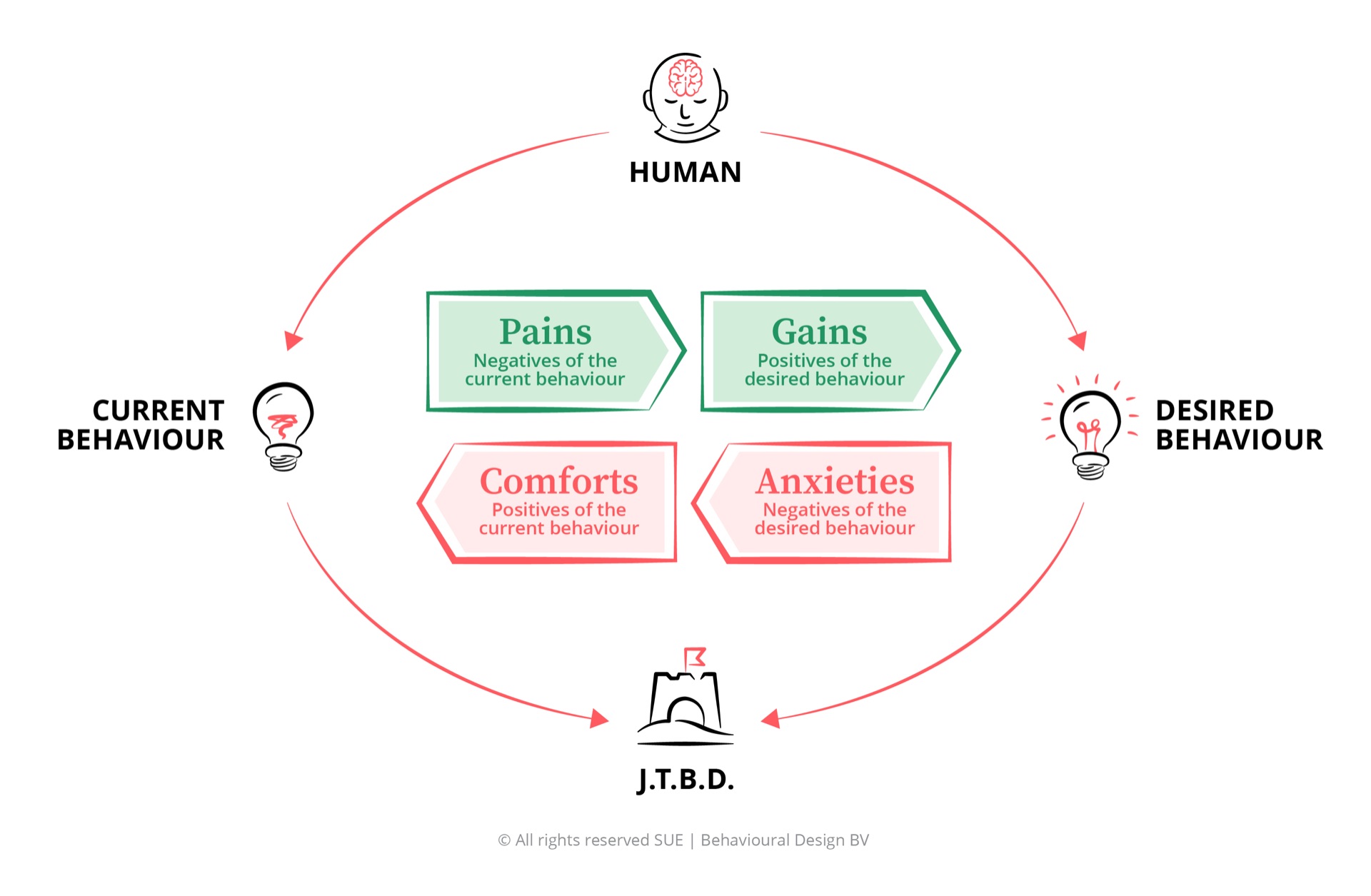
Run it on the specific group from step one, with people from that group in the room. The pattern that emerges is remarkably consistent.
The pains are genuine but tolerable: the report takes too long, the inbox never empties, the first draft is always the hardest part. Tolerable pains do not create movement. People have absorbed them for years.
The gains are large and abstract: hours saved, better quality, a more interesting job. Abstract benefits arriving later lose to concrete costs arriving now, which is the oldest finding in behavioural economics and still the most underrated in change programmes.
The anxieties are specific and immediate: looking slow in front of a colleague who seems fluent, producing something wrong and being held responsible for it, discovering in public that you do not know what a prompt is. Add the quieter one that nobody writes on a flip chart: if this works, what is left of my job.
The comforts are the most powerful force of the four and the least discussed. The current way works. It is fast because it is automatic. Nobody gets criticised for doing the report the way the report has always been done.
Put those four side by side and the conclusion writes itself. Your strategy needs to shrink the anxieties and dislodge the comforts. Most AI programmes spend their entire budget amplifying the gains.

Step 3. Pick one job, not one hundred use cases
The use case workshop is a standard fixture of AI programmes. A room full of people generates ninety ideas, they get scored on impact and feasibility, and a portfolio is born.
Portfolios are a poor instrument for behaviour change. They spread attention across many weak signals when what you need is one strong one.
Karl Weick made the argument in 1984, in an article about why large social problems resist solution: framing a problem at full scale produces anxiety and paralysis, while a series of small, concrete wins produces momentum, allies and the information you need for the next move.[4] An AI adoption strategy built on ninety use cases is a full-scale problem. One task, done differently by one team, is a small win.
Choose the task on three criteria. It happens weekly or more often, so the loop from attempt to result is short. The improvement is obvious on the first try, so nobody has to take the benefit on faith. And it sits inside the team's own control, so no other department has to approve anything.
Then defend the narrowness. Someone senior will suggest broadening it. Broadening it is how you lose.
Step 4. Make the beginner visible
This is the intervention that changes the most and costs the least, and it is almost always missing.
The reason people avoid a new tool in front of colleagues is not the tool. It is the assumption that everyone else has already figured it out. That assumption is nearly always false, and it is self-reinforcing: everybody stays quiet, and the silence is read as competence.
Amy Edmondson's research on hospital teams found that the better-performing teams reported more errors, not fewer. They were not making more mistakes. They were working in an environment where admitting one was safe, which is the condition under which teams actually learn.[5] The same condition determines whether anyone will try an unfamiliar tool where a colleague can see them.
So design for it, deliberately. Have a respected person in the team demonstrate their unpolished attempt: the prompt that produced nonsense, the output they had to rewrite, the thing they still cannot get to work. Not a champion presenting a success story. A credible peer being visibly mediocre in public.
This is also why the choice of who goes first is strategic rather than administrative. Everett Rogers spent decades documenting how innovations spread, and the recurring finding is that they travel through interpersonal networks: people adopt because someone like them, whose judgement they trust, adopted first and it went fine.[6] Your pilot group is not a technical selection. It is a credibility selection.
Related reading, if this is your bottleneck: AI adoption and psychological safety.
Step 5. Design the habit, and measure behaviour
A behaviour that depends on remembering to do it will not survive a busy week. Attach it to something that already happens.
The mechanism is well documented. Peter Gollwitzer and Paschal Sheeran reviewed 94 studies and found that if-then implementation intentions, plans of the form "when situation X occurs, I will do Y", produced a medium-to-large improvement in goal attainment over goal intentions alone.[7] The plan works because it hands control of the behaviour to the situation instead of to willpower.
Applied to your one task: "when I open the client update template on Friday, I draft version one with the assistant first." Written down, agreed in the team, tied to an existing cue.
Then measure the right thing. Licences issued, logins, seats activated and training completions are all measures of availability, and they will look encouraging while nothing changes. Measure instead how often the target task is done the new way, how many people have shared an attempt in public, and how long the task takes end to end now. Three numbers, reviewed weekly, visible to the team.
Weekly matters more than it sounds. A quarterly review of an adoption programme tells you the answer four times. It does not tell you in time to change anything.
Frequently asked questions about AI adoption strategy
What is an AI adoption strategy?
An AI adoption strategy is the plan that decides which people will do which work differently with AI, and what has to change in their context for that to happen. It is not the same as an implementation plan, which covers tooling, licences, security and integration. Implementation delivers capability. Adoption delivers changed behaviour, and the second does not follow automatically from the first.
How long does AI adoption take?
A single, well-chosen behaviour in one team can shift within four to six weeks, because the loop from attempt to visible result is short. Organisation-wide change is slower and follows the pattern Rogers described: adoption spreads person to person through credible peers, so it takes as long as it takes for early users to become visible to everyone else. Plan in quarters, but measure in weeks.
Why do AI adoption strategies fail?
Most fail because they treat non-use as a knowledge problem and answer it with training, communication and access. The real barrier is usually the cost of being visibly incompetent at something colleagues appear to have mastered, combined with the pull of a current routine that already works well enough. Neither of those is solved by another webinar.
How do you measure AI adoption?
Measure the behaviour, not the entitlement. Licences issued, logins and course completions tell you almost nothing. Useful measures are how often the target task is done the new way, how many people have shared an attempt in public, and how long the task now takes end to end. Pick two or three and track them weekly.
Conclusion
The five steps are not complicated, and that is rather the point. Define one behaviour. Diagnose the forces holding it back. Pick one job. Make the beginner visible. Design the cue and measure the act.
What makes them hard is that they ask for restraint at a moment when everything in the organisation is pushing for scale. Ninety use cases feel like ambition. One task, done differently by one team, feels like an underachievement, right up until it is the only part of the programme that actually changed how anybody works.
Want to build this properly? The online Deep Dive AI Adoption takes you through diagnosis, intervention design and measurement, at your own pace. Or learn the full method in The Art of Influence©, rated 9.3/10 by 10,000+ professionals.