A leadership team decides the organisation needs to become more customer-centric. A programme is launched, a communication plan is devised, a series of workshops is scheduled. Six months later: most employees are working exactly as before. The change team is frustrated. Management talks about “resistance.” And nobody asks the right question: why doesn’t behaviour actually change?
Change management is one of the most studied fields in management, and simultaneously one with the highest failure rates. McKinsey research consistently shows that around 70% of all change initiatives fail to achieve their intended results. That number doesn’t change. After decades of models, methods and methodologies, three in four change initiatives still stall.
This article explains why that is, and what behavioural science teaches us about an approach that actually works.
What is change management?
Change management is the systematic planning, guiding and embedding of organisational changes. That sounds broad, and it is. Change management covers everything from mergers and restructurings to software implementations, culture programmes and strategic transformations.
What all forms of change management have in common: they require people to act differently than they are accustomed to. That is precisely where most approaches go wrong.
Classic change management thinking is largely based on the work of Kurt Lewin (unfreeze-change-refreeze, 1940s) and later John Kotter (8-step model, 1996). Both models have value, but they are built on an assumption that behavioural science has since convincingly refuted: that people make rational decisions. That people, given the right information and a clear sense of urgency, will adjust their behaviour.
They don’t. Not because they are unwilling, but because behaviour works differently than these models assume.
Why does 70% of all change fail?
The most commonly cited reason for change initiatives failing is employee resistance. That is an observation, not an explanation. It is like saying a plane crash was caused by the plane falling down. You know it went wrong, but not why.
The deeper explanation lies in a fundamental misunderstanding of how behaviour change works. The assumption behind most change programmes is:
- If people understand why change is needed, they become motivated.
- If they are motivated, they change their behaviour.
Both steps are wrong. Understanding does not automatically lead to motivation, and motivation does not automatically lead to behaviour change. Daniel Kahneman described in Thinking, Fast and Slow (2011) how our brain operates via two systems. System 1 is fast, automatic, unconscious and emotional, responsible for approximately 96% of our decisions. System 2 is slow, rational and conscious, the system you engage with arguments, data and communication about the why.
Change communication almost always targets System 2. But behaviour is driven by System 1. The habitual way of working that feels familiar, the colleague you always approach a certain way, the tool you’ve used for years. These are System 1 patterns: ingrained, automatic, energy-saving.
People understand the need for change. They may even agree with it. But they don’t do it. That isn’t resistance. That is how behaviour works.
Two additional mechanisms reinforce this. First, loss aversion: our brain registers loss roughly twice as heavily as an equivalent gain. Every change means giving something up, a familiar routine, a proven approach, the certainty of the known. The new behaviour must not only be better; it must feel much better to overcome the resistance. Second, status quo bias: the human tendency to prefer the current situation, even when alternatives are objectively superior. The familiar way of working carries the advantage of now; the new way carries the burden of the unknown.
More on the behavioural science explanation: why change management fails.
The behavioural science view on change management
The fundamental lesson of behavioural science for change management is simple, but its implications are far-reaching: behaviour does not change when people understand. Behaviour changes when the environment changes.
W. Edwards Deming, the quality management pioneer, articulated it in the twentieth century: “Put a good person in a bad system, and the bad system wins every time.” Employees who do not display the new behaviour are rarely unwilling or incompetent. They are in an environment that facilitates old behaviour and obstructs new behaviour. The cause is not the people; it is the system.
This has profound implications for how you approach change management:
- Stop persuading, start designing. Don’t just communicate about the why; design the environment so the new behaviour is the path of least resistance.
- Diagnose before you intervene. Understand what keeps people locked in old behaviour before designing interventions.
- Make early adoption visible. Social norms are among the most powerful steering mechanisms: people look at what others do as a signal for what is normal.
- Remove administrative barriers. Every extra step, every extra form, every approval round is friction that slows new behaviour.
The SUE Influence Framework as a change diagnosis
Before you can design a change approach, you need to understand why people do what they do. Not what they say they do in a survey, but which unconscious forces are genuinely driving their behaviour.
At SUE Behavioural Design we use the SUE | Influence Framework©: a diagnostic model that distinguishes four forces that drive behaviour.
- Pains: the frustrations and pain points in current behaviour that motivate people to change. What irritates them about the current way of working?
- Gains: the concrete benefits of the new behaviour that attract people. What do they gain?
- Comforts: the habits, routines and familiar patterns that keep people locked in old behaviour. What is comfortable about the current way things work?
- Anxieties: the fears, doubts and uncertainties that block the new behaviour. What do people fear about the change?
The crucial insight: most change programmes focus exclusively on Pains and Gains. They explain why change is needed (addressing Pains) and highlight the benefits (emphasising Gains). But it is the Comforts and Anxieties that actually determine behaviour. Comforts are the habits that keep people in their current way of working. Anxieties are the fears that block the new behaviour.
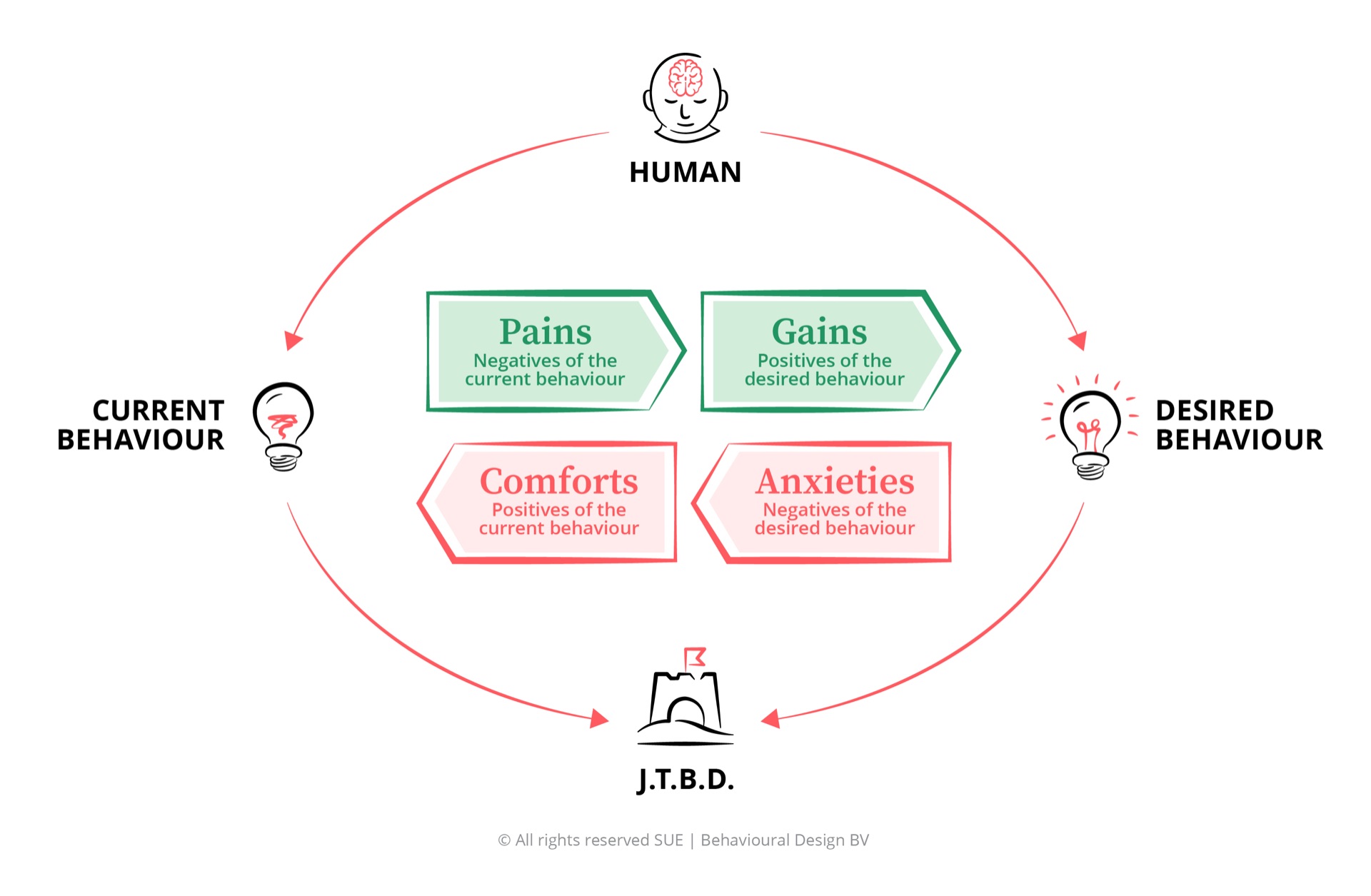
A practical example: an organisation wants to adopt a new project management tool. The gains are clear (more overview, fewer emails), but the comforts are stronger: email is familiar, always works and requires no new habits. And the anxieties are real: “What if I miss something?” “How do I use it?” “Will this increase my workload?” Communication about the benefits reaches the gains. But as long as comforts and anxieties remain unaddressed, behaviour does not change.
The diagnosis tells you exactly where to intervene.
5 principles of effective change management
Based on behavioural science and our practical experience with dozens of organisational transformations, these are the principles that consistently make the difference.
1. Make the new behaviour the default
Defaults are one of the most powerful tools in behavioural design. People overwhelmingly choose the pre-selected option, not because they consciously choose it, but because changing requires effort and the default “feels good enough.” In countries with opt-out organ donation, participation rates approach 100%; in opt-in countries, only 20-27%. Same people, same values, different default.
Translated to change management: make the new behaviour the standard way of working. Those who want to maintain the old approach must actively do something different. Those who do nothing do it right. This is fundamentally different from offering the change as an option alongside the existing one.
2. Remove friction from the new behaviour
The universal lesson of behavioural science: simplicity eats willpower for breakfast. The more steps the new behaviour requires, the fewer people will do it, regardless of their intention. Removing friction is more effective than increasing motivation. Read more in our article on friction in behavioural design.
3. Make the unwanted behaviour slightly harder
Simultaneously with removing friction from the new behaviour, you can add friction to the unwanted behaviour. No prohibition, the behaviour remains possible, but it costs something extra. An additional step, a conscious choice that activates System 2. This is what behavioural scientists call sludge: deliberately introduced friction to discourage unwanted behaviour.
4. Activate social norms
People are social animals. We automatically look at what others do as a signal for what is normal and appropriate. This makes social norms one of the most underestimated tools in change management.
Make early adoption visible. “82% of your department has already adopted the new way of working” is more effective than any rational argument. Not because people are irrational, but because social information is direct input for System 1. Making the new behaviour visibly the norm, even while the transition is still underway, significantly accelerates adoption.
5. Use commitment devices
A commitment device is a mechanism where people bind themselves in advance to desired behaviour: a public pledge, an implementation intention (“when I do X, I will also do Y”), a structure that limits future options. Commitment devices work because they use the force of the present moment, when motivation is high, to steer future behaviour. More on commitment devices.
Reducing resistance to change
Resistance is the most commonly cited obstacle in change management, and also the most widely misunderstood. Resistance is often treated as a personal problem: employees are conservative, negative, or simply refuse to change. But from a behavioural science perspective, resistance is a logical, predictable response to change.
Resistance has two sources:
- Comforts: people hold on to what is familiar. The current way of working is comfortable, proven and energy-efficient. Resistance here is not unwillingness; it is the reasonable preference for the certain over the uncertain.
- Anxieties: people fear what the change means for them. Loss of status, loss of competence, loss of autonomy. “Can I actually do this?” “What if I make mistakes?” “What does this mean for my role?”
Reducing resistance therefore does not mean convincing people of the importance of change. It means addressing the comforts (how do you make the new behaviour as comfortable as the old one?) and removing the anxieties (how do you reduce uncertainty about the change?).
Practically: make failure safe. People adopt new ways of working faster when they can experiment without immediate consequences. Give space to practise, offer accessible support, and celebrate early successes visibly. More strategies in our article reducing resistance to change.
Engaging employees in change
One of the most commonly given pieces of change management advice is “involve employees in the change.” That is correct, but the execution is crucial. There is a world of difference between token participation and genuine engagement.
Token participation: employees can give input on a plan that is already fixed. They are informed, perhaps consulted, but the fundamental direction is not up for discussion. The result: employees feel unheard, ownership is low, and adoption is slow.
Genuine engagement works differently. It is not about input on everything, but about ownership over the part that most affects employees: what the new behaviour looks like in their daily work. Behaviourally, this works through two mechanisms:
- The IKEA effect: people value what they have (co-)created significantly more than what is offered to them. Co-creating the implementation, even when the direction is fixed, increases ownership and adoption.
- Commitment through participation: those who think along about the rollout implicitly commit to the outcome. Participation is a commitment device.
More on the five behavioural principles that convert engagement into actual change behaviour: engaging employees in change.
Change communication: beyond informing
Most change communication is built on the information deficit model: if people don’t change, it is because they don’t understand. More information, better presentations, clearer communication will solve the problem. It won’t.
Effective change communication focuses not on what is going to change, but on the four forces that determine the audience’s behaviour. That means:
- Address Pains concretely: make the pain points of the current situation tangible and recognisable. Not “we need to be more customer-centric”, but “72% of our customers say response times are too slow.”
- Remove Anxieties explicitly: name the concerns people have about the change. Don’t deny them - address them specifically. “Many people wonder how this will affect their workload. Here is what you can expect.”
- Respect Comforts: acknowledge what works well in the current situation. Change that discards everything from before feels less safe than change that builds on existing strengths.
- Make Gains concrete: abstract benefits don’t move people. Make gains tangible: “This saves you an average of 40 minutes per week” works better than “this makes you more efficient.”
Further reading: change communication that works.
Conclusion: effective change management is environment design
The biggest mistake in change management is not a lack of urgency, communication or commitment. It is a flawed model of how behaviour change works. If you believe people decide rationally and that behaviour follows from understanding and motivation, your change programmes are built on sand.
Behavioural science offers a sharper perspective. Behaviour is largely automatic and environment-driven. People don’t change behaviour when they understand; they change when the environment makes the new behaviour easier than the old. Change management is therefore fundamentally environment design: systematically adjusting the context so desired behaviour becomes the logical choice.
That starts with a thorough diagnosis using the four forces of the SUE | Influence Framework. It continues with targeted interventions: removing friction, redesigning defaults, activating social norms, addressing anxieties. And it ends with measurement: behaviour is visible and measurable, making change management a field where you can actually know whether your intervention works.
Want to apply this in your organisation? Explore our training catalogue for change professionals. Further reading: behaviour change complete guide, decision making: how to make better decisions, and why behavioural interventions fail.