Cognitive biases in recruitment: the complete guide for HR
A hiring manager opens a recruitment process for a senior data role. 142 CVs come in. Three HR professionals share the screening. Two weeks later the shortlist is ready: six candidates, four men, two women, all aged between 32 and 41, five with a Dutch surname. The three screeners worked independently. None of them deliberately discriminated. And yet the profile of the shortlist looks structurally like the profile of the existing team.
This is not an accident. This is what cognitive biases in recruitment do when you don't deliberately design the process. They are the silent decisions that have already been made before the actual decision is taken. Which CVs are dismissed on the basis of a name, an age cue or an educational institution. Which candidates pick up a halo in the first two minutes of the interview that colours the rest of the conversation. Which salaries are offered based on what the candidate previously earned, rather than on what the role is worth.
Cognitive biases in recruitment are the systematic, unconscious thinking errors HR professionals and hiring managers make when assessing candidates. They drive which CVs are invited, how interviews are interpreted, which salaries are offered and which candidates are ultimately hired, often without the decision-makers noticing. The six most damaging biases in hiring are anchoring bias, the halo effect, confirmation bias, the availability heuristic, the framing effect and similar-to-me bias. Behavioural Design tackles them through process design, not through awareness.
What are cognitive biases in recruitment?
Recruitment is, at its core, a stack of judgements made under uncertainty. A CV is a handful of pages about someone you have never met. An interview is an hour in which you try to predict how someone will perform over the next five years in a role that will itself keep changing. Under that uncertainty, the brain reaches for mental shortcuts: heuristics that produce a quick answer and almost always land slightly off the truth.
The behavioural sciences call these shortcuts cognitive biases. Daniel Kahneman summarised them in Thinking, Fast and Slow as the price we pay for a System 1 that can produce decisions instantly.[1] In most situations that price is negligible. In recruitment the price is structural and expensive: wrong hires, skewed teams, underpaid employees, frustrated hiring managers and long ramp-up times for people who were never the right fit.
The 2004 study by Bertrand and Mullainathan made the impact painfully concrete. Identical CVs with a 'white-sounding' name received fifty per cent more callbacks than the same CVs with a 'black-sounding' name.[2] Not a single recruiter thought: I am discriminating. Everyone thought: I am picking the best candidate. The bias does not sit in the intention. It sits in the process.
Why awareness about biases doesn't make your hiring decisions better
The most stubborn misconception in HR circles is that unconscious bias training solves the problem. The reasoning sounds logical: make people aware of their biases and they will be less affected by them. The data tells a different story. Meta-analyses of unconscious bias training show that participant awareness rises, but actual hiring behaviour barely changes.[3] People can perfectly explain what a halo effect is and unconsciously apply it the next day to the first candidate who walks in.
Iris Bohnet has given the summary every HR professional should know in her book What Works: bias sits in people, but equal opportunity emerges from systems. Change the system and behaviour follows. Change only awareness and you get self-satisfied people producing the same outcomes.[4] This is precisely the Behavioural Design line: it is not a character problem, it is an environment problem.
For HR professionals this means a fundamental shift. Stop investing in training that tells people what they shouldn't do. Start redesigning the processes in which the biases arise. The rest of this article shows how.
The six most damaging biases in recruitment
At least fifty cognitive biases have been documented. In recruitment, six of them do most of the work. They reinforce each other, they appear at different stages of the process, and they can all be designed out of the system.
Anchoring bias in salary negotiations and the first pay offer
The first number that lands on the table in a salary conversation defines the playing field of the entire negotiation. If the recruiter asks first about the candidate's current salary, that current salary becomes the anchor for the offer, even though it has nothing to do with the market value of the role. A woman who has historically been undervalued in her previous role receives a new offer that is still below market rate. Not because the hiring manager wanted that, but because the anchor did its work.
The fix is structural. Don't ask for the current salary during the recruitment process. Set salary bands per role profile in advance, decoupled from what the candidate was earning before. Open the negotiation yourself with a concrete figure inside the band. That way you become the anchor-setter rather than the victim of an unknown reference point. Read more about how the mechanism works and which defences do and don't work in anchoring bias at work.
Halo effect in interviews: one trait colours the whole judgement
The first two minutes of an interview often determine the outcome. A good handshake, a smooth opening line, a shared anecdote about the same university town: one positive signal throws a halo over every subsequent answer. Whatever the candidate says next is interpreted in the light of that first impression. A vague answer becomes 'modest'. An unexpected opinion becomes 'original'. With a candidate without a halo, the same vague answer becomes 'unprepared' and the same opinion becomes 'difficult'.
The effect is so robust that researchers established it back in the 1920s. Edward Thorndike had military officers rate colleagues on separate competencies and found that one positive trait (such as good posture) systematically pulled all other ratings up. Since then the effect has been replicated hundreds of times in hiring, in performance reviews and in customer assessments. For HR professionals the implication is clear: never trust an interviewer's overall verdict. Use scoring per competency on a pre-defined scale before the interviewer is allowed to form an overall view. For the full analysis of the mechanism, see halo effect at work.
Confirmation bias in CV screening and structured interviews
Once a recruiter forms an initial hypothesis about a candidate (this one is strong, this one is doubtful), the rest of the assessment goes hunting for evidence to confirm that hypothesis. A CV screener who thinks 'interesting profile' in the first five seconds will interpret the gaps in the work history charitably. A screener who thinks 'not our person' will see the same gaps as red flags. The information is identical. The interpretation differs based on the initial hypothesis.
The same applies in interviews. Questions are asked in a way that confirms the first impression. With a haloed candidate the follow-up questions are open and inviting. With an unhaloed candidate the follow-ups are sceptical and short. Confirmation becomes self-fulfilling. The unhaloed candidate gets less room to shine and thereby confirms the first impression. Use a structured interview where every candidate gets literally the same questions in the same order, and have interviewers score independently per question. For the full mechanism: confirmation bias at work.
Availability heuristic: why the last candidate you saw always seems strongest
The brain judges chances and strengths based on what it can most easily recall. In recruitment this means the most recent candidate gets a disproportionate advantage. If you interview eight candidates in a day and rank them at the end of the day, your judgement anchors on the two interviews still vivid in memory. The candidates you spoke to in the morning fade into general impressions. The last candidate seems 'more energetic' simply because their answers are still available to your working memory.
The same applies to representativeness. If the three most successful team members all share a particular background, that background mentally becomes the 'template of success'. Candidates without that background must work harder to prove they fit, even when the cause of the success had nothing to do with the background. Use independent scoring directly after each interview, before the next candidate enters. Also assess candidates via joint evaluation: lay them next to each other rather than after each other. Dive into the underlying mechanism via availability heuristic at work.
Framing effect in job adverts: how word choice shapes your applicant pool
Before the first application comes in, your job advert has already baked in the bias. Research by Gaucher, Friesen and Kay has shown that job adverts written in stereotypically masculine-coded language ('competitive', 'driven', 'dominant', 'leader') systematically attract fewer female applicants, even when the role itself is equally suitable for both.[5] The effect is not conscious. Women reading the text feel unconsciously that the profile is not meant for them, even when they rationally know they could do the job.
The same applies to the framing of requirements. Research repeatedly shows that women only apply when they meet roughly one hundred per cent of the criteria, while men apply at around sixty per cent. A job advert that lists ten 'must-haves' therefore excludes unequally. A text that names three core competencies and notes that the rest is learnable opens the funnel structurally wider. Deeper exploration: framing effect at work.
Similar-to-me bias and the bandwagon effect in panel interviews
Similar-to-me bias is the tendency to rate candidates higher when they resemble the interviewer in background, education, hobbies or communication style. The cliché phrase is 'culture fit', and that very phrasing often makes the problem invisible. What does 'good chemistry' mean? Which observed behaviours support that judgement? If that question is not explicitly answered, similar-to-me bias is the most likely explanation. And the effect compounds: the more homogeneous the existing team, the stronger the pull toward similar profiles.
In panel interviews this is amplified by the bandwagon effect at work. As soon as the first interviewer voices a verdict aloud, the other panel members tend to agree. Nobody wants to be the dissenter. Independent judgements vanish into group dynamics. The fix is procedural: have panel members score independently on a pre-defined scale per competency before any joint discussion. The variance in those individual scores is more valuable information than any consensus verdict.
How biases in recruitment connect through the SUE Influence Framework
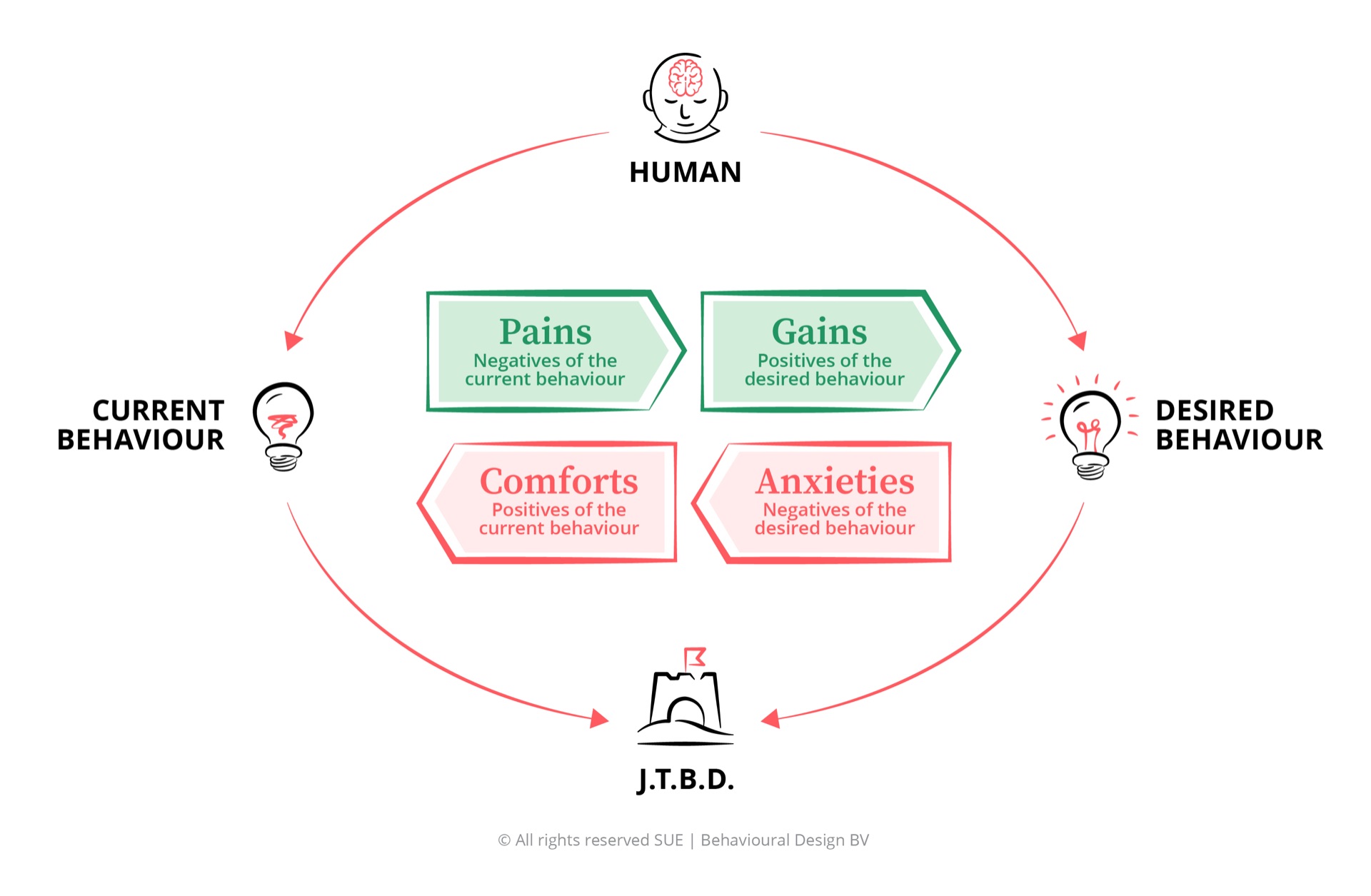
The six biases don't operate in isolation. They reinforce each other in a pattern made visible by the SUE Influence Framework. The Framework describes four forces that drive every behaviour: Pains, Gains, Anxieties and Comforts. In recruitment decisions, Comforts and Anxieties consistently dominate, and that is precisely why biases prove so persistent.
Comforts drive the system. Forming a first impression takes little energy. Extrapolating a halo is mentally cheap. Scanning a CV for name and educational institution produces an answer in seconds. Hiring managers and recruiters operate under time pressure and cognitive overload. Their brains reach for the shortcuts that keep the work feasible. The Comfort of a quick verdict is the engine behind every bias.
Anxieties reinforce the pattern. Disagreeing with a group verdict in a panel discussion feels socially risky. Hiring a candidate who doesn't resemble the existing team feels uncertain: what if it doesn't work? Fear of the wrong choice drives people back to what is recognisable. Under equal doubt, the candidate who looks like the team wins, not because they are better but because they are more comfortable.
Pains are real but delayed. A wrong hire leads to a misfit, an early exit and an expensive restart. But that pain only manifests months later and is rarely traced back to the specific biases that drove the choice. Nobody says in the exit interview: 'we hired this person because we unconsciously anchored on his previous salary.'
Gains are abstract. More diverse teams perform better, prove more innovative and have higher employee engagement. But those benefits don't feel real in the moment a hiring manager assesses an individual candidate. The abstract good loses out to the concrete easy.
This is the classic pattern. Concrete forces in the moment of the decision (Comfort and Anxiety) beat abstract forces over the long term (Pain and Gain). Awareness does not break this pattern. Process design does, because process design removes the Comforts and lowers the Anxieties by making the right action the easiest one.
Eight interventions that make recruitment bias-resilient
The Behavioural Design line is unambiguous: change the environment, not the person. For recruitment that means eight concrete interventions, each of which structurally neutralises a specific bias.
1. Write job adverts in gender-neutral language. Use tools such as Textio or Gender Decoder to check the linguistic colour of your adverts. Strip out masculine-coded words where they are not functional. Cut the number of 'must-haves' to three and explicitly label the rest as 'learnable'. This widens the funnel before you ever reach selection.
2. Use blind CV screening for the first sift. Conceal name, photo, age, gender, nationality and educational institution during the first CV review. What remains is the actual experience and competency. This is one of the best-validated interventions against unconscious discrimination. The Boston Symphony Orchestra saw the share of women hired quadruple after introducing blind auditions.[6]
3. Use structured interviews with the same questions for every candidate. Every candidate gets the same set of questions in the same order. This eliminates the effect where favoured candidates get more room to shine. Use behavioural questions ('tell me about a time when...') rather than hypothetical ones ('what would you do if...').
4. Score independently per competency before any group discussion. Give interviewers a pre-defined scoring sheet per competency. Fill the scores in independently and only share them once the discussion begins. This prevents the bandwagon effect from synchronising the verdict.
5. Compare candidates side by side (joint evaluation). Bohnet's research consistently shows that candidates assessed side by side are weighed more fairly than candidates assessed one by one. Joint evaluation activates comparative facts rather than general impressions.
6. Don't ask for current salary. Use salary bands per role established before the first application comes in. Open the negotiation yourself with a concrete figure inside the band. In a growing number of jurisdictions, asking about current salary is now even illegal, which signals how damaging the anchor is.
7. Run 'devil's advocate' sessions for final decisions. Designate someone for every shortlist whose job it is to attack the favoured candidate. Not to be negative, but to ask: what would have to be true for this choice to be wrong? This breaks confirmation bias at the group level.
8. Measure your own biases through outcome data. Track how shortlists, hires and exits distribute by gender, age, background and educational institution. Patterns not explained by role requirements are likely biases. Data trumps anecdote.
Cognitive biases in recruitment and diversity: from bias awareness to inclusive recruitment design
Conversations about diversity and inclusion in HR circles often get stuck on the tension between two stories. The first story says individual recruiters are well-meaning and the problem must therefore lie elsewhere. The second story says the system is racist or sexist and individuals are therefore part of the problem. Both stories miss the point. The problem is not a matter of bad intentions or bad people. It is a matter of a process designed around System 1 instead of System 2.
Cognitive biases in recruitment are the mechanical explanation for what otherwise becomes an ideological debate. Bertrand and Mullainathan's CV experiment works because anchoring, similar-to-me and availability all play out together. Not because recruiters are racists. The mechanical lens makes the problem attackable without individuals feeling attacked. And it makes the solution technical rather than moral.
For HR leaders applying Behavioural Design for HR, this means reframing the diversity conversation. Stop communicating about values and commitments. Start showing how your job adverts get linguistic colour checks, how CVs are blind-screened, how interviews are structured and how scoring sheets are filled in before group discussion. Diversity follows from design, not from intention. And that is how every behaviour change works: culture change emerges from making behaviour possible, not from communicating values.
Frequently asked questions about cognitive biases in recruitment
What are cognitive biases in recruitment?
Cognitive biases in recruitment are the systematic thinking errors HR professionals and hiring managers make when assessing candidates. They drive which CVs are invited, how interviews are interpreted, which salaries are offered and which candidates are ultimately hired. The six most damaging are anchoring bias, the halo effect, confirmation bias, the availability heuristic, the framing effect and similar-to-me bias.
Which bias has the biggest impact on hiring decisions?
The halo effect and confirmation bias together probably have the largest impact, because they distort the entire interview. The first impression in the first two minutes colours every subsequent answer. Whatever the interviewer hears next is interpreted as confirmation of that initial impression. Structured interviews with blind scoring per competency neutralise the bulk of this effect.
Does unconscious bias training reduce discrimination in hiring?
Barely. Meta-analyses of unconscious bias training show that awareness rises but actual hiring behaviour changes very little. Iris Bohnet describes in What Works that structural interventions are far more effective: structured interviews, blind CV screening, joint evaluation, and clear assessment criteria established before applications come in.
How do you design a bias-resilient interview?
Use a structured interview format where every candidate gets the same questions in the same order. Have panel members score independently on a pre-defined scale per competency before any group discussion. Compare candidates side by side (joint evaluation) rather than separately (separate evaluation). Where possible, conceal demographic data during the CV screening phase.
What is similar-to-me bias and how do you spot it?
Similar-to-me bias is the tendency to rate candidates higher when they resemble the interviewer in background, education, hobbies or communication style. You spot it through phrases like 'good chemistry', 'fits the team', 'culture fit' that are not anchored in specific observed behaviours. It is one of the leading causes of homogeneous teams and the opposite of inclusive recruitment.
How do you prevent anchoring bias in salary negotiations with candidates?
Set salary bands per role profile in advance, decoupled from the candidate's current pay. Don't ask for current salary during the recruitment process; that figure automatically becomes the anchor for the offer. Open the negotiation yourself with a concrete figure inside the band rather than waiting for the candidate to name an expectation.
Conclusion: from bias awareness to bias-resilient recruitment design
The six biases this article lays out are not the fault of individual HR professionals or hiring managers. They are the mechanical consequences of a System 1 that reaches for shortcuts under uncertainty. That realisation is both freeing and confronting. Freeing because the problem isn't about morality. Confronting because the standard solution of the past fifteen years (awareness training) is provably insufficient.
The Behavioural Design route is fundamentally different. Stop investing in training that tells people what they shouldn't do. Start redesigning the processes in which the biases arise. Job adverts get checked for linguistic colour. CVs get blind-screened. Interviews are structured. Scoring sheets are filled in independently before group discussion. Salary conversations are decoupled from current pay. Outcome data gets measured and fed back.
Want to learn how to apply this fully in your own organisation? In the Behavioural Design Fundamentals Course you learn to apply the Influence Framework and the SWAC Tool to diagnose and redesign HR processes, from recruitment to onboarding to retention. Rated 9.3 by 10,000+ alumni from 45 countries, including hundreds of HR professionals who apply the same Framework daily to their own recruitment.