Design Sprint vs Behavioural Design Sprint: what's the difference?
Both involve a team locked in a room for two to five intense days. Both promise to move faster than any regular project meeting. Both end with something you can actually use. And yet the Design Sprint and the Behavioural Design Sprint solve fundamentally different problems.
I get asked about this regularly, especially from product managers and innovation leads who have done a Design Sprint and want to know whether the Behavioural Design Sprint is "basically the same thing, but for behaviour change." It is not. Understanding the difference will tell you exactly which one you need, and when.
Short answer: The Design Sprint asks does this solution work? The Behavioural Design Sprint asks why are people not using what already exists? Same format, completely different question.
| Dimension | Design Sprint (GV) | Behavioural Design Sprint |
|---|---|---|
| Duration | 5 days | 2 days |
| Core question | Does this solution solve the problem? | Why aren't people doing the desired behaviour? |
| Starting point | Unknown solution, known problem | Known solution, adoption failing |
| Scientific basis | Design methodology | Behavioural economics, cognitive psychology |
| Method | Map, sketch, decide, prototype, test | Influence Framework: diagnose behavioural forces, design interventions |
| Output | Tested prototype | Validated behavioural intervention |
| When to use | Early product development | After launch, when adoption stalls |
What is the Design Sprint?
The Design Sprint was developed by Jake Knapp while he was at Google Ventures, and popularised through the 2016 book Sprint.[1] The idea is simple and powerful: instead of spending months building a product to discover it does not work, you compress the learning into five days. You build a prototype on Thursday. You test it with real users on Friday. By Friday afternoon you know whether your core assumption holds.
The five phases are: Map the problem and choose a target. Sketch competing solutions. Decide which solution to test. Prototype just enough to look real. Test with five users and observe what breaks.
The Design Sprint excels at reducing risk in the early stages of product development. You do not know yet what to build. You have a hypothesis. The sprint tests it cheaply before any significant investment is made. This is enormously valuable for product teams, startups, and innovation labs who need to move fast and learn faster.
But the Design Sprint contains an assumption that is rarely stated out loud: if the prototype tests well, users will adopt the real product. That assumption is frequently wrong. And when it is wrong, you need a different kind of sprint.
What is the Behavioural Design Sprint?
The Behavioural Design Sprint is a 2-day in-company process developed by SUE Behavioural Design, rooted in behavioural economics and cognitive psychology. Where the Design Sprint starts from a blank slate - "we do not know yet what to build" - the Behavioural Design Sprint starts from a specific failure: "we know what people should do, but they are not doing it."
The problem might be that your newly rolled-out AI tool sits unused at 20% adoption. That a health behaviour campaign is well understood but produces no change. That a new organisational process keeps being worked around. That customers abandon a checkout flow you designed carefully and user-tested thoroughly.
The Behavioural Design Sprint uses the SUE Influence Framework to map the four forces that govern behaviour: the Pains that push people away from their current behaviour, the Gains that pull them towards the desired behaviour, the Comforts that keep them locked in what they already do, and the Anxieties that hold them back from changing. The output is not a prototype of something new. It is a validated intervention: a nudge, a reframe, a changed default, an architectural shift in the choice environment.[2]
The core skill trained in a Behavioural Design Sprint is not ideation. It is diagnosis. You learn to see the invisible forces that keep people locked in their current behaviour, and to design precise interventions that shift those forces.
| Criterion | Design Sprint | Behavioural Design Sprint |
|---|---|---|
| Starting question | "What should we build?" | "Why aren't people using what we built?" |
| Problem type | Solution is unknown | Adoption is failing |
| Method foundation | Design methodology (IDEO, Stanford d.school) | Behavioural science (Kahneman, Thaler, Cialdini) |
| Team focus | Ideation and prototyping | Behavioural diagnosis and intervention design |
| Day 1 activity | Mapping the problem, sketching solutions | Mapping the behavioural forces (Influence Framework) |
| Day 2 activity (final) | User testing of prototype | Designing and validating behavioural interventions |
| Best-case output | "We know what to build" | "We know why people aren't doing it and what to do" |
The core difference: building versus adopting
The best way to understand the difference is through the intention-action gap. This is one of the most robust findings in behavioural science: people consistently intend to do things they never actually do. They intend to exercise, save money, use the new software, fill in the form, adopt the process. The intention is real. The action does not follow.
The Design Sprint is designed to answer the question "should we build this?" It cannot answer "why are people not using what we already built?" because it is not designed for that question. It assumes that a well-designed, well-tested product will be adopted.
The Behavioural Design Sprint is designed specifically for the intention-action gap. It takes the desired behaviour as given and asks: what is getting in the way? The answer is almost never "people do not understand it" or "people do not want it." The answer is usually a combination of invisible psychological forces - status quo bias, loss aversion, social norms, friction - that conspire to keep people where they are.
Naming those forces precisely is the first step to removing them.
When to use which
Use the Design Sprint when:
- You have a product hypothesis you want to validate before committing to full development
- Your team is stuck on a decision and needs a structured way to explore and align
- You are entering a new market or product category and do not yet know what users need
- The central question is "what should we build?" not "why are people not using what we built?"
Use the Behavioural Design Sprint when:
- A product, process, or policy exists but adoption is far below expectation
- You have rolled out an AI tool, new process, or organisational change that is being resisted or ignored
- A campaign or communication effort is understood but is not changing behaviour
- Your team needs a shared language and method for diagnosing why people do not do what they should
- The central question is "why aren't people doing it?" not "what should we build?"
Behavioural Design Sprint
In two intensive days, your team diagnoses the behavioural barriers to your specific challenge and leaves with validated interventions ready to implement. Used by T-Mobile, Rabobank, Eneco and others.
Explore the in-company Sprint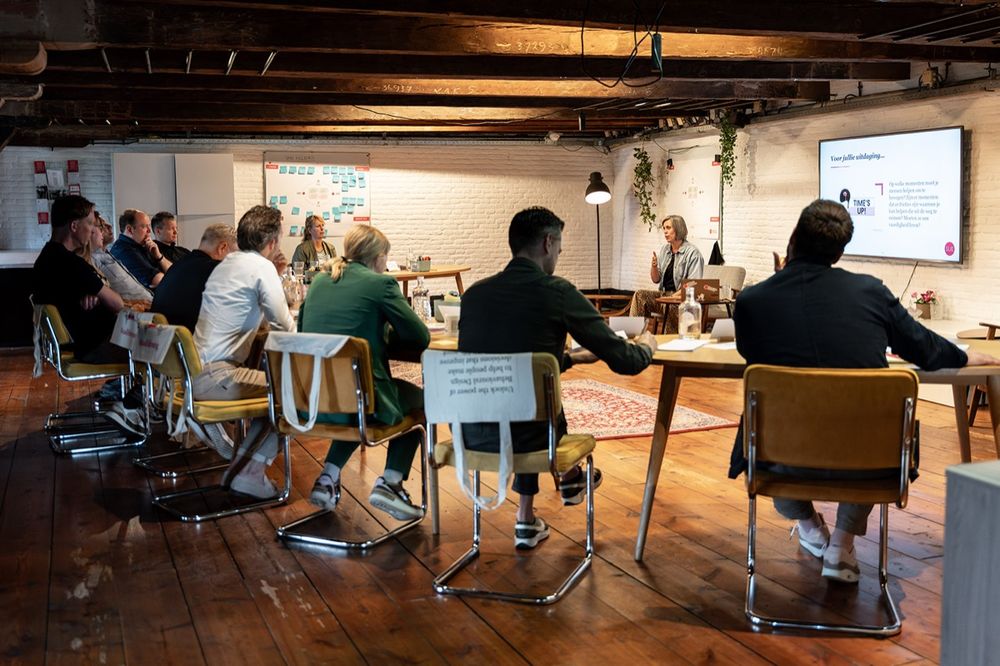
How they complement each other
The most powerful combination is to use both. The Design Sprint ensures you are building the right thing. The Behavioural Design Sprint ensures people actually adopt what you built.
Many teams discover this sequence through experience. They run a Design Sprint, build a product that tests well, launch it - and then watch adoption plateau at 15 or 20 percent. The Design Sprint told them the product was desirable. It did not tell them why people resist changing their existing habits to use it.
T-Mobile described it this way after a joint Behavioural Design Sprint with SUE: "In just one week, we took the perspective of the user together with SUE. We discovered how to simplify our T-Mobile proposition by removing human barriers. A real addition to a normal design sprint."
That is exactly what it is. Not a replacement for the Design Sprint. An addition. The Design Sprint answers the product question. The Behavioural Design Sprint answers the adoption question. Most real challenges require both answers.
The science behind the Behavioural Design Sprint
The Behavioural Design Sprint is rooted in three decades of behavioural science research. Daniel Kahneman's work on System 1 and System 2 established that most everyday behaviour is governed by fast, automatic thinking, not deliberate rational choice. Richard Thaler and Cass Sunstein showed how choice architecture - the design of the decision environment - can systematically shift behaviour without restricting freedom. Robert Cialdini documented the principles of social influence that shape whether people follow or resist.
Where the Design Sprint draws on design methodology and creative process, the Behavioural Design Sprint draws on this scientific literature. Every diagnostic category in the Influence Framework maps to a body of empirical research. The interventions it produces are not creative guesses. They are hypotheses grounded in evidence about how human behaviour actually works.
This is the critical difference for practitioners who want methods that reliably work. Design methods help you build well. Behavioural methods help you understand why people do not change even when a well-built solution is in front of them.
Frequently asked questions
What is the difference between a Design Sprint and a Behavioural Design Sprint?
The Design Sprint (developed by Jake Knapp at Google Ventures) is a 5-day process for validating product ideas before you build them. The central question is: does this solution solve the problem? The Behavioural Design Sprint is a 2-day process for diagnosing why people are not adopting a solution that already exists. The central question is: what psychological barriers are preventing people from doing the desired behaviour?
Can you use a Design Sprint and a Behavioural Design Sprint together?
Yes, and many teams do exactly this. The Design Sprint helps you build the right thing. The Behavioural Design Sprint helps you ensure people actually adopt it. Teams often use the Design Sprint in the early stages of product development, then use the Behavioural Design Sprint when adoption stalls after launch. T-Mobile described the combination as "a real addition to a normal design sprint."
When should I use a Design Sprint?
Use a Design Sprint when you have a product or feature you want to validate before building. When you need to align a team around a shared direction quickly. When you want to test a risky assumption cheaply. The Design Sprint is most valuable at the beginning of a product development cycle, before significant resources have been committed.
When should I use a Behavioural Design Sprint?
Use a Behavioural Design Sprint when a solution already exists but people are not using it as intended. When an AI tool has been rolled out but adoption is at 20 percent. When an organisational change meets persistent resistance. When a health campaign is understood but does not change behaviour. The Behavioural Design Sprint diagnoses the psychological forces that keep people locked in their current behaviour and designs interventions to shift them.
Is the Behavioural Design Sprint based on the Google Ventures Design Sprint?
No. The Behavioural Design Sprint is an independent methodology developed by SUE Behavioural Design, built on behavioural economics and cognitive psychology. Where the GV Design Sprint focuses on product validation, the Behavioural Design Sprint focuses on behaviour change: diagnosing why people resist a solution and designing evidence-based interventions to remove those barriers. The methods share a sprint format but ask entirely different questions.
Conclusion
If your question is "what should we build?", run a Design Sprint. If your question is "why are people not using what we already built?", run a Behavioural Design Sprint. Most teams eventually discover they need both.
The Behavioural Design Sprint is available as an in-company programme through SUE Behavioural Design. In two intensive days, your team leaves with a clear diagnosis of the behavioural barriers to your specific challenge and a set of validated interventions ready to implement. Explore it at suebehaviouraldesign.com/en/training/team-training.
Want to learn the underlying method yourself? The Behavioural Design Fundamentals Course teaches the Influence Framework in two days - rated 9.3 by 10,000+ professionals from 45+ countries.