Soft skills training that sticks: Why the environment matters more than the training itself
No matter how objective you try to be - and no matter how motivated you walk out of a training room - nobody is immune to falling back into old patterns. Myself included.
And that is precisely the point. Soft skills don't change because you attended a course for a day or two. They change when the environment supports the new behaviour day after day. That is not a personal failing. It is how the brain works.
Most soft skills training ignores this. It delivers knowledge and insights, then sends participants back into the same environment that kept the old behaviour in place. The result is predictable.
Soft skills training that sticks is training that doesn't only transfer knowledge - it also designs the context in which new behaviour can become automatic. Behavioural science shows that communication, collaboration and self-regulation are most durably embedded by removing barriers and building in repetition, not through awareness and motivation alone. Explore our training →
What are soft skills and why are they so hard to train?
Soft skills are the behavioural and interpersonal abilities that determine how you function professionally: communication, collaboration, giving feedback, handling pressure, empathy, self-direction. They are called "soft" to distinguish them from technical skills - but in most roles they are the decisive factor for long-term success.
The difficulty with soft skills is that they are contextual. You can learn in a safe training environment exactly how to give effective feedback. But back at your desk, in a meeting with your manager present and time pressure on your shoulders, you have the same knowledge - but your brain behaves differently.
That is not failure. That is System 1 in action. In familiar, routine situations, the automatic brain takes over. And the automatic brain uses what it knows: the old behavioural pattern.
"Knowing is something completely different from doing. That gap is not a character flaw. It is how people are built."
Why most soft skills training doesn't last
There is a structural problem with the way soft skills training is typically designed. It focuses on what people know and understand - not on how their environment drives their behaviour.
The assumption is: if someone understands why active listening matters, they will do it. If someone knows how to give feedback using the SBI model, they will apply it. If someone realises they communicate too bluntly, they will become more nuanced.
This is what we call at SUE "a recipe for disappointment." It treats people as rational actors who convert knowledge into behaviour. While behavioural science has shown for decades that this is simply not how it works.
The intention-action gap is one of the most studied phenomena in psychology. People know what they should do. They are motivated to do it. And yet they don't - or not consistently. Not because they are lazy, but because their environment rewards the old behaviour and the new behaviour hasn't been built in anywhere.
After soft skills training, someone returns to an environment with the same meeting structures, the same leadership style from their manager, the same time pressure, the same implicit norms about how you are expected to behave. That context pulls harder than two days of training.
What behavioural science tells us about soft skills
The SWAC model central to SUE's work offers a different lens for thinking about soft skills training. SWAC stands for Spark, Want, Again, Can - the four elements every behaviour requires. If any one of the four is missing, behaviour won't change.
Most soft skills training focuses exclusively on WANT: it tries to motivate and persuade people. But WANT is the most volatile element. Motivation fades quickly after the training ends. System 1 takes over.
The CAN element is the most underrated. How easy is the new behaviour in daily practice? Is there a moment in the week where giving feedback is the natural next step? Is there a format that makes it easier? Is the meeting structure designed so someone can contribute actively without social risk? If the answer to these questions is no, the most motivated participant will not sustain the new behaviour.
How soft skills training actually becomes durable
Soft skills training that sticks designs all four SWAC elements. That sounds abstract, but it translates into concrete choices.
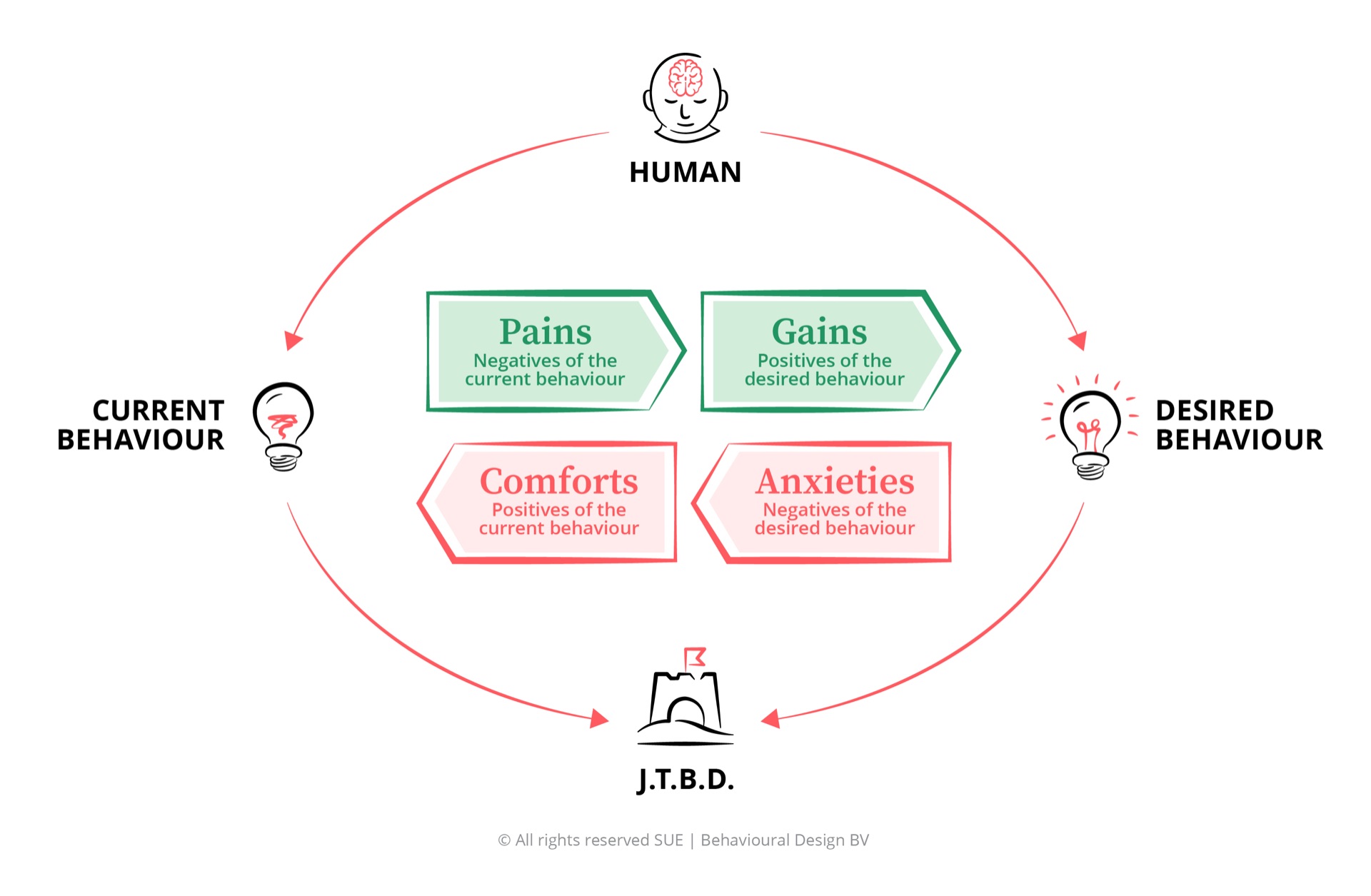
WANT: create a genuine reason to change. Not from fear of an appraisal, but from a clear picture of what the new behaviour delivers. What kind of professional do you become when you truly master this? What does it solve in your daily work? The SUE approach always starts with the specific person's pains and gains - not a generic competency list.
CAN: make the new behaviour as easy as possible. This is where most training falls short. Concretely: give people a feedback format they can use in two minutes. Build a weekly check-in that makes the new behaviour practised automatically. Remove the threshold that makes the new behaviour harder than the old one. Behaviour change is most durably embedded by repeating the simplest version of the desired behaviour - not occasionally demonstrating the most ambitious version.
SPARK: trigger the behaviour at the right moment. People don't display new behaviour spontaneously. They need a cue: a moment in the meeting where the structure invites the new approach, a reminder when it matters, a team member who leads by example. Without a SPARK, the intention stays dormant.
AGAIN: build in the repetition that forms a habit. Behavioural science shows that it takes an average of 66 days to form a habit - not 21. And missing a day doesn't need to break the chain, as long as the structure returns. For soft skills, this means: ensure there is a weekly opportunity to practise the new behaviour, with low stakes. Not the annual performance review, but the short daily stand-up.
Want to discover how to apply this for yourself or your team? Explore our individual training or learn more about how behavioural science applies to personal effectiveness.
Frequently asked questions about soft skills training
What are soft skills?
Soft skills are interpersonal and self-regulating abilities such as communication, collaboration, empathy, giving feedback and handling pressure. They are called "soft" to distinguish them from technical skills, but in most roles they are decisive for long-term success. They are harder to train than technical skills because they depend on context and habit.
Why doesn't soft skills training stick?
Because most training transfers knowledge without changing the environment. New behaviour requires the context to support it: colleagues who practise it too, managers who reward it, and situations where the new behaviour is the easiest choice. Without that context, System 1 reverts to the old automatism once post-training motivation fades.
How do you make soft skills training last?
By designing all four SWAC elements: ensure people want to change (WANT), make the new behaviour as easy as possible (CAN), trigger the behaviour at the right moment (SPARK), and build in the repetition that forms a habit (AGAIN). Any missing element is a reason the training won't stick.
What is the difference between soft skills and hard skills?
Hard skills are demonstrable technical competencies. Soft skills are behavioural and interpersonal abilities. Hard skills are more measurable, but research consistently shows that soft skills are more determinative of long-term career success. The distinction is also less sharp than it sounds.
Which soft skills training demonstrably works?
Training that works combines a behavioural science foundation, practice in real situations, and environment design. The Art of Influence© at SUE is built on this model and rated 9.3/10 by over 10,000 professionals. Browse our learning and development courses for the full overview, including in-company options for teams.