Personal effectiveness: What your teachers never told you about behaviour change
You are smart. You know what you should be doing. You have read the books, attended the training, written down the goals. And yet, a week later, you still aren't doing it.
Not because you are lazy. Not because you don't want to. But because knowledge and willpower have never been the real engine of behaviour. That is something behavioural science has made crystal clear - and something most personal effectiveness training ignores entirely.
This article explains why personal effectiveness is a design problem, and how to approach it.
Personal effectiveness means designing your environment and habits so that desired behaviour becomes automatic - without needing a conscious decision each time. Behavioural science shows that effectiveness is more a question of context than of willpower. Explore our training →
What is personal effectiveness?
Personal effectiveness is the ability to act consistently in line with your goals. That sounds simple. In practice, it is one of the hardest things there is - not because people are weak, but because their environment systematically pulls them in the wrong direction.
Most definitions of personal effectiveness centre on time management, prioritisation, focus and self-discipline. These are System 2 concepts: conscious, rational, demanding. And that is exactly the problem.
Kahneman's research showed that about 96% of our daily behaviour runs through System 1: automatic, unconscious, routine-based. System 2 - the conscious thinking we use for time management decisions - accounts for around 4% of our behaviour. A personal effectiveness training that focuses exclusively on System 2 therefore works for 4% of your behaviour. Once the training ends and the motivation peak subsides, System 1 takes over again.
"Simplicity eats willpower for breakfast."
Why most effectiveness training doesn't last
There is no shortage of personal effectiveness training. From time management courses to mindfulness retreats, from Getting Things Done to the Pomodoro technique. They all work - for a while. Then they don't.
The reason is structural. Almost all effectiveness training is built on the assumption that knowledge leads to behaviour change. If you know how to manage your time, you will do it. If you understand why focus matters, you will create it. If you realise you have been procrastinating, you will stop.
This is what behavioural science calls the intention-action gap. Knowing what is good for you is something entirely different from actually doing it. The problem is not the content of the training - it is the model of the human being underneath it. A model that treats people as rational actors who translate information into action. While System 1 runs on heuristics, routines and automatisms - not insights and good intentions.
What actually works?
The behavioural science behind personal effectiveness
The core question of behavioural science is not "how do I motivate someone?" but "how do I make desired behaviour as easy as possible?" That distinction changes everything.
Behavioural science identifies six factors that make behaviour difficult: it takes too much time, too much money, too much physical effort, too much thinking, it deviates from social norms, or it doesn't fit existing routines. Each of these is a barrier. And removing barriers is more effective than increasing motivation.
This is the core of the SWAC model central to SUE's work: Behavioural Change = Spark x Want x Again x Can. The CAN element is the most underrated. People think they need more willpower (WANT). But if the behaviour is easy enough (CAN), you barely need willpower at all.
For personal effectiveness, this means: you don't need more motivation. You need to design your environment so that desired behaviour is the default - and unwanted behaviour is something you have to actively choose.
The Influence Framework as a personal diagnostic tool
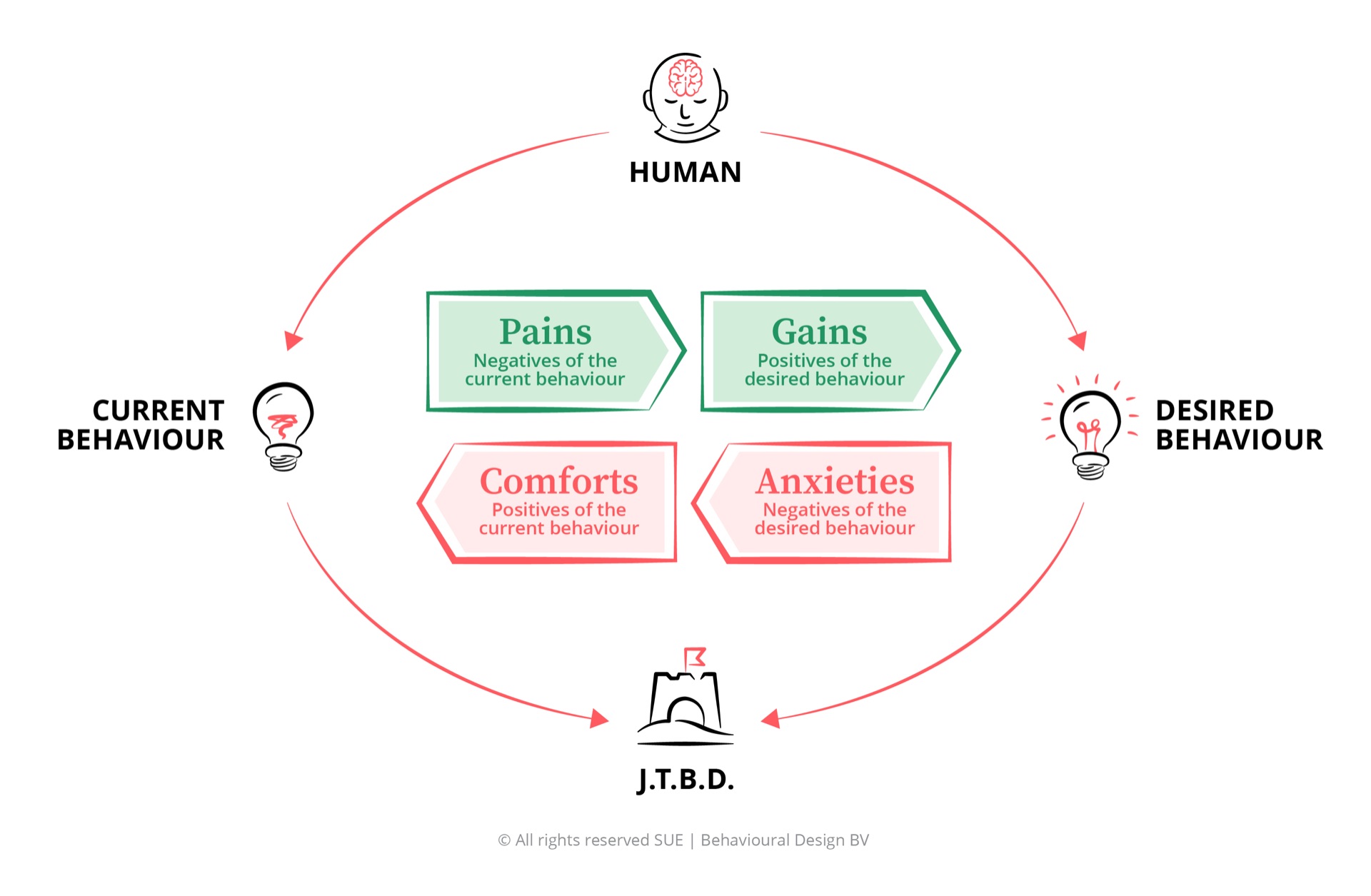
The SUE | Influence Framework was developed to understand the behaviour of others. But it works just as well as a mirror for your own behaviour.
The framework centres on four forces that determine behaviour. Pains are the frustrations of your current situation that drive you towards change. Gains are the concrete benefits the new behaviour offers you. Comforts are the positives of your current routine that hold you back. Anxieties are the doubts, uncertainties and thresholds that block the new behaviour.
If you want to increase your personal effectiveness, you first need to honestly identify which forces apply to you. Why do you keep postponing focus time? What comforts exist in your current habit of working reactively? What anxieties surround blocking your calendar? What pains are you tired of carrying?
Only once you have mapped those forces can you design targeted interventions. Not generic tips and tricks - but solutions that fit your specific pattern.
How to design personal effectiveness in practice
Three approaches that behavioural science has validated, translated into personal effectiveness.
design defaults that work for you. A default is the standard that something falls back to without an active choice. In opt-out countries for organ donation, consent rates are 80-90%; in opt-in countries, 15-30%. Not because people are different, but because the default is. Set focus time as a recurring block in your calendar. Set your phone to silent as standard during meetings. Lay your gym kit out the evening before. Each of these defaults reduces the decision load at the moment it counts.
Use implementation intentions. Research by Peter Gollwitzer shows that behaviour is 200-300% more likely to happen when you specify in advance exactly when, where and how you will do it. Not "I'm going to do more deep work" but "I write every morning from 8:00 to 10:00 at the standing desk in the quiet zone." The specificity engages System 2 once - so System 1 can take over automatically afterwards.
Make unwanted behaviour harder. This is called "sludge" in behavioural science: adding friction to behaviour you want to reduce. Want to use less social media? Remove the apps from your home screen. Want less ad-hoc email checking? Turn off notifications and make it a planned moment. The assumption isn't that you will never do it again - but that the threshold becomes high enough to deter System 1.
These are not tricks. They are interventions that address System 1 rather than System 2. And that is the difference from most personal effectiveness training you have encountered. Want to learn how to apply this systematically - to yourself, your team, and the people around you? Explore our individual training.
Frequently asked questions about personal effectiveness
What is personal effectiveness?
Personal effectiveness is the ability to act consistently in line with your goals. According to behavioural science, this is not primarily about willpower or motivation - but about designing an environment where desired behaviour becomes automatic. The easier the desired behaviour, the more effective you become.
Why doesn't personal effectiveness training stick?
Most training focuses on knowledge and motivation - System 2. But 96% of daily behaviour runs through System 1: automatic and unconscious. Knowledge without environment design doesn't change behaviour structurally. Once motivation fades, people fall back into old patterns. Effective training focuses on designing habits and context.
How do you increase personal effectiveness with behavioural science?
By designing your environment so desired behaviour is the easiest choice. Use defaults (recurring calendar blocks for deep work), implementation intentions (specify exactly when and where you'll do something), and increase friction for unwanted behaviour. Removing barriers is more powerful than increasing motivation.
What is the difference between personal effectiveness and productivity?
Productivity is about how much you do. Personal effectiveness is about whether you're doing the right things, consistently. Productivity techniques only work when they match how your brain makes decisions. Behavioural science helps you understand and use that.
Which training builds lasting personal effectiveness?
The Art of Influence© at SUE teaches professionals how behavioural science works and how to apply it. Rated 9.3/10 by more than 10,000 alumni and EQAC-certified.