Framing effect in practice: how to build the frame before you write the words
Most advice about framing arrives too late. It tells you to swap "you will lose" for "you will gain", to say 95 per cent success rather than 5 per cent failure, to lead with the benefit. All of it is true. All of it happens at the last possible moment, when the real work is already finished.
Because by the time you are choosing adjectives, the frame exists. It was built earlier, in three decisions you probably made without noticing: what people are comparing your proposal against, what sits next to it, and what they read first.
This article is about those three decisions. If you want the definition and the classic word-level techniques, we have written those up separately: what framing is and five techniques that use it, and how the framing effect plays out at work. What follows starts one step before both.
The framing effect is the finding that logically identical information produces different choices depending on how it is presented, demonstrated by Amos Tversky and Daniel Kahneman in 1981. In practice, the frame is set before the sentence: by the reference point people compare against, by the alternatives you place beside your option, and by the order in which information arrives. More on the framing effect →
A frame is a comparison, not a wording
Start with what actually happens in someone's head when they judge anything. They do not evaluate it in absolute terms. They cannot. A salary of 4,000 a month means nothing until you know what you earned last year, what your colleague earns, or what you were promised.
This is the core of prospect theory. Kahneman and Tversky showed in 1979 that people do not evaluate outcomes as final states of wealth, but as gains and losses relative to a reference point, and that losses hurt roughly twice as much as equivalent gains feel good.[1] Everything downstream, including every framing technique you have read about, is a consequence of that one mechanism.
Their most quoted demonstration makes the point sharply. In 1981 they described an outbreak expected to kill 600 people and offered two programmes. When the options were described in lives saved, 72 per cent of participants chose the certain option. When exactly the same outcomes were described in lives lost, 78 per cent chose the gamble instead.[2] Same numbers, opposite decision. Nothing changed except the reference point the wording implied.
People never judge your proposal. They judge the distance between your proposal and something else.
Which means the practical question is never "how do I phrase this?" It is "what is the something else?" And you get to choose it, or you get to inherit whichever one your audience reaches for by default.
Decision one: choose the reference point
Every message contains an implied "compared to what". Leave it unstated and people supply their own, almost always the status quo. That is the most expensive default in professional communication, because measured against the status quo, every change is a loss before it is anything else.
A concrete example. A finance team reports that costs rose by four per cent. Compared to last year, that is a failure. Compared to the eleven per cent rise across the sector, it is a strong result. Compared to the forecast the board approved in January, it might be exactly on plan. All three comparisons are honest. Only one of them will be in the room if you do not put it there.
So the first move, before drafting anything, is to write down the comparison your audience will make on their own. Then decide whether you can offer a fairer one. Three tests:
- Is it true? A reference point you cannot defend in follow-up questions will cost you more credibility than the frame earns you.
- Is it relevant to them? Sector benchmarks land with a board. They mean nothing to the team whose workload went up.
- Does it survive contact with the alternative? If naming the other comparison out loud destroys yours, you had a hiding place, not a frame.
There is a second choice hidden inside the reference point: whether you frame the attribute or the goal. Irwin Levin, Sandra Schneider and Gary Gaeth mapped this in 1998 and showed the two are not interchangeable. Attribute framing describes a thing (75 per cent lean, or 25 per cent fat). Goal framing describes the consequence of acting or not acting (do this and you gain, skip it and you lose).[3] Attribute frames shift how something is evaluated. Goal frames shift whether people move at all. Choose based on which of the two you actually need.
And on goal frames, the direction matters more than most people assume. Alexander Rothman and Peter Salovey argued in 1997 that gain frames work better for actions people experience as safe and preventive, while loss frames work better for actions that risk uncovering something unwelcome, such as a screening, an audit or an honest customer survey.[4] Beth Meyerowitz and Shelly Chaiken had already shown the pattern experimentally in 1987: women who read a loss-framed leaflet about breast self-examination were more likely to be performing it four months later than women who read the gain-framed version.[5] The rule of thumb is not "loss frames are stronger". It is: match the frame to how risky the action feels.
Decision two: choose what it sits next to
The second decision is the one most communicators never make at all: which other options are visible when yours is being judged.
Christopher Hsee demonstrated in 1996 why this changes everything. He asked people what they would pay for second-hand music dictionaries. One had 10,000 entries and was in perfect condition; the other had 20,000 entries but a torn cover. Seen on its own, the smaller pristine one attracted the higher price. Seen side by side, the larger damaged one did.[6] His explanation, the evaluability hypothesis, is simple and useful: some attributes are impossible to judge alone. Nobody knows whether 20,000 entries is a lot. Everybody knows that 20,000 is more than 10,000.
This has a direct consequence for your work. If the strongest thing about your proposal is an attribute people cannot evaluate in isolation, showing it alone wastes it. Give them the comparison that makes it legible.
The same mechanism explains why a third option changes the appeal of the first two. Itamar Simonson showed in 1989 that adding an extreme alternative makes the middle option more attractive, because a choice in the middle is easy to justify to yourself and to others.[7] This is the compromise effect, and it is the reason most price pages have three tiers rather than two.
A word of caution here, because this territory is full of confident advice that has not aged well. The related attraction effect, where a deliberately inferior decoy is added to push people towards a target option, comes from work by Joel Huber, John Payne and Christopher Puto in 1982.[8] It is one of the most repeated ideas in marketing. It is also one of the shakiest: Shane Frederick, Leonard Lee and Ernest Baskin found in 2014 that the effect largely disappeared when the options were realistic rather than abstract lists of numbers.[9] Use the compromise effect. Treat the decoy as a hypothesis you test, not a trick you rely on.
Decision three: choose the order
The third decision is sequence, and it is the cheapest of the three to get right because it costs nothing to reorder a document.
Order matters because the first number in the room becomes the anchor for everything after it. Tversky and Kahneman showed this in 1974 with an experiment that should be absurd and is not: participants watched a wheel of fortune land on a number, then estimated the percentage of African nations in the United Nations. Those who saw a high number gave systematically higher estimates.[10] An obviously random number moved a judgement that had nothing to do with it.
In practice that means the first figure in your budget document, the first option on your slide, the first example in your pitch, is not neutral information. It is the reference point for the rest of the meeting. If you open with the cheapest option because it feels modest, everything after it reads as expensive.
Sequence also decides what people evaluate jointly and what they evaluate alone. Present option A, discuss it, then present option B, and you have created two separate evaluations. Put A and B on one page and you have created a comparison. Hsee's dictionaries show those are not the same exercise and do not produce the same answer. Deciding which one you want is a design choice. Making it by accident is the norm.

The forces a frame has to move
A frame does not persuade by itself. It works when it lines up with what someone already wants and fears. The SUE | Influence Framework sorts those forces into pains, gains, anxieties and comforts, which is a useful checklist before you settle on a reference point.[11]
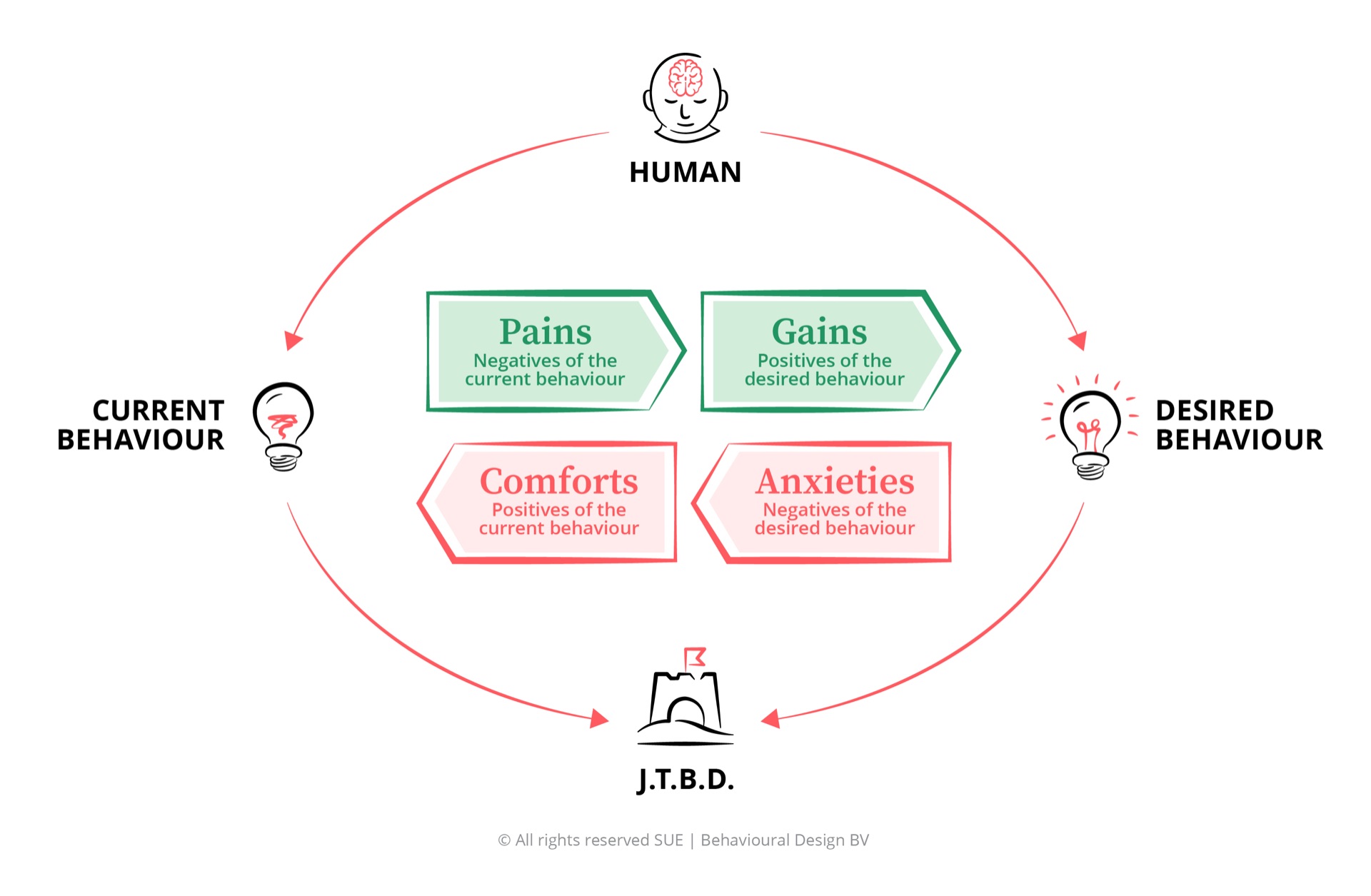
The pains tell you which reference point will be felt. If a team is drowning in handovers, framing a new system against last year's costs is irrelevant to them. Framing it against the number of handovers is not.
The gains tell you what a fair alternative comparison could be, and whether it is worth naming at all. A gain nobody wants is not a frame, it is noise.
The anxieties are where most frames quietly fail. A confident gain frame placed on top of an unspoken fear reads as spin, and once a message reads as spin the frame works against you. Name the anxiety first, then frame.
And the comforts explain the pull of the status quo reference point. It is familiar, it requires nothing, and it is what people will compare against unless you give them something better within the first two sentences.
Building a frame: a working sequence
Four steps, in this order, before you write a single sentence of the actual message.
1. Write down the default comparison
One line: "if I say nothing, they will compare this to ______." Nine times out of ten the answer is the current situation or last year's figure. Now you know what you are up against, and whether your entire message is fighting a comparison you never chose.
2. Pick the reference point you can defend
Choose the alternative comparison and stress-test it: is it true, is it relevant to this audience, does it survive someone naming the other comparison out loud? If it fails any of the three, pick another. Then put it in the first two sentences, because a reference point introduced on slide nine arrives after the judgement has already formed.
3. Decide what is visible alongside it
Two options or three. Presented together or one at a time. Your strongest attribute shown alone, or shown against something that makes it evaluable. These are separate decisions and each one moves the outcome.
4. Sequence, then write
Order the document so the anchor is the number you would want people to hold. Only now do the wording, gain or loss, attribute or goal, matched to how risky the action feels. Word choice is the last five per cent, and it only works when the previous ninety-five is in place.
One habit is worth adding to all four steps: write the opposite frame. Draft the version that argues against you, honestly, with the comparison you excluded. If your own frame still stands up next to it, you have a case. If it collapses, you have learnt something more valuable than a better sentence.
Frequently asked questions about framing in practice
What is the framing effect in practice?
In practice the framing effect is not about adjectives. It is about three design decisions you make before writing: which reference point you give people to compare against, which alternatives you place beside your option, and in what order the information arrives. The sentence only expresses a frame that those three decisions have already built.
Should I use a gain frame or a loss frame?
It depends on what you are asking people to do. Rothman and Salovey argued in 1997 that behaviours people experience as safe and preventive respond better to gain frames, while behaviours carrying the risk of finding something unwelcome, such as a screening or an audit, respond better to loss frames. Match the frame to how risky the action feels, not to your own preference.
How do you choose a reference point?
Ask what people will silently compare your proposal against if you say nothing. That default comparison, usually the current situation or last year's number, is the reference point you inherit. Choosing one deliberately means naming the comparison yourself, in the first sentence, and being able to defend it as fair.
Is deliberate framing manipulation?
There is no unframed version of a message. Every reference point, comparison and sequence is a choice, including the one you make by not thinking about it. The honest test is whether the frame you build would still hold up if you showed people the alternative frames alongside it. If it would not, you are not framing, you are hiding something.
Conclusion
The reason framing advice so often disappoints is that it is applied at the wrong moment. Rewriting a sentence cannot repair a comparison you never chose, an option shown in isolation, or an anchor set by the first number on the page.
So work backwards. Decide the comparison, decide what sits beside it, decide the order. By the time you get to the words, most of the outcome is already determined, which is exactly why the words feel so easy when the rest is right.
Want to learn how to design frames that hold up? Framing is a core part of the method you learn in The Art of Influence© online: from reference points and comparison sets to tested interventions. Rated 9.3/10 by 10,000+ professionals from 45+ countries.