How to become a behavioural designer
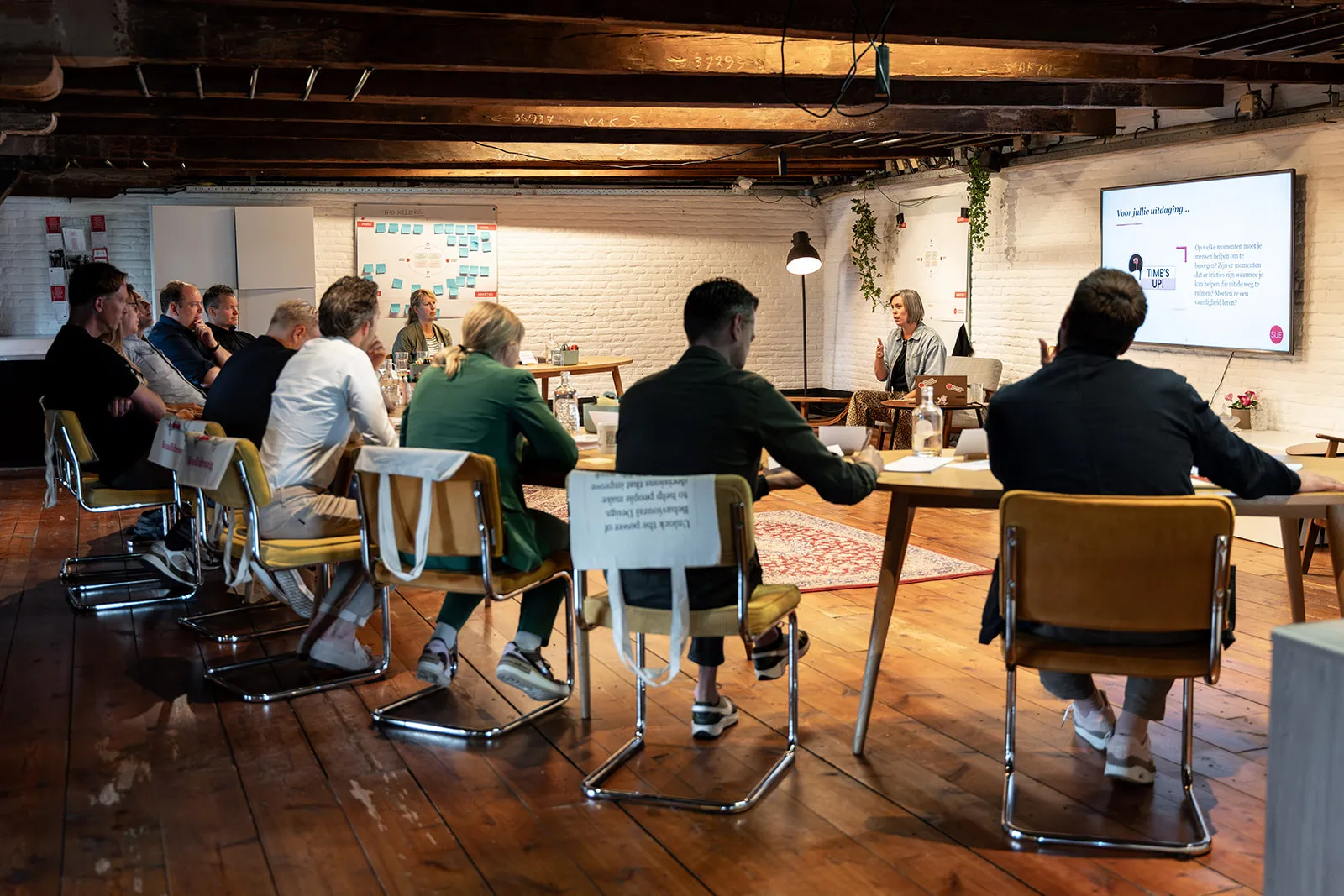
The question I get most often after a training is not about the method. It is about the step after: I want to get into this field, where do I start?
I understand the question. When Tom and I started SUE in 2009, the job of behavioural designer did not exist. There was behavioural economics, there were nudges, there were psychologists. But nobody who turned a big problem into a design question and then did something about it. We gave that gap a name. Since then, more than ten thousand professionals from 45 countries have learned with us how it works.
What has struck me most in all those years: the best behavioural designers I know do not have a psychology degree. They have a profession. And on top of that profession they learned one thing most people in their field are missing.
A behavioural designer brings a large, complex problem down to concrete behaviour and then designs the context so that the desired behaviour becomes easier than the current one. The profession combines behavioural science with a design process: observe, analyse, design interventions and test. You do not need a psychology degree for it. You do need a method. More about the SUE Behavioural Design method →
What does a behavioural designer do?
A behavioural designer takes a problem that is too big to tackle and turns it into behaviour. "People don't recycle" is not a design question. "People don't put the paper bin out on Tuesday evening" is. At that level you can look, measure and change something.
Then the designer does something most professionals skip. She does not ask how to convince people. She asks what it is in the situation that makes people do what they do now. Daniel Kahneman showed that the vast majority of our decisions run on autopilot, through what he called System 1. Fast, unconscious, steered by the environment. The conscious, reasoning brain comes in afterwards, usually to justify what has already been decided.
Look, that changes your work fundamentally. If the environment steers the behaviour, you design the environment. You put the bin in the right place at the right moment, rather than running a campaign that explains why. That difference between informing and designing is the whole profession.
"What Behavioural Designers do is take a big, complex problem, and bring it down to the level of behaviour."
- Astrid Groenewegen, The Art of Designing Behaviour (2024)
Behavioural designer or behavioural scientist?
The titles get mixed up, and that does not help when you are searching. A behavioural scientist studies and explains behaviour. A behavioural designer uses the science, but her work is only done when something in the world has changed and been measured.
| Behavioural scientist | Behavioural designer | |
|---|---|---|
| Starting point | A research question | A problem in practice |
| Typical background | Psychology, economics, sociology | A profession: marketing, HR, policy, product, healthcare |
| Core question | Why do people do this? | What do I change in the situation so they do something else? |
| End product | Insight, publication, advice | A tested intervention |
| Way of working | Research methods | A design process with behavioural science inside it |
| Proof of competence | A degree | A case that worked |
You need both. Without the science you design on gut feeling. Without the design, the science stays in the report. But if the question is how to get into the field, the second path is shorter than the first. Because you already have a profession.
Three entry routes into behavioural design
Roughly speaking there are three ways in. The first is the degree: psychology, behavioural economics, a master's in behavioural science. Solid, and long. The second is a career change from your current field. The third is a short, practical course that teaches you the method and puts you to work straight away.
What most people do not know is how small the share of the first route is. In 2020, Stephen Wendel ran a global survey for Behavioral Scientist among 324 organisations with a behavioural team. Of the people in those teams, 52 percent had a formal degree in behavioural science. So the other half did not. Of that group, 83 percent learned the field from books, 77 percent on the job, and about half through a course or online class.[1]
Half the field, then, are career changers, and that fits exactly with how the field works. A behavioural designer designs a situation in which a nurse, a customer or a civil servant starts doing something different. Whoever knows that situation from the inside has a head start you cannot get in a lecture hall.
That is what I call the missing layer in The Art of Designing Behaviour. Almost every professional I train knows an enormous amount about her own field. What she is missing is the layer underneath: how people actually decide. You add that layer. You do not have to trade your profession for it.
What does a behavioural designer need to be able to do?
In people who really master the profession you see the same five things come back. Five habits, rather than five courses.
It starts with looking instead of asking. People tell you what they intend to do, and intentions barely predict behaviour. At SUE we keep a minimum: every six weeks, two hours talking to or watching real people from your target group, about what they actually did last time. No survey can replace that.
Then, bringing a problem down to behaviour. That sounds simple and it is not. Most briefings that reach us are about "engagement", "adoption" or "awareness". A behavioural designer refuses to start until there is a concrete behaviour on the table, of a concrete person, at a concrete moment.
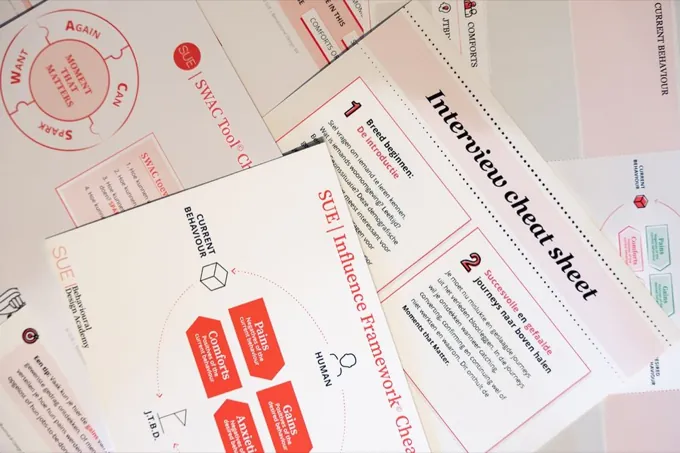
The third is analysing the forces. Why does someone do what she does now, and what keeps her from doing something else? For this we use the SUE Influence Framework. It maps four forces: the pains and gains that push towards new behaviour, and the comforts and anxieties that keep someone in the old one. Kurt Lewin showed back in the 1940s that you change behaviour more effectively by weakening the restraining forces than by pushing harder. Almost nobody does that. Everybody pushes.

The fourth is designing. From analysis to intervention, and that is where many people hit the gap. For this we use the SUE SWAC tool: behaviour happens when someone wants it (want), is able to (can), there is a trigger (spark) and it gets repeated (again). Remove one and nothing happens. The surprising part is that the strongest ideas are almost always in the "can". Making something easier beats convincing someone. Simplicity eats willpower for breakfast.
And the fifth: testing. In Wendel's survey, 69 percent of behavioural teams used A/B tests or randomised experiments to measure whether their work had an effect.[1] A behavioural designer who does not measure is a consultant with a nice vocabulary.
Where are the behavioural science jobs?
Let me be honest about the numbers: the field is small. Wendel estimated in 2020 that around 6,300 people worldwide worked in an applied behavioural team at a company or non-profit.[1] I am not going to quote a number of vacancies or a salary here, because any figure I wrote down would be a guess.
What the numbers do show is where the work sits. More than half of the teams, 55 percent, are in consulting and contracting firms. Inside organisations, teams sit mainly in data science (32 percent), product (30 percent), marketing (25 percent) and design (20 percent). HR brings up the rear with 5 percent, which is odd when you consider how much behaviour passes through there every day.
And then the figure that matters most to me. Of all the people applying behavioural science, 38 percent do so from another discipline, without the job title. They are product managers, policy advisers, communication professionals, and they design behaviour. The vacancy "behavioural designer" is rare. The job in which you do it is everywhere.
I see the same pattern in our alumni. Most simply go back to their own department after the course and become the person there who is first to ask: which behaviour do we actually want, and why is it not happening now? That is the role, with or without a new business card.
"If you want to become a prime Behavioural Designer, you need to fall in love with the problem."
- Astrid Groenewegen, The Art of Designing Behaviour (2024)
The logical next step
If you have read this far, you know enough to start. Pick one problem from your own work. A campaign that does not land, a process nobody follows, a tool nobody uses. Bring it down to behaviour. Talk to three people who are not doing it now. Look for the anxiety, not the argument.
Only: whoever tries that on their own usually ends up collecting loose nudges and biases and gets stuck at "interesting". What you need is one complete method, from analysis to intervention, that you keep using afterwards. That is what we built The Art of Influence© online for. Thirty-three lessons at your own pace, the SUE Influence Framework and the SUE SWAC tool, applied to your own case, with lifetime access. The first lesson is free, so you can see whether the method fits you before you decide.
What you do after that decides whether you are in the field. A certificate does not make you a behavioural designer. You become one the first time someone else does something different because you changed the situation.
Frequently asked questions about becoming a behavioural designer
Do you need a psychology degree to become a behavioural designer?
No. According to Stephen Wendel's global survey for Behavioral Scientist (2020), 52 percent of people working in applied behavioural science have a formal degree in the field. The other half learned it from books (83 percent), on the job (77 percent) or through a course. A background in marketing, HR, policy or product is often an advantage, because you know the situation you want to change.
What is the difference between a behavioural designer and a behavioural scientist?
A behavioural scientist studies and explains behaviour, usually from an academic background. A behavioural designer uses that knowledge to design a context in which the desired behaviour becomes easier, and tests whether it works. The scientist delivers the insight, the designer the intervention.
Where do behavioural designers work?
According to Wendel (2020), 55 percent of behavioural teams sit in consulting and contracting firms. Inside organisations, teams sit mainly in data science, product, marketing and design. A further 38 percent of practitioners apply behavioural science from another discipline, without the job title. There are no reliable counts of vacancies or salaries for individual countries.
How long does it take to become a behavioural designer?
You can learn the method in a few days. You learn the profession by applying it. Career changers have enough evidence to carry the role internally after their first own case.
What is the best first step?
Learn one complete method and apply it straight away to a problem from your own work. The Art of Influence© online from SUE is built for that: 33 lessons at your own pace, the SUE Influence Framework and the SUE SWAC tool, applied to your own case. The first lesson is free.