You have asked, rewarded and repeated. Nothing changes.
You asked them to put their shoulders to the wheel. You dangled a bonus, organised a team day and repeated in every meeting why this matters. For a while it seemed to work. Then it slid back to where it was.
So you go looking: how do you motivate employees? Most answers are lists. Give compliments, set goals, celebrate wins. None of it is wrong. You have just already done it.
The question itself puts you on the wrong track. It assumes motivation is something you put into people. What you can actually influence is something else: the situation in which someone does their work. That is where it is decided whether people get moving and keep moving.
Motivating employees rarely works by asking, rewarding or repeating. That produces movement for as long as you push. People are motivated by the work itself: achieving something, carrying responsibility, growing and being able to choose. As a manager you motivate by changing the situation and removing what slows people down. Also read the guide to employee engagement →
How do you motivate employees?
You motivate employees by arranging the work and the circumstances so that people get moving of their own accord. That is a different answer from the one most managers expect. They look for what they can say or give. The answer lies in what they can change and take away.
The difference is practical. If you try to motivate, you focus on the person: a conversation, a compliment, a reward. If you change the situation, you look at the task, the room to decide, the obstacles along the way and what colleagues do. The first you have to keep repeating. The second keeps working when you are not there.
That makes motivating staff less a matter of inspiring and more a matter of designing. It is also fairer to your team. You assume people want to work, and you find out what is getting in the way right now.
Why do asking, rewarding and repeating not work?
Asking, rewarding and repeating do not work for long because they produce movement and not motivation. Psychologist Frederick Herzberg made that distinction in 1968, in a Harvard Business Review article with a title that still fits: one more time, how do you motivate employees?[1]
Herzberg had a name for everything a manager does to get someone moving: KITA, short for a kick in the pants. The negative version is pressure. The positive version is the reward you hold out. On the first he is brief:
"Negative KITA does not lead to motivation, but to movement."
Frederick Herzberg, Harvard Business Review (1968)
On the second he is just as strict. You can charge someone's battery, he writes, and then recharge it, and recharge it again. You can only speak of motivation when someone has a generator of their own. Then no outside stimulus is needed.
His article rests on research among 1,685 employees from twelve different investigations. They were asked about moments when they had been extremely satisfied or dissatisfied with their work. It turned out that satisfaction and dissatisfaction have different causes. Of the factors that contributed to satisfaction, 81 per cent were motivators: achievement, recognition for it, the work itself, responsibility, growth. Of the factors behind dissatisfaction, 69 per cent fell into another group, which Herzberg called hygiene factors. Company policy and administration, supervision, working conditions, salary, status, security.
That is why your bonus worked for a while. Salary and terms of employment can take dissatisfaction away. They do not motivate.
What does motivate employees?
Employees become motivated when three psychological needs are met: competence, autonomy and relatedness. That is the heart of self-determination theory by psychologists Richard Ryan and Edward Deci of the University of Rochester, which they summarised in American Psychologist in 2000.[2] The feeling that you are capable, that you choose for yourself and that you belong.
Ryan and Deci also describe what breaks intrinsic motivation down, and that list looks suspiciously like an average working week. Threats, deadlines, directives, pressured evaluations and imposed goals. Rewards belong on it too. They refer to a 1999 meta-analysis by Deci, Koestner and Ryan, which found that tangible rewards that people expect and that depend on their performance on a task undermine intrinsic motivation for that task.
What strengthens motivation is the reverse: choice, acknowledgement of how someone feels and room to shape the work themselves.
Herzberg and Ryan and Deci worked more than thirty years apart and with different methods. They arrive at the same place. Motivation sits in the work and in the freedom to do it well. What you add from the outside works for as long as you keep adding it. You can read more in the article on intrinsic motivation at work.
Why does a motivated team still not move?
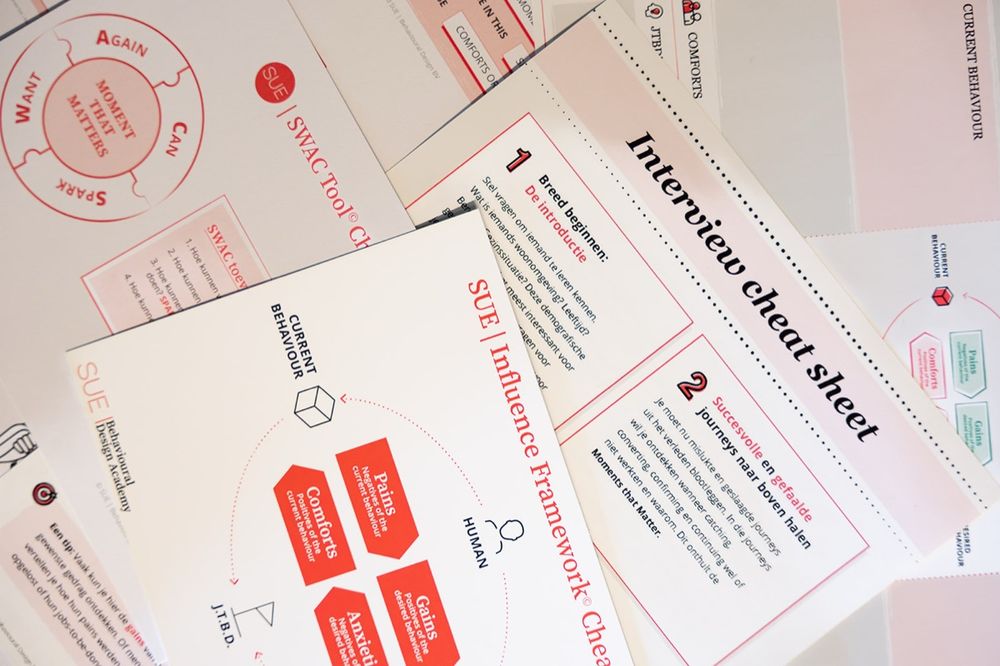
A motivated team does not move when what holds it back is stronger than what attracts it. Motivation is one side of the story. At SUE we look at both sides with the SUE | Influence Framework©, the model from Behavioural Design that maps four forces which together decide what someone does.[3]
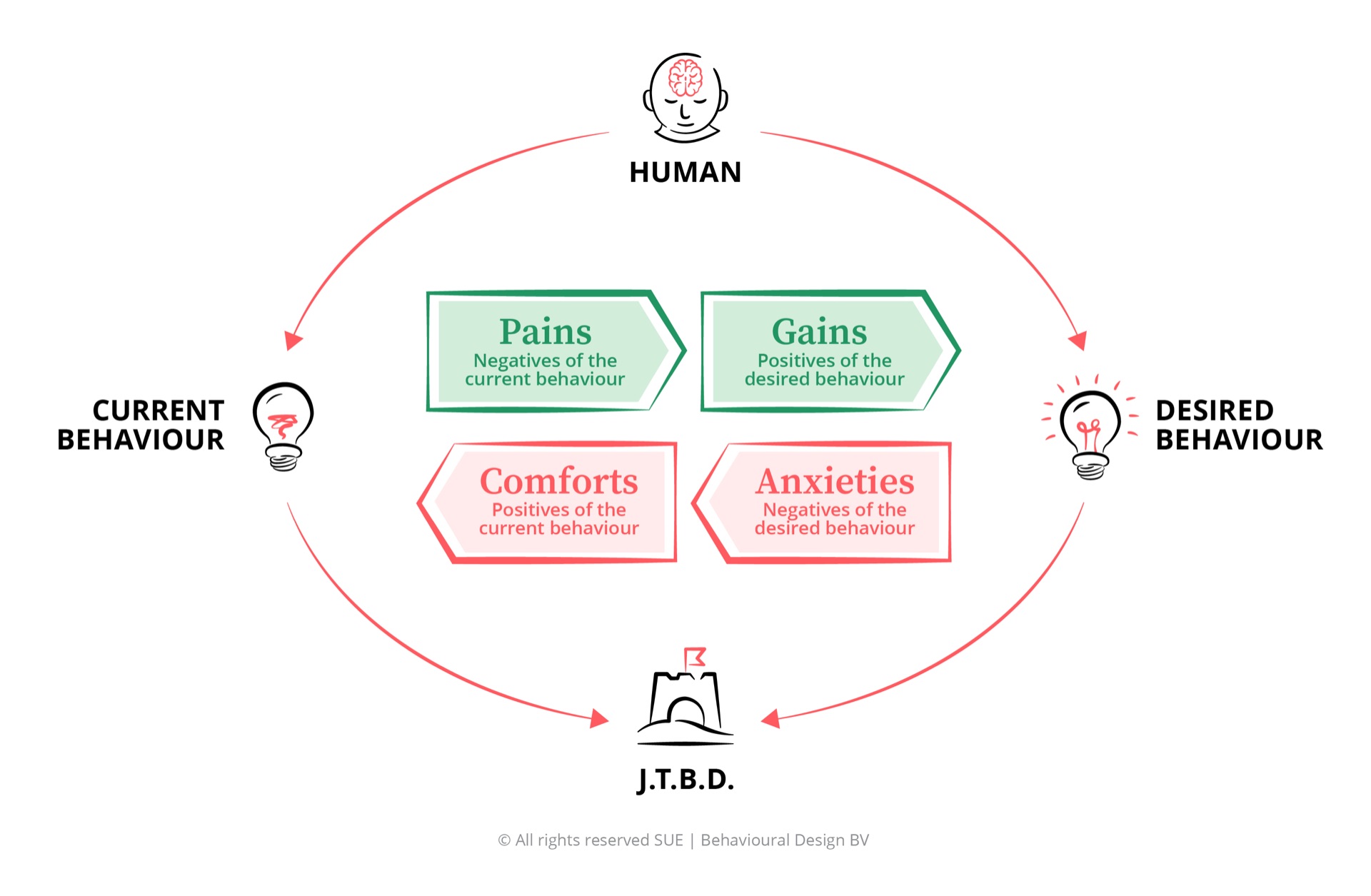
Two forces move someone towards new behaviour. The pains: what is not working now, for this person? The gains: what do they get out of it if things go differently? This is the side motivating is about, and where you have already done a lot.
Two forces keep someone with what they do now. The comforts: the current way of working takes no effort, everyone does it like this and it goes well enough. The anxieties: doubt about whether the new will work, whether it will be valued, whether it is just extra work.
In 2017 Daniel Kahneman said that the idea behind this breakdown, which comes from psychologist Kurt Lewin, was the best idea he had ever heard in psychology.[4] Behaviour is an equilibrium between driving forces and restraining forces. The good way to change it, he says, is to diminish the restraining forces. Increasing the driving forces works less well.
For anyone who wants to motivate a team, that is a liberating thought. You do not have to make your people more enthusiastic than they are. You have to find out what is slowing them down.
Keep motivating and you have to keep pushing. Remove what slows people down and you can let go.
How do you motivate a team? Five interventions
Five things you can do without a budget and without a speech.
1. Ask what makes the work heavier than it needs to be
Ask every employee the same question: what costs you the most energy without producing anything? You get a list of comforts and anxieties, and of hygiene factors that should have been fixed long ago. Visibly fix one of them.
2. Give responsibility back
Herzberg called it job enrichment. His first principle: remove controls and leave accountability for the result in place. Look at which approval, signature or intermediate step you can scrap without things going wrong.
3. Let people choose how
Fix the goal and leave the route open where you can. Autonomy is about whether someone feels they are choosing for themselves. Order, method and planning are enough for that.
4. Make progress visible
Achievement comes first in Herzberg's list of motivators, and competence is one of Ryan and Deci's three needs. Cut work into pieces that can be finished and show what has been finished. A team that only sees the end point feels nothing for months.
5. Drop the extra incentive
Take a critical look at the bonus, the competition and the reward for desired behaviour. First fix what causes dissatisfaction, such as a salary that is felt to be unfair. After that, do not expect motivation from an extra.
And if your people are motivated but not engaged?
Motivation and engagement are often used interchangeably and are not the same. Motivation is about the task: does someone want to do this work? Engagement is about the organisation: does someone feel connected to the team and to where it is heading? You can be motivated for your profession and have checked out of your employer.
What to do about that is in the guide to employee engagement. If your team does say yes and nothing happens afterwards, it is about ownership and following through. And if you run into outspoken objections, read about dealing with resistance to change.
Frequently asked questions about motivating employees
How do you motivate employees?
You motivate employees by arranging the work so that people can achieve something, carry responsibility and make their own choices. Also remove what slows them down, such as unnecessary controls and lack of clarity. According to Herzberg, asking, rewarding and repeating produce movement, not motivation.
How can you motivate a team?
You motivate a team by asking each person what makes the work heavier than it needs to be and visibly fixing part of that. Give the team a say in how the work is done and make progress visible. That lasts longer than a team day or a bonus.
How can you motivate people?
Motivating people starts with asking why they are not doing something yet. Usually the will is there and something is in the way: habit, doubt or hassle. Removing that and giving people choice achieves more than raising the pressure or the reward.
Do rewards work to motivate staff?
Rewards work temporarily. A fair salary prevents dissatisfaction, and that matters. But according to Ryan and Deci (2000), expected rewards that depend on performance undermine intrinsic motivation. Once the reward stops, the behaviour often stops too.
What is the difference between motivation and engagement?
Motivation is about the task: the desire to do the work. Engagement is about the bond with the team and the organisation. Someone can be motivated for their profession and still have little engagement with their employer. They therefore call for different approaches.
Conclusion
You asked, rewarded and repeated, and those were three ways of pushing. Pushing works for as long as you keep it up. The research by Herzberg and by Ryan and Deci points to the work itself and to the room people get in it. Lewin's idea adds that removing what holds people back achieves more than pulling harder.
That turns motivating employees into a form of influence: understanding how people choose and designing the situation so that the right behaviour is the easy route. In The Art of Influence© online you learn which forces shape behaviour and how to map them for your own team.
A team that can work unhindered does not need motivating.