Inclusive leadership: why it fails and how to design it
Count something in your next meeting. Not the ideas. The airtime. Who talks, who gets interrupted, whose suggestion quietly dies until someone more senior repeats it twenty minutes later and gets the credit.
You will probably find what most leaders find: three people fill eighty per cent of the meeting. And here is the uncomfortable part. You already knew. Everyone in the room knows. It just never changes.
Organisations respond to this with awareness. Diversity workshops, inclusion e-learning, a leadership session on unconscious bias. The intention is right. The mechanism is wrong.
Inclusive leadership is the practice of leading so that every team member can contribute, dissent and influence decisions, regardless of status or similarity to the leader. Research by Juliet Bourke (Deloitte) links it to measurably better team performance and decision quality. Crucially, it is observable behaviour, not a mindset, which means you can design it. More on leadership and behaviour →
What is inclusive leadership?
Inclusive leadership is often described as a set of values: openness, humility, curiosity. That description is true and useless at the same time. Values do not run meetings. Behaviour does.
The research is more precise. Juliet Bourke, who led Deloitte's work on this, identified six signature traits of inclusive leaders, from visible commitment to cultural intelligence. In a study with Andrea Espedido published in Harvard Business Review in 2019, teams with inclusive leaders were 17 per cent more likely to report high performance and 20 per cent more likely to say they make high-quality decisions.[1]
Look closely at what those leaders actually do, and a pattern appears: they manage who gets heard. They ask the quiet person for a view before the loud one. They credit ideas to their source. They treat dissent as information instead of friction.
Diversity is who is in the room. Inclusion is who gets heard once they are there.
That distinction matters, because researchers Robin Ely (Harvard) and David Thomas (Morehouse College) showed that diversity by itself does not improve performance. The gains only appear when teams actually use their differences: when dissenting perspectives change the conversation and the decision.[2] Which brings us to the leader. The leader controls the conditions under which that happens.
Why diversity training barely changes anything
The standard response to exclusion is education. Teach leaders about bias, and behaviour will follow. It is a reasonable theory. It is also, on the evidence, largely wrong.
Sociologists Frank Dobbin (Harvard) and Alexandra Kalev (Tel Aviv University) analysed decades of workforce data from more than 800 US companies. Their finding, published in Harvard Business Review in 2016: mandatory diversity training produced no lasting improvement in the representation of women and minorities in management. In several cases the numbers went down afterwards.[3]
Why? Because the barrier was never knowledge. Most leaders can describe affinity bias perfectly well. The barrier is that bias operates in System 1, the fast, automatic thinking Daniel Kahneman described: it fires in milliseconds, during the meeting, under time pressure, precisely when your trained good intentions are hardest to reach.[4]
Behavioural economist Iris Bohnet (Harvard Kennedy School) draws the conclusion in her book What Works: if you cannot debias people, debias the process. Change how CVs are compared, how meetings are structured, how promotion decisions get made. In her words: it is easier to change the environment than the mind.[5]
That is the shift this article makes. Stop treating inclusive leadership as a personal virtue to be trained. Start treating it as a context to be designed.
What behavioural science says about who gets heard
Three mechanisms decide who speaks and who stays silent in your team. None of them is about character.
The first is similarity. People automatically favour members of their own group, a finding that goes back to Henri Tajfel's minimal group experiments in the 1970s: even randomly assigned groups start favouring their own side within minutes.[6] In a team, that shows up as leaders giving more airtime, more credit and more stretch work to people who resemble them. Not out of malice. Out of autopilot.
The second is conformity. Solomon Asch showed in the 1950s that people will deny the evidence of their own eyes to agree with a unanimous group. A third of his participants went along with an obviously wrong answer.[7] Now add a status difference: when the most senior person speaks first, every following contribution is anchored to that opinion. The meeting has consensus before it has thinking.
The third is risk. Speaking up against the grain has an immediate, concrete social cost and an abstract, uncertain benefit. For team members with less status, the maths is worse. This is the terrain of psychological safety: the belief that dissent will not be punished. Without it, your most junior voices, often the ones closest to the customer or the problem, contribute the least.
The forces behind speaking up, and staying silent
To design inclusion, first map the forces. The SUE | Influence Framework structures them into pains, gains, anxieties and comforts.[8]
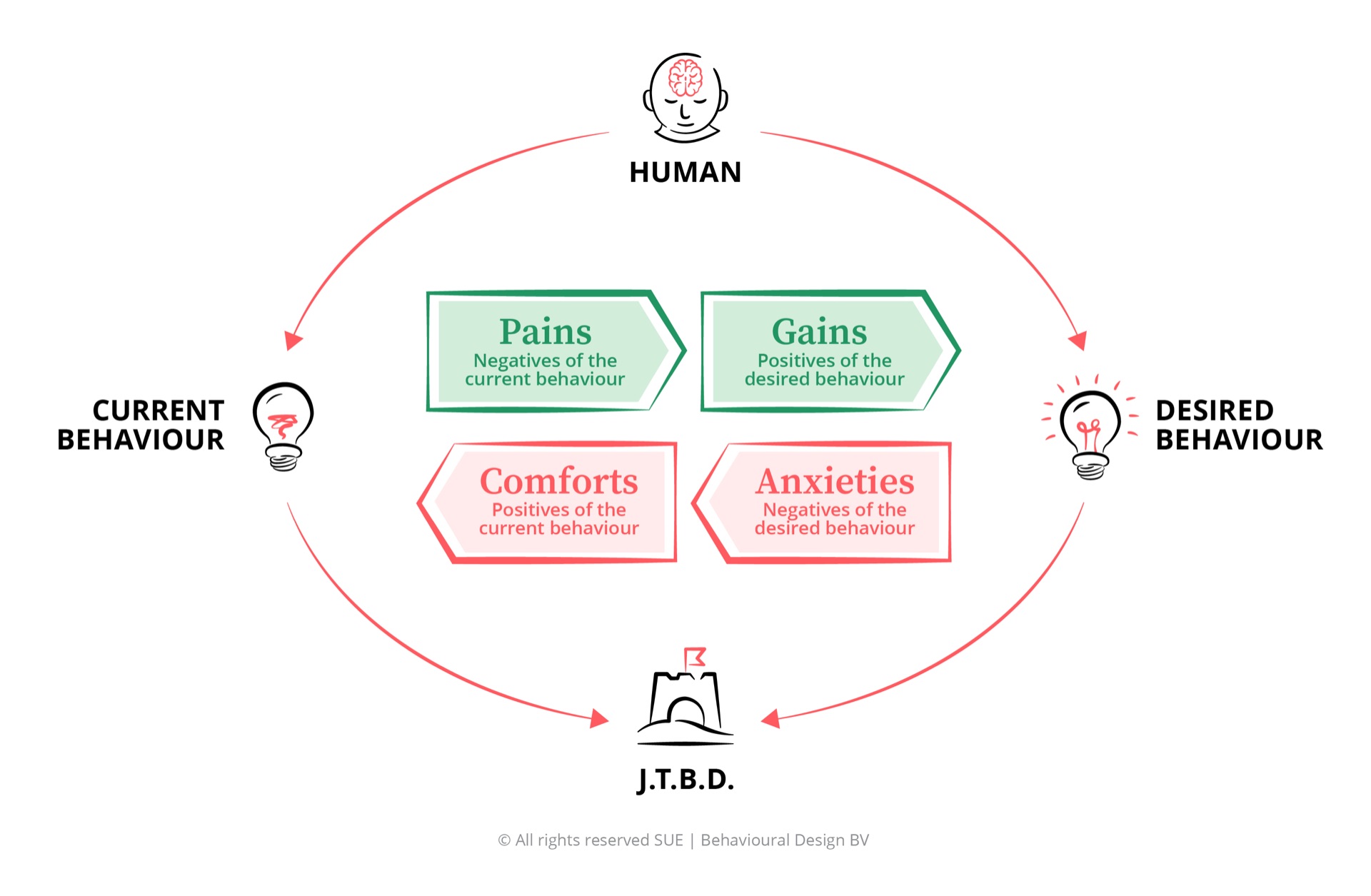
For the team member who stays quiet, the pains are real: watching worse ideas win, doing the work without shaping the direction, the slow discovery that effort does not convert into influence.
The gains of contributing are equally real but distant: better decisions, visibility, growth. Distant rewards lose against immediate risks.
The anxieties are immediate: being talked over, being the only one who disagrees, watching your point get politely ignored, again. Each experience updates the lesson: contributing here is expensive.
And the comforts of the current pattern serve everyone in the short term. The loud three keep their status. The quiet five avoid risk. The leader gets fast meetings. Exclusion is not a bug in the routine. It is the routine.
Which is exactly why another workshop changes nothing. You have to redesign the routine itself.
How to design inclusive leadership
Four interventions that change the context instead of the person. None of them requires a budget. All of them require consistency.
1. Separate thinking from talking
The classic meeting rewards speed and confidence, not quality. Change the default: let everyone write their view down for two minutes before anyone speaks. Then collect the views, quiet voices first, senior voices last. Bohnet's research is blunt about why this works: when the highest-status person speaks last, the anchor disappears and the range of ideas widens. Amazon institutionalised a version of this with written memos read in silence at the start of meetings.
2. Give credit an owner
Ideas migrate towards status: a junior suggestion becomes a senior insight within one meeting. Design against it. When staffers in the Obama White House noticed women's points being overlooked, they adopted a tactic journalists later called amplification: repeat a colleague's point, name the person who made it, until crediting stuck.[9] As a leader you can install this norm in one sentence, used repeatedly: "Building on what Sara said..." The team copies what you model.
3. Count the airtime
What you measure, you see. Pick three meetings and tally who speaks, for roughly how long, and who gets interrupted. Share the tally with the team without blame: this is our pattern, not our intention. Behaviour that is invisible feels normal; behaviour that is counted becomes a choice. Most teams adjust within weeks, because nobody actually endorses the pattern once they see it.
4. Design the response to dissent
Inclusion is built or broken in the three seconds after someone disagrees with you. A sigh, a "yes, but", a glance at the clock: System 1 in every observer registers the verdict instantly. So script your own response. First thank the dissenter for the objection, then explore it, and only then evaluate. When an objection changes your decision, say so publicly and name its source. One visible "you were right, we changed course because of you" recalibrates the whole team's maths on whether speaking up pays.
Frequently asked questions about inclusive leadership
What is the difference between inclusive leadership and diversity?
Diversity describes who is in the room; inclusive leadership determines who gets heard once they are there. A team can be diverse on paper while the same three people make every decision. Inclusive leadership is the set of behaviours, in meetings, decisions and feedback, that turns diversity into better judgement.
Does diversity training work?
Rarely on its own. Frank Dobbin and Alexandra Kalev analysed decades of data from over 800 US companies and found that mandatory diversity training often produced no change, and sometimes backfired. Awareness does not rewire automatic behaviour. Changing structures, how meetings run, how candidates are compared, how work gets allocated, does.
How do you measure inclusive leadership?
Measure behaviour, not sentiment. Track who speaks in meetings and for how long, whose ideas get built on, who gets stretch assignments, and who interrupts whom. These are observable and countable. A simple airtime tally over three meetings tells you more than an engagement survey.
How long does it take to become a more inclusive leader?
Behaviour can shift in weeks when the context changes: a round-robin in your next meeting works immediately. Reputation takes longer. Teams update their expectations after they have seen the new behaviour repeated consistently, which typically takes two to three months of visible follow-through.
Conclusion
Inclusive leadership fails when we treat it as a conviction and succeeds when we treat it as a design. The leaders in Bourke's research were not better people. They ran better rooms: rooms where thinking preceded talking, credit found its owner, airtime was visible, and dissent was rewarded in public.
Every one of those is a designable routine. Which means the honest question is no longer "do I value inclusion?" You do. The question is: what does your meeting design value?
Want to learn how to design behaviour in your team? The online Deep Dive Leading Change and Transformation teaches you to apply behavioural science to leadership: from meeting design to dissent to follow-through. Or learn the full method in The Art of Influence©, rated 9.3/10 by 10,000+ professionals.