Team development: why team building isn't enough
The team just got back from two days away. Escape room, long walk, a great dinner, conversations until midnight. Everyone was enthusiastic. "We should have done this much earlier."
Three weeks later. Same meetings. Same dynamics. Same colleague dominating every discussion, same tensions left unspoken, same pattern of pushing problems onto other departments.
Nobody had bad intentions. The off-site was genuinely good. But nothing changed. Not because of bad team spirit, and not because of a lack of motivation. It is a design problem.
Team development is a structured learning process in which teams systematically build new behavioural habits that lead to lasting collaboration, rather than attending a one-off event. Unlike team building activities, team development focuses on the behavioural patterns that determine how a team actually functions, makes decisions, and handles change. Explore team training at SUE →
What is team development (and what it isn't)?
Team building is a day or event. An activity designed to create connection, improve the atmosphere, have fun together. There is nothing wrong with that in itself. But it is not team development.
Team development is the systematic work on the behavioural patterns that determine how a team collaborates, makes decisions, handles conflict, and responds to change. It is about what a team does every day, not what they experience together once a year.
The difference lies in what you have afterwards. After a team building event you have a memory. After a well-designed team development programme you have different habits. And habits determine behaviour on Monday, Tuesday, and Wednesday - not the memory of a weekend away.
Aristotle knew this already: we are what we repeatedly do. Behavioural science confirms it. An off-site does not change what you do daily. A well-structured learning programme can - provided it is designed around repetition, context, and concrete behavioural change rather than inspiration alone.
The stages of team development: Tuckman's model
Search for team development and you almost always meet one model: Bruce Tuckman's stages. In his 1965 paper "Developmental Sequence in Small Groups", the psychologist described how teams grow through four stages. With Mary Ann Jensen he added a fifth in 1977.
Forming. The team has just come together. People are polite, tentative, working out where they fit. Little gets said that really grates. The mood is good, but shallow.
Storming. The differences surface. Who sets the direction, whose approach wins? Friction appears here, and this is exactly where many teams get stuck. Usually because nobody names the underlying conflict out loud, not because it is too big.
Norming. The team settles its agreements. Roles become clear and shared norms emerge about how you work and decide together. Irritation gives way to rhythm.
Performing. The team performs. People trust each other enough to disagree, name mistakes, and move quickly. This is the stage everyone wants to reach.
Adjourning. The fifth stage, added later: the team wraps up and disbands, for example after a project. That ending deserves attention too.
The model is useful because it makes one thing clear: friction belongs. A team in the storming stage is not a bad team, it is in a normal stage. But the model describes what happens, not how you move a team from one stage to the next. That is the trap. Teams don't progress on their own. A team can stay in storming for years, or slip back the moment a new colleague joins or the pressure rises. The stage changes only when the behaviour changes, and behaviour changes only when you redesign the environment around it. The stage model tells you where your team stands. It doesn't tell you what to do to help it grow.
Why a team building event doesn't change team dynamics
Behaviour is not driven by intention. It is driven by environment and routine. Daniel Kahneman showed that about 96% of our behaviour runs via System 1: fast, automatic, unconscious. Teams don't revert to old patterns because they don't want better. They revert because the environment is unchanged.
A team building event creates a peak - openness, connection, energy. But the moment the team returns to the normal work context, that context takes over. Same meeting structure, same hierarchy, same incentives. Behaviour adapts to the environment, not the other way around.
Informing and inspiring people changes behaviour about as much as a map makes you fit. You can get a team to think about collaboration for two days. But when they walk into the same meeting on Monday, with the same agenda and the same dominant voice at the table, everyone behaves exactly as they did the week before.
At SUE we call this a "design for disappointment": an approach built on the assumption that people act rationally once they have insights and inspiration. Whereas behaviour is the product of environment and repetition, not intention and insight.
What high-performance teams do differently
Google ran a large internal research project a few years ago to find out what distinguished their best-performing teams. Project Aristotle, they called it. The expectation was that the best teams had the smartest people, the most senior members, or the strongest managers.
That turned out not to be the case.
The most important factor was psychological safety: the feeling that you can raise an idea without being laughed at, that you can admit a mistake without it costing you your position. Amy Edmondson from Harvard describes it as the shared belief that the team is safe for interpersonal risk.
But here is the crux: psychological safety is not a trait of people. It is a trait of the environment. You cannot create it by talking about it for an afternoon. You can design it, by structuring meetings, feedback moments, and daily interactions so that safe behaviour becomes the norm, not the exception. Edmondson's original 1999 research describes exactly which team behaviours make that possible.
High-performance teams do not stand apart because of what they are, but because of what they repeatedly do. They give regular direct feedback, in a way that is psychologically safe. They discuss mistakes without looking for someone to blame. They set goals clearly and check progress frequently. They listen actively in meetings, but that is practised and agreed, not assumed. These are habits - designed, not inherited.
The four forces that hold team development back
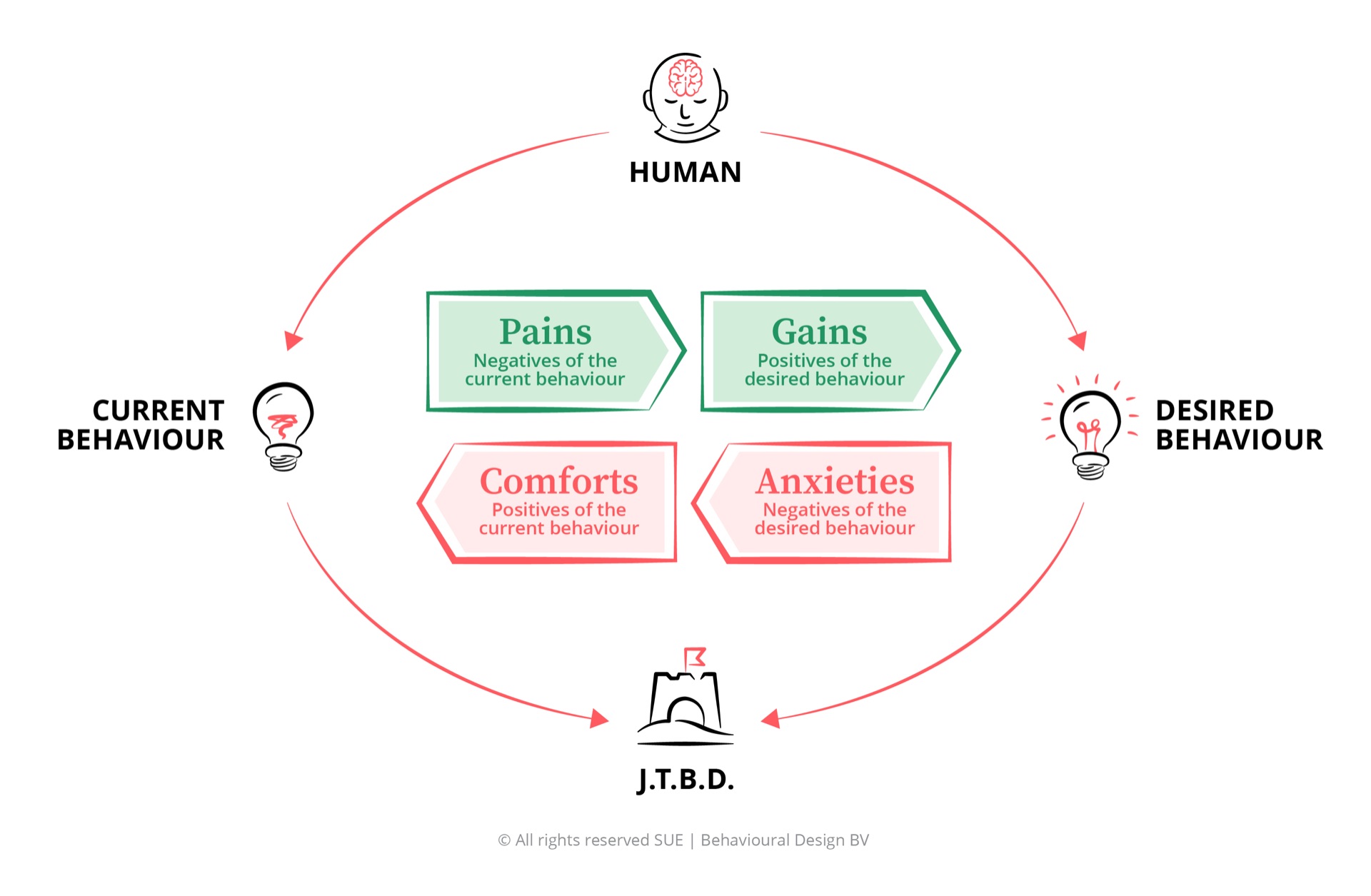
To design team development that works, you first need to understand why teams don't change. The SUE | Influence Framework looks at four forces that together determine whether behaviour shifts or not.
Pains are the frustrations driving teams toward change: the silos blocking collaboration, the meetings that produce no decisions, the loss of talent in a culture that offers no room to grow. When that pain is strong enough, a team wants something different.
Gains are the expected benefit: a team that makes decisions faster, generates more ideas, and spends less energy on internal friction. That benefit needs to be concrete and tangible, not abstract.
Comforts are the forces that keep current behaviour in place. And they are stronger than you might think. "This is just how we do things here." The annual off-site as a ritual that feels familiar and therefore good. The unspoken hierarchy in meetings that nobody questions. The familiarity with existing patterns, even when those patterns don't work.
Anxieties are the barriers to change. What if it gets uncomfortable? What if the conflict that has always simmered beneath the surface comes out? What if being vulnerable in front of colleagues gets used against me? For many teams, the fear of openness is greater than the pain of the status quo.
Lasting team development works with all four forces at once. It strengthens the pains and gains, but also resolves the anxieties. And it offers a new ritual to replace the comfort of the old one - one that can become just as familiar, but works better.
How to design lasting team development
Start with behaviour, not attitude. "We want a culture of openness" is not a goal. "Every meeting starts with two minutes of anonymous input via a shared document" is a goal. Good team development translates abstract values into concrete, observable behavioural changes.
Repetition over intensity. A one-off two-day training has less effect than six sessions of four hours spread over three months. Behaviour change is a process, not an event. It takes between two and eight months to establish a new habit - not 21 days, as popular mythology suggests. Training with follow-up days at SUE is designed exactly this way: several sessions, with assignments in between applied to the team's own work.
design the environment, not just the insights. If you want teams to give better feedback, build a feedback ritual in: a fixed moment, a fixed structure, so the desired behaviour becomes the easiest option. If you want everyone to speak in meetings, make anonymous input the default. The tool, not the intention, changes the behaviour.
Make psychological safety structural, not incidental. Not by talking about it once, but by designing meeting structures that make safe behaviour the norm. Explicit space for dissenting opinions. Discussing mistakes without naming individuals. Small adjustments to the design of the work context produce large shifts in what people feel comfortable saying.
You can't train a team into trust. You design it.
Training with follow-up days combines all these principles: teams learn the behavioural design method and apply it immediately to a real problem from their own work. That is what makes the difference: you change the team's work context while you learn.
Frequently asked questions about team development
What is the difference between team building and team development?
Team building is an activity or event focused on connection and enjoyment. Team development is the systematic work on the behavioural patterns that determine how a team collaborates, makes decisions, and handles conflict. Team building creates a memory. Team development creates new habits. For teams that want to collaborate structurally better, team building is a supplement, not the core.
What are the stages of team development?
The best-known model is that of psychologist Bruce Tuckman (1965): forming, storming, norming, and performing, with a fifth stage, adjourning, added later (Tuckman and Jensen, 1977). In the forming stage the team finds its place, in the storming stage friction appears, in the norming stage shared agreements emerge, and in the performing stage the team performs at its best. The model describes where a team stands, but not how to move it from one stage to the next. That takes deliberate behavioural change, not time alone.
Why doesn't anything change after a team building event?
Behaviour is not driven by intention but by environment and routine. After a team building event, the team returns to the same work context, with the same meeting structure, the same hierarchy, and the same incentives. That context takes over. Informing and inspiring people changes behaviour about as much as a map makes you fit. Lasting change requires redesigning the environment, not just a peak in motivation.
What is psychological safety in a team?
Psychological safety is the shared belief within a team that it is safe to raise ideas, admit mistakes, and share opinions without social or professional consequences. Google's Project Aristotle showed this was the single strongest predictor of high-performing teams. It is not a trait of people but of the environment, and you can design it through meeting structures and feedback moments. See also: psychological safety at work.
How long does an effective team development programme take?
Research shows it takes between two and eight months to establish new habits. An effective team development programme runs for at least three months, with multiple sessions spread across that period. One-off trainings lack the repetition needed for lasting behavioural change.
What is training with follow-up days?
Training with follow-up days is a team training spread over several sessions. Teams learn the behavioural design method and apply it immediately to a real problem from their own work. Not abstract knowledge, but applied experience that changes the team's work context while you learn. Rated 9.3/10 by more than 10,000 professionals.
PS
At SUE we see organisations invest in team development most readily after something has gone wrong. A team that has fallen apart, a leader who has left, results that disappoint. That is understandable. But team development works best as a preventive investment, not a last resort. A team that works well together is not a luxury. It is a design question - and one you can ask earlier than you think. Our learning and development courses are built for exactly that moment.