Three quarters of all change programmes fail. Not because the strategy is bad, but because people simply don't change from information alone. With Behavioural Design and AI, you learn to design interventions that don't just make people change, but make them want to.
Fundamentals from €1,490 · EQAC-accredited · max. 16 participants
Three quarters of all change programmes fail not because of a bad plan, but because behaviour doesn't change. When you understand how people really make decisions, you design interventions that don't just work for the first week. A proven method grounded in behavioural science, amplified with AI. The difference is never in the technology. It's in the people.
Individually, with your team, or organisation-wide: there are several ways to learn.
What is Behavioural Design for change management? Behavioural Design is the application of behavioural science to organisational change. Rather than assuming people adopt change when given good reasons, it teaches you to map what truly makes change stick or fail, and design interventions that people don't just understand, but genuinely embrace. The SUE Influence Framework gives you an evidence-based method for making change happen at scale.
Learn the fundamentals individually or go deeper. Live in Amsterdam or online at your own pace.
Train your change team together. In-company, at your location or at our Amsterdam office.
Embed behavioural thinking in your organisation with a bespoke multi-year learning and development programme.
Four shifts that change professionals name time and again after the training.
You stop trying to convince people and start changing the context. You learn to see which barriers are blocking the new behaviour and which triggers make it more appealing. You design interventions that work, even without buy-in as a starting point.
You know that people want to change but still fall back. With the SWAC Tool you learn to bridge the gap between wanting and doing. Your change plan won't get stranded at the intention-behaviour gap.
You set up the environment so the new behaviour becomes the easiest choice. You use defaults, social norms and timing. Change doesn't depend on motivation alone — it depends on a cleverly designed context.
With behavioural frameworks as your foundation you prompt AI with precision. You know which behavioural data is relevant and how to translate it into interventions. The result: stronger change plans in less time, grounded in behavioural science.
Need to convince your manager? Here's what concretely changes:
Most participants start without any prior knowledge, and that's exactly the point. The training teaches you the behavioural science you need, linked directly to your own change practice. No academic theory for theory's sake, just actionable insights you can apply the very next day in your change programmes.
Change managers are one of the biggest groups in our courses. The method gives you a scientific foundation for interventions you currently make on instinct: which barrier do you remove, which trigger do you activate, how do you design an environment that supports the new behaviour. Your change programmes become measurably more effective.
The training is most valuable for experienced change professionals. You've got the practical experience. The training gives you the scientific framework that underpins and sharpens your intuition. Many participants say afterwards: "I was already doing some of this, but now I finally understand why it sometimes doesn't work."
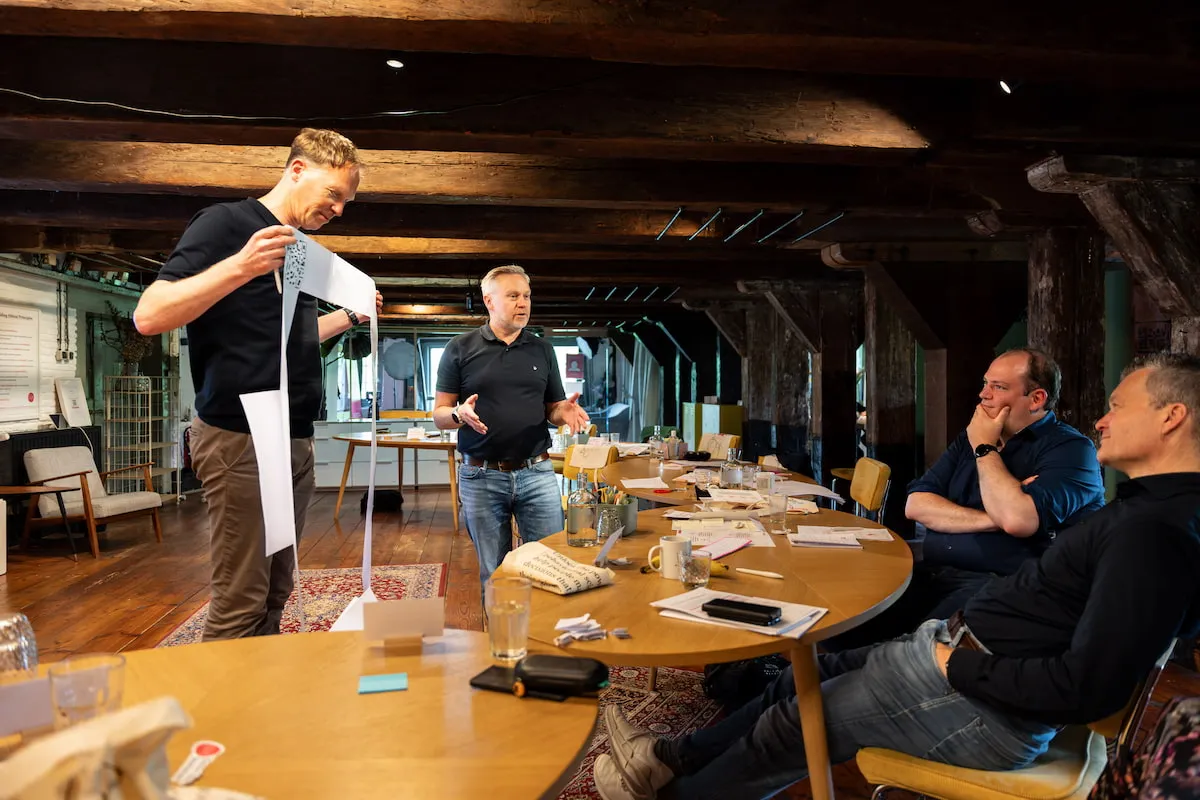
You're deliberately placed in a mixed group, with professionals from all kinds of sectors and disciplines. Change managers, HR professionals, communication advisers, policy makers and leaders sit together. A maximum of 16 participants per group. That mix is what makes the training so valuable: you don't just learn from the content, but also from how people in other sectors tackle the same challenges.
Start with the Fundamentals. It gives you the complete Behavioural Design framework: the Influence Framework, the JTBD method and all the core tools. The Advanced Course builds on that with deeper persuasion psychology and framing techniques. Without the Fundamentals, the Advanced is missing its foundation.
Yes. We invoice on your company name and the training is EQAC-accredited, which makes expensing it straightforward. The 'For your manager' section above gives you the business arguments you can use in your request.
You go home with a complete Behavioural Design Toolkit: the SUE Influence Framework Canvas, the JTBD method, cheat cards for CAN, WANT and AGAIN interventions, the Behavioural Interview Guide, Behavioural Statement worksheet, System 1 and 2 guide and the Prototyping Guide. You also get lifetime access to the BD Club, the BD x AI Guru and an EQAC-accredited certificate. At the live training there's also a follow-up session after 6 weeks.
Ready to transform your change programmes with behavioural science?
Rated 9.7/10 · 10,000+ professionals trained · max. 16 participants per group
Change rarely fails due to a bad plan. It fails because people don't come along. Learn how to bypass confirmation bias and build genuine conviction with sceptical stakeholders.
Download free ↓PDF · 20 pages · no sign-up required
Discover how to apply behavioural science in your change work. Practical insights you can use right away.
Knowledge alone doesn't change behaviour. Find out why your change message isn't landing and what to do about it.

Five behavioural principles that make your change communication more effective. From informing to activating.
Most change programmes fail at the same point. Here's what's really going wrong and how to prevent it.