Thursday 22 October 2026
You attached a consequence to the behaviour you wanted gone. Now there’s more of it
 By Astrid Groenewegen · 3 min read
 1:54
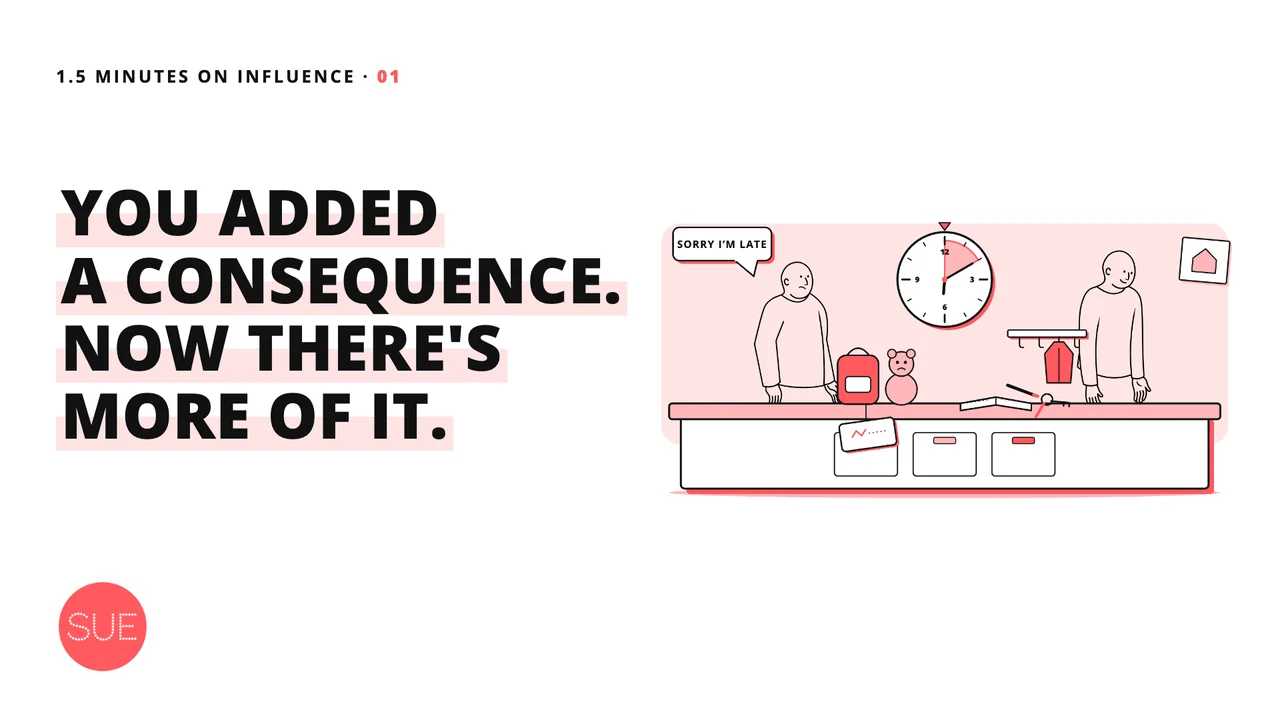
Film 1:54. Voice: an AI clone of Astrid Groenewegen’s own voice.
Read the text of the film
You attached a consequence to the behaviour you wanted gone. Now there’s more of it. This is how Behavioural Design changes that behaviour without a sanction. The obvious move is a stricter rule: make it count in the appraisal, or add more checks. Two economists tested what a fine does. In ten day-care centres in Haifa, parents kept picking up their children late.
Uri Gneezy and Aldo Rustichini brought in a fine at six of the centres. Ten shekels for anyone more than ten minutes late. The other four centres had no fine. The study ran from January to June. Late pick-ups went up. Within a few weeks, they settled at almost twice the old level. From about eight late pick-ups a week to about eighteen.
One explanation the researchers give is about guilt. Before the fine, being late was a moral matter. Parents felt bad about letting a teacher down. Our Influence Framework maps what pushes people and what holds them back. Guilt is one of the pushing forces. We call it a pain. Guilt got parents there on time. The fine turned that guilt into a price.
Parents were buying extra childcare. And when the centres scrapped the fine, the lateness stayed. At work, it’s the late timesheet that now costs a point in someone’s review. Or the missed deadline that’s tied to the bonus. Find out what keeps the behaviour in check, before you attach a consequence. If it’s guilt, show who is affected.
Name the colleague who waits for the late timesheet. A consequence can turn guilt into a price people simply pay. My name is Astrid Groenewegen, from SUE Behavioural Design, and this was 1.5 Minutes on Influence. Subscribe for the next one. And if this was useful, give it a thumbs up or share it.
Your team keeps doing the thing you want them to stop. So you attach a consequence: a point off in the review, a penalty, a target with teeth. It feels like taking control. Sometimes it does the opposite.
The clearest evidence I know comes from ten day-care centres in Haifa. In 1998, economists Uri Gneezy and Aldo Rustichini looked at a problem every parent and every childcare worker will recognise: parents picking up their children late, and teachers waiting until the last child was collected.
For four weeks the researchers simply counted. Then, in six of the ten centres, chosen at random, they introduced a fine: ten shekels per child, about three dollars, whenever a parent was more than ten minutes late. The other four centres carried on as before.
Late pick-ups went up. Not a little. Within a few weeks the six centres with a fine had settled at almost twice the number of late parents they started with. The four centres without a fine were the control group: same part of the city, same months, same weekly count, and their numbers stayed where they were. The fine was the only difference.
That matters, because it means the parents in those six centres hadn't suddenly become more careless people. Their situation had changed, and their behaviour followed the situation.
After twelve weeks the fine was scrapped, and the lateness didn't come down. It stayed at that new level.
Why would a fine increase the very behaviour it was meant to stop? The researchers offer two explanations and are careful not to choose between them. One is about information: the fine told parents exactly how bad being late could get, and ten shekels turned out not to be very bad at all. The other is the one I keep coming back to. Before the fine, being late was a moral matter. You were taking advantage of a teacher's goodwill, and most people don't like doing that. The fine changed the frame. Lateness became a service with a price, and you can buy a service without feeling bad about it.
That second explanation is uncomfortable, because it describes something organisations do every day. We take behaviour that runs on goodwill or conscience and attach a consequence to it. The late timesheet that now costs a point in someone's review. The missed deadline that's tied to the bonus. The colleague who used to hurry because someone was waiting on them now does the sum instead: one point, I can live with that.
It looks like control, but it can switch off the norm that was doing the work for free. And as the day-care centres found, removing the consequence later doesn't necessarily switch that norm back on.
In the SUE | Influence Framework© we would describe the late parent's guilt as a pain: a negative of the current behaviour that pushes people away from it. Read that way, the fine took the place of that pain rather than adding to it, which makes the consequence look stronger on paper while it grows weaker in people's heads.
So before you attach a consequence, find out what keeps the behaviour in check today. If it's guilt, don't put a price on it. Make it visible instead. Show who is affected. Name the colleague who waits for the late timesheet, so the delay has a face again rather than a cost. Mapping what holds a behaviour in place comes before designing anything that is meant to change it.
The researchers themselves note that a much larger fine would probably have reduced the lateness. Consequences can work. A small one, though, can weigh less than the guilt it replaces, and then what it mainly buys is permission.
A consequence can turn guilt into a price people simply pay.
Sources
- Gneezy, U., & Rustichini, A. (2000). A fine is a price. The Journal of Legal Studies, 29(1), 1–17. https://doi.org/10.1086/468061