Saturday 31 October 2026
Why people check out when a change drags on
 By Astrid Groenewegen · 3 min read
 2:01
Film 2:01. Voice: an AI clone of Astrid Groenewegen’s own voice.
Read the text of the film
Your change was announced months ago. Since then, only apologies. This is how Behavioural Design gets an announced change moving. You’ve probably promised, once again, that it’ll be worth the wait. Two researchers tested what keeps people hanging on while they wait. Nira Munichor and Anat Rafaeli, at the Technion in Israel, put real callers on hold.
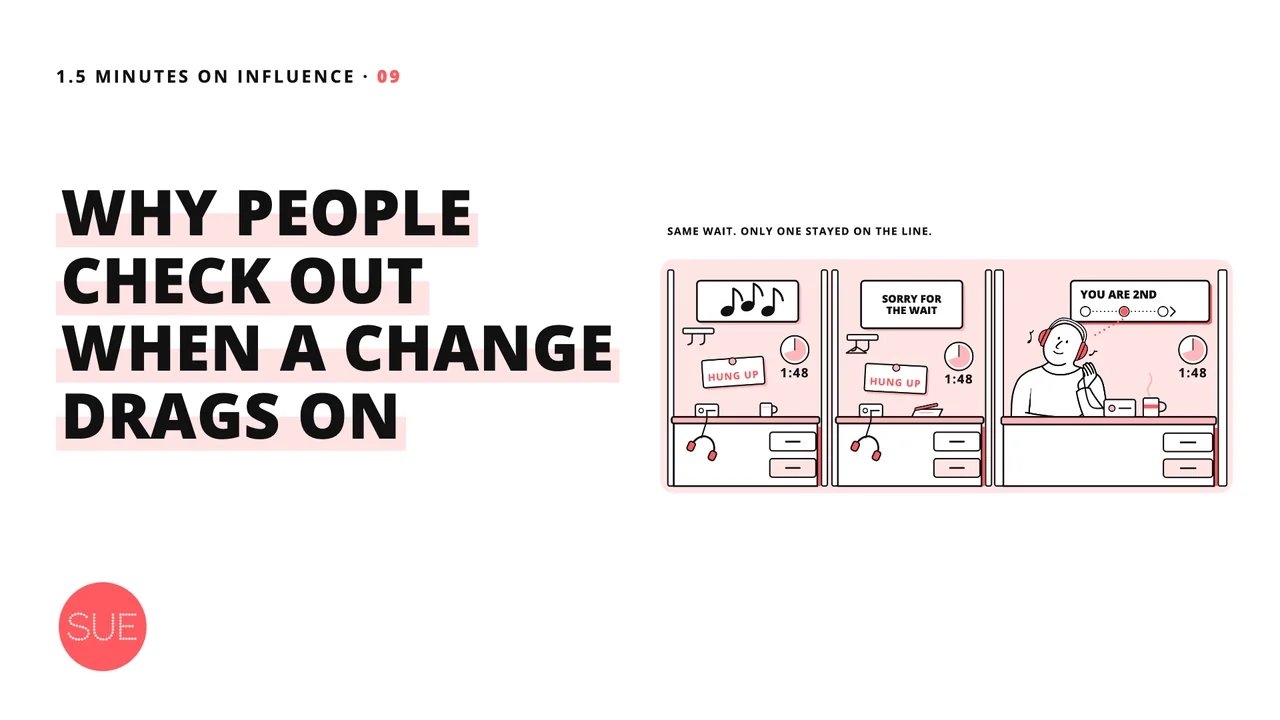
Everyone waited exactly one hundred and eight seconds. Some heard only music. For others, the music stopped three times for an apology. A third group heard their place in the queue. ’You are third in line.’ With music, sixty-nine per cent hung up. With apologies, sixty-seven per cent. Hardly any better. With their place in the queue, thirty-six per cent.
Roughly half as many people gave up on the call. Waiting without news leaves people unsure they’re getting anywhere. The wait was just as long. But knowing their place gave people a sense of progress. Our Influence Flow names Catch, Convert, Confirm and Continue, the four steps from first noticing something to sticking with it. The last step, Continue, is about whether people keep going.
With an apology, they didn’t. They hung up. Hearing their place in the queue kept them on the line. Take your own migration, or your merger. Every newsletter apologises for the delay. Nobody knows which step comes next, or when. Tell people exactly where it stands. Step three of five. Next decision on the twelfth. Your migration is a queue too.
People stay when they can see where they are in it. They hang up when they can’t tell where they are. My name is Astrid Groenewegen, from SUE Behavioural Design, and this was 1.5 Minutes on Influence. Subscribe for the next one. And if this was useful, give it a thumbs up or share it.
A while ago I sat in a municipal office, waiting to renew my passport. There was a small flyer on the wall: 'Rules for our clients'. One word jumped out at me. Clients. I could picture the strategy session where someone proposed that the municipality should treat citizens as clients rather than case numbers. A lovely intention.
Then I looked around. I had a number, and nothing else. No expected waiting time, no idea how many people were ahead of me, nothing to do but stare at the display. The hard wooden benches stood back to back, so close that strangers' hair touched. Nothing in that room said 'valued client'. The word had changed. The waiting hadn't.
In my experience, organisations do this whenever people have to wait, and change programmes are full of waiting. The reorganisation is announced, and then months go by while nothing seems to move. People check out. The new system is coming, and then it's coming a bit later. What many organisations send in the meantime is words: thank you for your patience, we're working hard on it, we'll update you soon. It's the corporate version of 'sorry to keep you waiting'.
David Maister described the psychology of waiting lines back in 1985. Uncertain waits feel longer than known, finite waits, he wrote, and anxiety makes waits seem longer still. But the most useful experiment I know on what to say to people who wait comes from Nira Munichor and Anat Rafaeli of the Technion in Israel. They published it in 2007 in the Journal of Applied Psychology, under a title that is almost a design brief: Numbers or apologies?
They used a real phone line: people calling a university lab to sign up for experiments. In this first study there were 123 real calls. Every wait was set at exactly 108 seconds, chosen to be a little longer than usual so that callers would be tempted to hang up. Some heard music the whole time. For others the music stopped three times for an apology: 'We are sorry to keep you waiting.' A third group heard where they stood, for example 'You are third in line', with the numbers kept deliberately low.
Of the callers who heard music, 69 per cent hung up before the end. With apologies, 67 per cent. With their place in the queue, 36 per cent. Of the callers who stayed on the line to the end, those who had heard their position were the most satisfied with the wait, and those who had heard apologies the least. Only 48 of the 123 callers stayed to the end, so these scores rest on a small group.
That last part surprised me most. An apology is the polite thing to do. It's also what almost every organisation does. And in this experiment it didn't keep people on the line any better than music.
A second study, with 83 participants in a simulated wait, looked at what made the difference. One explanation is that position information works because the wait feels shorter. It didn't: how long the wait felt did not differ significantly between the three. What differed was the sense of progress. People who heard their place in the queue felt they were making progress, and that sense of progress explained why they were less likely to hang up and was also linked to greater satisfaction.
In the SUE | 4C Influence Flow© this is the last step, Continue: do people keep going? Waiting without news leaves a doubt. Am I getting anywhere at all? That doubt makes Continue say no, and people drop out. A position answers it. An apology only confirms that you're still waiting. Munichor and Rafaeli studied phone queues, not change programmes. Linking their finding to Continue, and to change at work, is my own interpretation.
This is why I'm sceptical of the patience update. In my reading, people in a long change programme are perfectly able to wait. What they lose is the will to keep waiting when nothing shows them they're moving. Nicer words leave that no where it is. Their place in the line turns it into a yes. Tell them exactly where it stands: step three of five, next decision on the 12th. A real position in a real queue, even when the queue is long.
Back in that municipal office, a text message ten minutes before my turn would have done more for the word 'client' than any flyer. I'd have gone for a walk instead of watching a number display.
People hang up when they can't tell where they are.
Sources
- Nira Munichor & Anat Rafaeli (2007), "Numbers or apologies? Customer reactions to telephone waiting time fillers", Journal of Applied Psychology 92(2), 511–518. https://doi.org/10.1037/0021-9010.92.2.511
- David H. Maister (1985), "The psychology of waiting lines", in J. A. Czepiel, M. R. Solomon & C. F. Surprenant (eds.), The Service Encounter, Lexington Books, 113–123 (boekhoofdstuk, geen DOI). https://davidmaister.com/articles/the-psychology-of-waiting-lines/