Saturday 31 October 2026
You know which party will block your plan. But you may be wrong
 By Astrid Groenewegen · 3 min read
 1:33
Film 1:33. Voice: an AI clone of Astrid Groenewegen’s own voice.
Read the text of the film
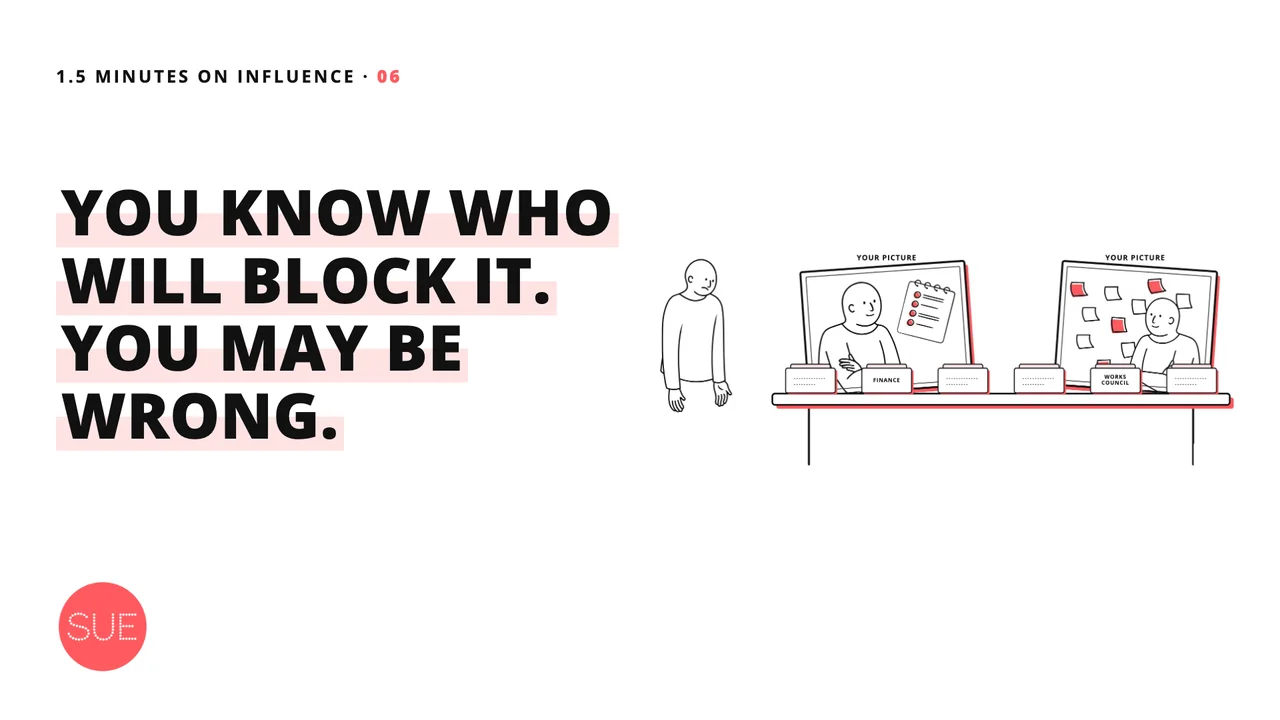
You know which party will block your plan. But you may be wrong. This is why. The usual reflex is to prepare your best arguments for the ones you expect to block it. In twenty twenty-four, Curtis Puryear, Kurt Gray and colleagues asked Democrats: how many Republicans think it’s fine to jail an innocent person? Democrats guessed more than a quarter.
Among Republicans themselves, almost none did. In a second study, people did a puzzle with a partner from the other party. Some first learned that their partner condemned the same wrongs. They asked to swap partners half as often: twelve per cent against twenty-six. We picture the other side as far worse than it is. Our Behavioural Design Method starts with insight: check what people really think, not what you assume.
Learning what their partner thought did exactly that. Now picture your own plan. The finance director you expect to block every investment. The works council you assume opposes anything new. So check your picture first. Before the agenda, find your common ground, one thing you both agree on, and name it. From there, you can negotiate. Often you’re not up against the other side.
You’re up against your picture of them. My name is Astrid Groenewegen, from SUE Behavioural Design, and this was 1.5 Minutes on Influence. Subscribe for the next one. And if this was useful, give it a thumbs up or share it.
Someone in my building wanted to hang a 'peace now' poster in our shared lobby. She emailed all of us to ask. I was perfectly fine with it. A week later she emailed again: the poster had led to heated discussions, and she would keep it to herself.
What struck me was how quickly a request most people would agree with in principle turned into a conflict. It reminded me of a paper by Curtis Puryear, Kurt Gray and their colleagues, published in PNAS Nexus in 2024.
They asked American Democrats and Republicans a simple question: how many people on the other side accept things almost everyone condemns? Child pornography. Embezzlement. Animal abuse. Wrongful imprisonment. Tax fraud. Cheating on a spouse.
The estimates were startling. Democrats thought more than a quarter of Republicans accept wrongful imprisonment. Republicans thought 15 per cent of Democrats accept child pornography. In a survey of about 700 people, matched to the US population on age, gender and ethnicity, people estimated that on average almost 23 per cent of their opponents found these wrongs acceptable, against 13 per cent of their own side. When the researchers asked partisans themselves, the real share was tiny on every one of these issues.
The researchers call this the basic morality bias: the exaggerated belief that people on the other side lack basic moral values. It isn't a disagreement about policy. It's a wrong picture of who the other person is. And it matters, because in their studies the bias went hand in hand with seeing opponents as less than human and being less willing to engage with them.
Then they tried something almost embarrassingly simple. In the fifth of their eight studies, people were told they'd play a puzzle game with a teammate, who was always a political opponent, and that they could switch to someone else. One group first saw that this teammate condemned the same six wrongs they did. Without that information, 25.6 per cent asked for another teammate. With it, 11.9 per cent, less than half as many. A larger study of 810 people, matched to the US population on several demographics, found the same direction: 16.7 per cent switched without the information, 9.8 per cent with it.
The part I like best is a pilot the researchers ran first. They asked people whether this kind of correction would change how they saw someone. Eighty per cent said it wouldn't. People underestimate what correcting a false picture does.
You don't need politics to see this at work, although the study itself is about politics and the transfer is mine. Every organisation has its parties with their own interests. The finance director you expect to block every investment. The works council you assume opposes anything new. The department you've already filed as the enemy of your plan. Before the first meeting you've built a picture of them, and you prepare accordingly: your defence, your counterarguments, your plan B.
That's why our Behavioural Design Method© starts with insight: check what people really think, not what you assume. A picture like that keeps people where they are, whether it's true or not. On both sides of the table.
So more arguments won't help. The other party often has the mandate, the knowledge and the time to work with you. What stands in the way is that they expect the worst of you, just as you expect it of them. Take that anxiety away first, and this study shows one way in.
Before the agenda, find your common ground, one thing you both agree on. The safety of clients. The jobs of the people who do the work. The quality nobody wants to give up. Name it together and put it first on the table, rather than tucking it into a warm-up round. From there, you can negotiate. It costs little time. The study tested something narrower: learning that the other person condemned the same six wrongs. Opening with common ground is my application of it, not their finding.
I never found out what was said in those lobby discussions. I'd be surprised if the people involved disagreed on as much as they assumed.
Often you're not up against the other side. You're up against your picture of them.
Sources
- Puryear, C., Kubin, E., Schein, C., Bigman, Y. E., Ekstrom, P., & Gray, K. (2024). People believe political opponents accept blatant moral wrongs, fueling partisan divides. PNAS Nexus, 3(7), pgae244. https://doi.org/10.1093/pnasnexus/pgae244