Saturday 31 October 2026
You lowered your fee. The client hired a pricier firm
 By Astrid Groenewegen · 3 min read
 1:48
Film 1:48. Voice: an AI clone of Astrid Groenewegen’s own voice.
Read the text of the film
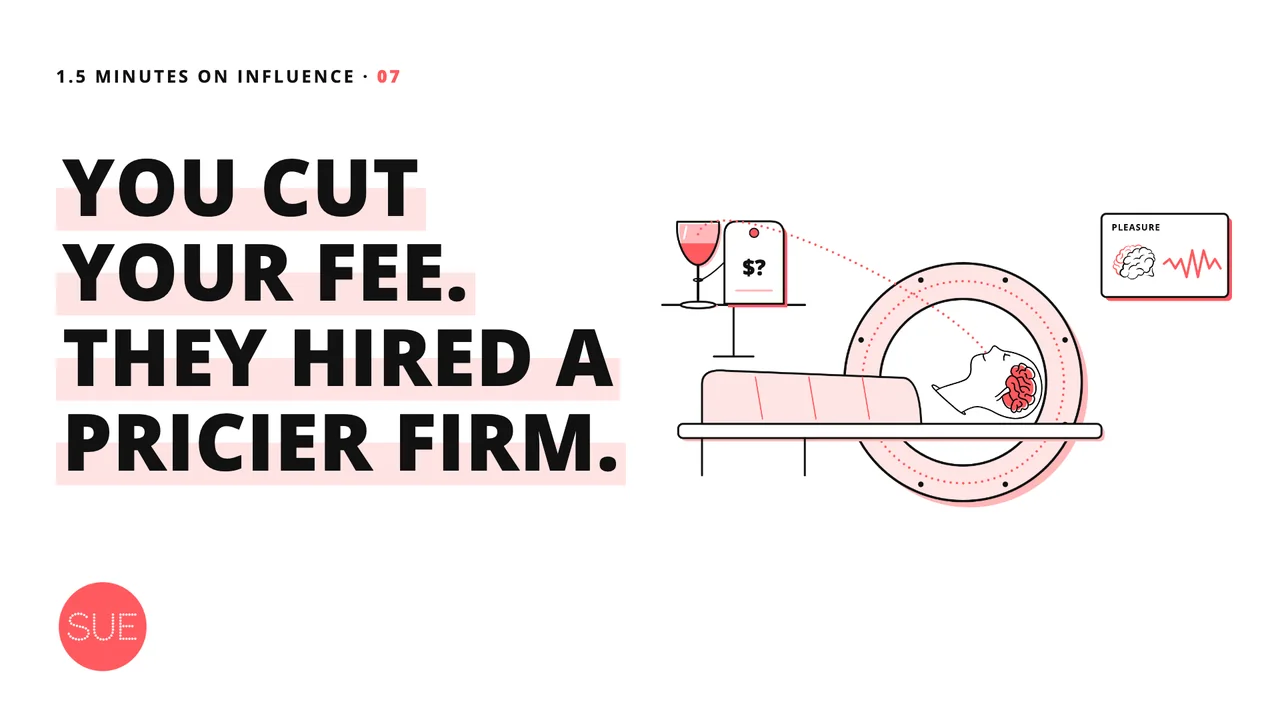
You cut your fee to win them. They still hired a pricier firm. This is how Behavioural Design makes clients value your advice. You’ve probably already lowered your next quote, and thrown in some free advice. Researchers at Caltech tested what a price does to how something tastes. Hilke Plassmann, Antonio Rangel and colleagues had twenty people taste wine in a brain scanner.
They were told it was five wines, each with its price. In fact there were three. Two were poured twice. Once labelled cheap, once labelled expensive. The same wine scored clearly higher at ninety dollars than at ten. And a brain area linked to pleasure was more active. The price changed how much people enjoyed what was in the glass. The price told people what to expect.
Expecting more, they enjoyed it more. Our Influence Framework looks at what pulls people towards a choice and what pushes them away. A high price pulls. It promises something better. We call that a gain. A low price sends the opposite signal. The study was about wine. Clients choosing between firms may well judge advice the same way. Your lower fee told them what your work was worth.
Your client opens your proposal. There’s the discount you gave before anyone asked. Next to it lies a proposal from a pricier firm. Put your full fee in the proposal, and say plainly what the client gets for it. A discount may make your proposal taste like the ten-dollar wine. My name is Astrid Groenewegen, from SUE Behavioural Design, and this was 1.5 Minutes on Influence.
Subscribe for the next one. And if this was useful, give it a thumbs up or share it.
I have something to admit: I'm a bit of a food snob. Not in the sense that I like fancy restaurants, but I do have a weakness for beautiful packaging. A few weeks ago I bought a bottle of olive oil that cost three times what I'd normally spend. I told myself it was because the quality was better. Maybe it was. But the honest truth is that the bottle is just really, really nice.
What I didn't realise at the time is that the price may have done more than justify the purchase. It may well have changed how much I enjoyed the oil.
The clearest evidence I know comes from a brain-scan study at Caltech. In 2008, Hilke Plassmann, John O'Doherty, Baba Shiv and Antonio Rangel invited 20 people who liked red wine into an fMRI scanner. They were told they would taste five different Cabernet Sauvignons, each identified only by its price, and that the study was about how flavour develops while you taste. In reality there were three wines. One was shown once at $5, its real price, and once at $45. Another was shown at $90, its real price, and at $10.
The same wine was rated clearly more pleasant when people thought it was the expensive one. The researchers point out themselves that ratings alone could be politeness: some people might not want to admit that the cheap wine tastes better. That's where the scanner comes in. When the price was higher, activity rose in the medial orbitofrontal cortex, an area widely thought to encode how pleasant an experience actually is. Their explanation: a higher price raises your expectations, and those expectations change the experience itself.
About eight weeks later, subjects tasted the wines again without prices. They then reported no difference between the wines.
So the price wasn't a label on the experience. It was part of it.
Now think about how advice is usually priced and presented. In my experience, advisers are often generous. They add an extra insight at the end of a meeting, free of charge. They knock something off a proposal before the client has asked, because they want the work. They tuck their most important recommendation into an appendix, so the report doesn't feel pushy.
Every one of those choices sends a signal about value before the client has looked at the content. The study is about wine, not advice, so this is my extrapolation. But if expectations can change how a wine tastes, I see no reason why they wouldn't change how convincing a recommendation feels.
In the SUE | Influence Framework© this is about gains: the positives people expect from the behaviour you want, in this case following your advice. Price, setting and timing all shape how big that gain feels.
That tells you where to work. Your client understands your advice and has the means to follow it. What's missing is a gain they can feel, and arguing harder about the content won't create it. Make the gain visible instead, by designing the signals around your advice: who brings the advice, in which setting, at what moment and at what price. Give the recommendation that matters most its own moment, and stop handing it out as a free extra.
None of this is manipulation. A price that's too low isn't a neutral choice. It makes a claim about value, and the client hears it.
As for my olive oil: it was probably worth the money. But even if it wasn't, the price may well have made it taste like it was.
Your price isn't on the label. It's in the glass.
Sources
- Plassmann, H., O'Doherty, J., Shiv, B., & Rangel, A. (2008). Marketing actions can modulate neural representations of experienced pleasantness. Proceedings of the National Academy of Sciences, 105(3), 1050–1054. https://doi.org/10.1073/pnas.0706929105