Saturday 31 October 2026
Your plan is sound. The other side rejects it on sight
 By Astrid Groenewegen · 3 min read
 1:46
Film 1:46. Voice: an AI clone of Astrid Groenewegen’s own voice.
Read the text of the film
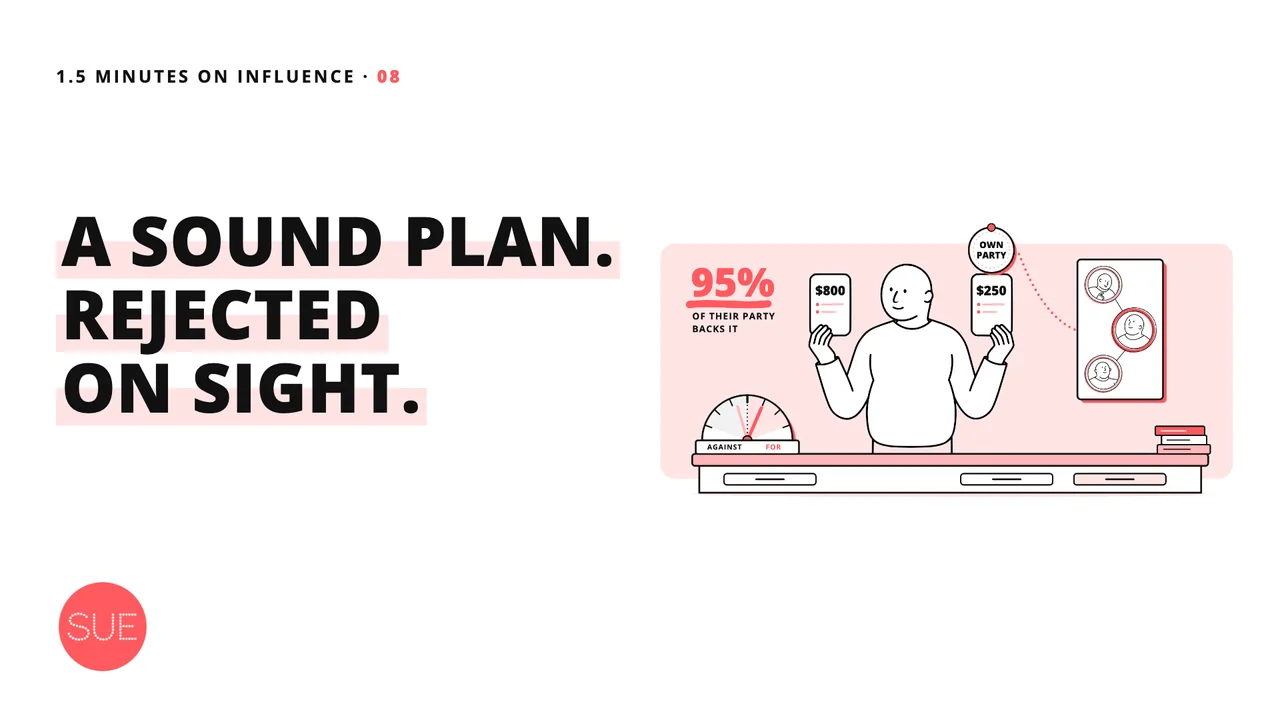
Your plan is sound. Yet the other side rejects it on sight. This is how Behavioural Design gets a sound plan a fair hearing. The easy answer is to add more evidence. Psychologist Geoffrey Cohen tested how much the content of a plan counts. He asked liberal students in the US to judge two welfare plans. A generous one and a harsh one. With no labels, they preferred the generous plan.
Then some students read one extra line. Ninety-five per cent of Democrats in Congress, their own party, backed the harsh plan. Without labels, they scored the harsh plan three point three out of seven. That’s against it. With their own party behind it, they scored it five. Now they were for it. And they said their party had influenced them less than anything else.
People trust their own group to share their values. So the group’s position tells them what a plan means. Cohen calls this the social meaning of a policy. Our Influence Framework maps the forces for and against a change. For the other side, backing a plan from your camp feels risky. That worry holds them back. We call it an anxiety. At work, it’s the plan from head office that the regions reject.
Or the proposal from finance that sales won’t even read. Ask whose plan they think this is. Then let someone they see as one of their own bring it in. Who brings the plan decides how it gets read. My name is Astrid Groenewegen, from SUE Behavioural Design, and this was 1.5 Minutes on Influence. Subscribe for the next one. And if this was useful, give it a thumbs up or share it.
Watching the news can get me down. There seems to be such a gulf between people, and every argument only seems to make it wider. That sent me looking for answers a while ago, and I found some in Keith Payne's book Good Reasonable People. One idea from it stayed with me, as I read it: what people believe is rooted less in ideology than in who they are when they believe it.
That sounds like a point about politics. It's just as true in a boardroom.
You know the scene. Your plan is sound. You've done the analysis, checked the numbers and tested the logic. The leadership team listens, nods, and doesn't move. So you go back and do what many of us do. You add evidence. A sharper analysis, a benchmark, an extra appendix.
The clearest study I know on why that can fail comes from psychologist Geoffrey Cohen. In 2003 he published four experiments in the Journal of Personality and Social Psychology, under a title that says it all: Party over policy.
Cohen asked students who identified as liberal to judge a welfare plan. Some read a generous version, others a harsh version. Without any labels, the liberal students did what you'd expect. They preferred the generous plan.
Then Cohen added one line. Some students read that the harsh plan was supported by ninety-five per cent of House Democrats, their own party. In the second study, on a scale from one to seven, support for the harsh plan was 3.3 without labels and 5 with them. The students now backed a plan that went against what they said they stood for. Conservatives did exactly the same the other way round: once Republicans backed the generous plan, so did they.
Two details make this study uncomfortable reading for anyone who believes in the power of a good argument. The first is that the students weren't skimming: Cohen reports that the pull of the party held even when people processed the information carefully. The second detail is what they said afterwards. They denied that their party had influenced them, while they expected other people, especially their opponents, to be swayed by it. Themselves, not at all.
Cohen's account is that people read a plan through their group. When the group takes a position, it shifts what people assume about the plan's facts and what they think it means morally. The facts don't disappear. They get read through the group.
In the SUE | Influence Framework© we call this an anxiety: a force that holds people back from a new behaviour, whether or not it's justified. Cohen does not use that word; translating his finding into an anxiety is my own interpretation. In my experience this one is quiet and hardly ever said out loud. What does it say about me if I back this? Whose side am I on?
Once you see that, a lot of resistance at work looks different. Think of the plan from head office that the regions turn down, the HR policy that operations won't touch, the partner group that waves away a sensible idea because it came from the new managing director. In my experience we hear objections about content, and we answer with more content.
That's why more content misses. Your audience is perfectly able to judge your plan. What holds them back is the anxiety, and evidence alone rarely takes an anxiety away. What I would try instead is changing who brings the plan, because that can matter as much as what's in it. Cohen did not test this step: he showed how a group's position shapes judgement, and the conclusion about who should bring the plan is mine. So before the meeting, find the person your audience sees as one of their own, and let your plan arrive through them. Involve them early enough that it really is partly theirs. Then the content gets the careful reading it deserves, from people who no longer have to choose between your plan and their group.
You don't hide where a plan comes from. You accept how people decide, and you design for it. A good plan still matters. It just never gets read on its own.
Who brings the plan decides how it gets read.
Sources
- Geoffrey L. Cohen (2003), "Party over policy: The dominating impact of group influence on political beliefs", Journal of Personality and Social Psychology 85(5), 808–822. https://doi.org/10.1037/0022-3514.85.5.808