Daily Dose of Influence
Choice overload: when more choice is the right choice
 By Astrid Groenewegen · 2 min read
For years, we believed that offering more choice leads to fewer decisions. Behavioural psychology often emphasises the pitfalls of too much choice: decision fatigue, choice paralysis, the paradox of choice. I’ve taught these concepts so many times, explaining why limiting options and reducing friction in decision-making paths is key. But the research is not as clear-cut as we thought. A meta-analysis of 50 experiments by Scheibehenne, Greifeneder and Todd (2010) found an average choice overload effect close to zero, with large differences between studies.
Sometimes, people actually want, perhaps even need, more choice.
In specific situations, like financial planning, medical treatment options, or learning paths, people seem to want a chance to dive in and explore.
They need to:
take in information,
weigh up their options,
and make decisions with care.
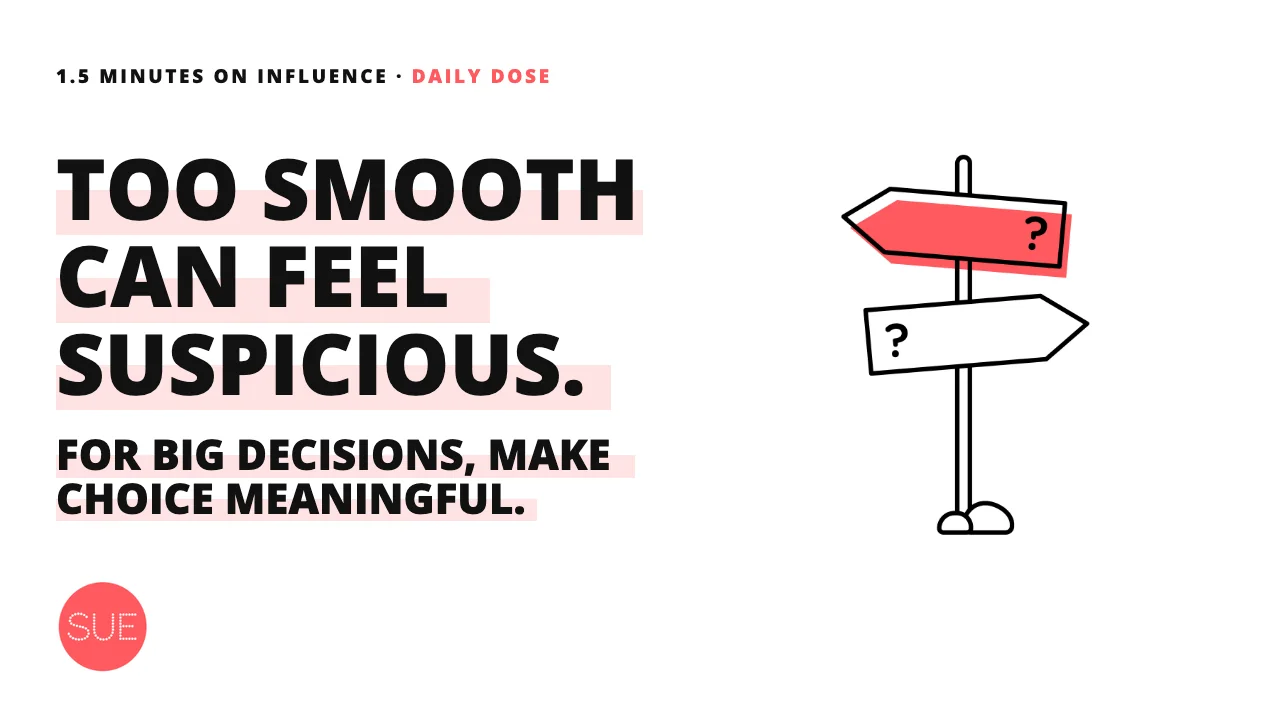
In decisions where trust is key, too much ease can even backfire.
If something feels too slick or overly smooth, it can feel a bit suspicious, almost too good to be true.
Take something like choosing a financial adviser. Some platforms make it almost too quick and simple, letting you pick one with a few clicks. But for something as significant as financial security, most people want to know they’re making a well-informed choice, not just the fastest one available.
While it’s great to keep choices clear and filtered, sometimes we need more than “don’t make me think.” For bigger decisions, like choosing the right support for your finances or health, people benefit from processes that support thoughtful, personal choices.
So, I’ve learned it’s not always about limiting choice, but about making choice more meaningful.
Yes, I was off on this point, but here’s what I’ve learned: sometimes, rethinking our assumptions makes us more open, even humble. And in these complex times, staying open to shades of grey rather than rigidly black-and-white thinking might just be a little superpower.
Sources: Scheibehenne, B., Greifeneder, R., & Todd, P. M. (2010). Can there ever be too many options? A meta-analytic review of choice overload. Journal of Consumer Research, 37(3), 409-425. https://doi.org/10.1086/651235