Daily Dose of Influence
Customer loyalty: the missing step that turns customers into fans
 By Astrid Groenewegen · 3 min read
This week, I received an email that I must share with you. It wasn't a discount offer or a "We miss you!" plea. Instead, Honest Greens, my favourite healthy restaurant chain in Barcelona, sent me this: "I've noticed you've been ordering our Wild Mediterranean Bowl a couple of times..."
What followed was pure magic. They described how they source the pomegranate seeds for that perfect burst of sweetness, why they char the aubergine just so, and how the tahini dressing brings everything together. By the end, I wasn't just hungry, I was genuinely excited about a salad I'd already eaten multiple times.
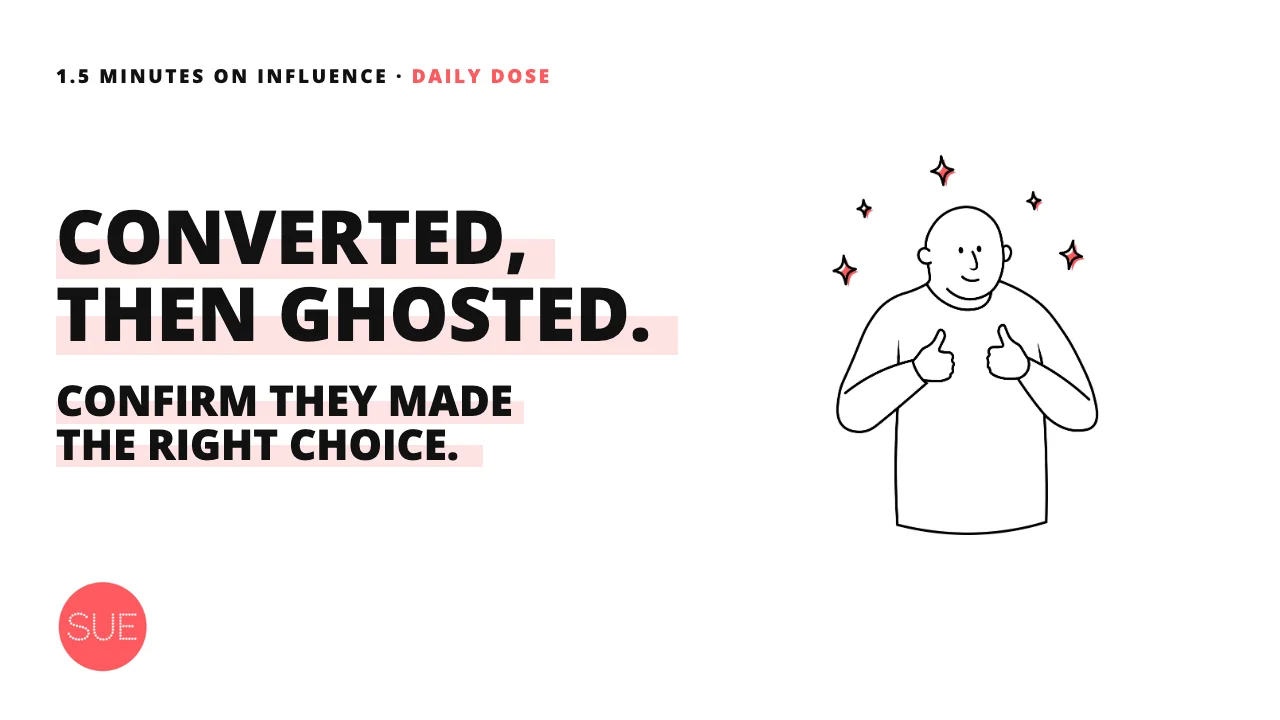
This email is a masterclass in something most businesses completely forget: confirmation. We're obsessed with catching attention and converting customers, but then we ghost them.
Yet behavioural science shows us that what happens after someone takes action is just as important as getting them to act in the first place.
This is why I developed the 4C Flow: Catch their attention, Convert them to action, Confirm they made the right choice, and Continue to help people stick to their behaviour .
That third C - Confirmation - is where the magic happens, and it’s almost always underused.
Here's why confirmation is so powerful:
Our brains crave post-decision validation. After we make any choice, from ordering lunch to buying software, we experience what psychologist Leon Festinger called cognitive dissonance. Did I choose well? Was this worth it? Smart companies answer these questions before we even ask them.
Confirmation creates emotional attachment. When Honest Greens told me why my bowl tastes so good, they weren't just describing food, they were validating my taste, my choice, my intelligence. Suddenly, I wasn't just a customer; I was someone with excellent judgment who appreciates quality ingredients.
It prevents buyer's remorse and builds loyalty. The same need to feel right explains the pull: people want to believe their past choices were good ones, so they welcome confirmation of it. That confirmation email didn't just make me feel smart about yesterday’s lunch, it made me crave tomorrow's.
Yet most of us skip this step entirely. We onboard new employees but never circle back to remind them why joining was brilliant. We sell our services but forget to celebrate the client's smart decision to hire us. We launch products but never help customers feel good about buying them.
Here's how to build confirmation into your own influence strategy:
Follow up with "why this was smart." After someone chooses you, remind them specifically what makes their decision intelligent.
Show, don't just tell. Honest Greens didn't just say their bowl was good, they painted a picture of pomegranate bursts and perfectly charred aubergine.
Make it personal. "I noticed you've been..." beats "Our customers love..." every time.
Time it right. Confirmation works best when the experience is fresh but the initial excitement has settled.
The beautiful irony? By confirming my choice, Honest Greens didn't just make me feel good about past orders - they practically guaranteed future ones. Now if you'll excuse me, I have a sudden craving for a Wild Mediterranean Bowl.
The Peak-End Rule: Why last impressions matter most
Ever notice how a great dessert can salvage a mediocre meal? That's the Peak-End Rule at work:
We judge experiences almost entirely based on their most intense moment (the peak) and how they ended.
Nobel laureate Daniel Kahneman and Donald Redelmeier discovered this when they had patients rate medical procedures (1996). In a later randomised trial (2003), a colonoscopy that was longer but ended on a less painful note was remembered as more pleasant than a shorter but more abruptly painful one.
Here's what's brilliant about that Honest Greens email: they didn't just confirm my choice. They gave me a perfect "end" to my dining experience. Instead of my meal ending when I finished eating, it ended with me feeling like a discerning food connoisseur.
Smart businesses understand this.
The lesson?
Don't let experiences just... stop. Design endings that leave people feeling great about the whole journey.
Sources
Festinger, L. (1957). A Theory of Cognitive Dissonance. Stanford University Press.
Redelmeier, D. A., & Kahneman, D. (1996). Patients' memories of painful medical treatments. Pain, 66(1), 3-8. https://doi.org/10.1016/0304-3959(96)02994-6
Redelmeier, D. A., Katz, J., & Kahneman, D. (2003). Memories of colonoscopy: a randomized trial. Pain, 104(1-2), 187-194. https://doi.org/10.1016/S0304-3959(03)00003-4