Thursday 14 May 2026
FOBO: the curse of too many good options
 By Astrid Groenewegen · 3 min read
When I started out in advertising, many light years ago, I once attended a marketing meeting where I noted down over 20 abbreviations, none of which I had any idea what they meant. If you work in business, you might recognise this. It’s like we’re all speaking a different language. Well, I have to warn you: there’s a new kid on the abbreviation block, one I hadn’t come across before.
FOBO.
I came across an interview this week with Patrick McGinnis, the Harvard Business School graduate who coined the term FOMO back in 2004. Most people know FOMO. Fewer people know the concept he developed afterwards: FOBO, or Fear of a Better Option.
Where FOMO makes you want to do everything, FOBO keeps you from choosing anything.
You have perfectly acceptable options in front of you, but you keep looking for the perfect, riskless one. And so you wait. And look. And wait some more.
McGinnis describes FOBO as an affliction of abundance. It tends to increase the more options and resources you have. Which means that the people who have worked hardest to build successful lives are often the ones most paralysed by the choices those lives produce.
Psychologist Barry Schwartz popularised this paradox in his work on decision making. His argument is that when people are given more options, they can become more anxious, less decisive, and more prone to regret whatever they eventually choose. The effect is not universal, though: a 2010 meta-analysis of 50 experiments by Benjamin Scheibehenne and colleagues found that on average it is close to zero, and that it depends heavily on the situation.
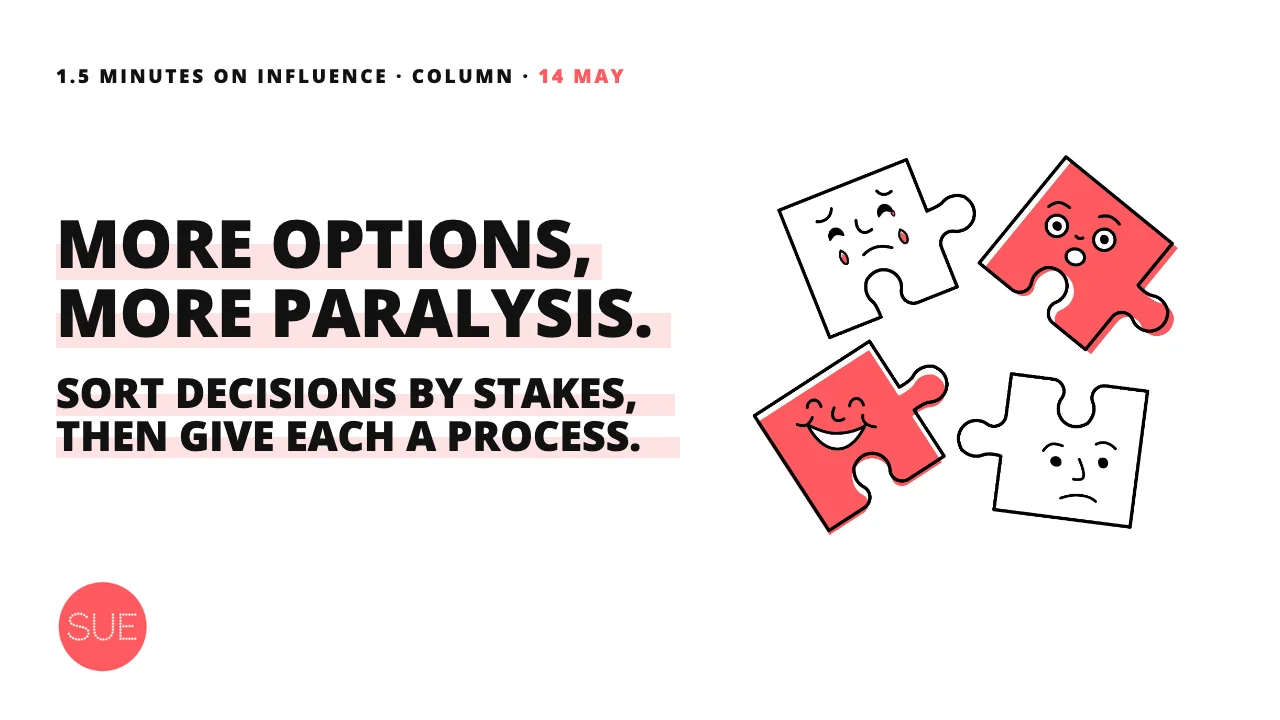
More options can mean more paralysis and less satisfaction.
The mechanism behind this is what Schwartz calls the opportunity costs. Every option you consider but do not choose becomes a source of imagined loss. The more options you have weighed, the more losses you have mentally accumulated, and the worse your eventual choice feels by comparison, even if it is objectively good.
This is where Behavioural Design becomes genuinely useful.
The solution to FOBO is not to try harder to be decisive. It is to redesign the choice architecture so that the decision becomes easier to make and easier to feel good about.
McGinnis suggests a simple framework: sort decisions by stakes. No-stakes decisions get outsourced immediately, to whoever cares most or to a random input. Low-stakes decisions get a deadline and a trusted outside opinion. High-stakes decisions get structured due diligence with a diverse group of people who are explicitly invited to disagree with you.
What all three approaches share is a designed process that takes the decision out of your head and puts it into a structure. The enemy of FOBO is not willpower. It is a well-designed decision environment.
How to use this insight:
The first move is to name what kind of decision you are actually making. Most FOBO lives in the low-stakes and no-stakes category, dressed up as high-stakes because we have given it so much mental airtime. Recognising that is already half the work.
For teams and organisations: FOBO is contagious. When a leader cannot commit, the people around them cannot either. One of the most powerful things a manager can do is model decisive behaviour on small decisions, not because the decision itself matters enormously, but because it establishes a norm that choosing is acceptable and that imperfect decisions can be corrected.
For anyone designing a process, a product, or a service: reducing the number of options available is often more helpful than increasing them. The instinct is always to add. The smarter move is frequently to edit. A shorter menu, a cleaner proposal, a recommendation rather than a list, these are not lazy shortcuts. They are acts of respect for the people you are asking to decide.
BTW and FYI, FOBO might actually beat FOMO. At this rate, we might as well YOLO and stick to the FAQs. LOL.
Sources
McGinnis, P. J. (2004). Social theory at HBS: McGinnis’ two FOs. The Harbus, 10 May 2004.
McGinnis, P. J. (2020). Fear of Missing Out: Practical Decision-Making in a World of Overwhelming Choice. Sourcebooks.
Schwartz, B. (2004). The Paradox of Choice: Why More Is Less. Ecco.
Scheibehenne, B., Greifeneder, R. and Todd, P. M. (2010). Can there ever be too many options? A meta-analytic review of choice overload. Journal of Consumer Research, 37(3), 409-425.