Daily Dose of Influence
Goodhart's law: when metrics hijack decision-making
 By Astrid Groenewegen · 2 min read
I have to admit something: I’ve always been a bit sceptical about metrics, especially on social media. You know, those likes, shares, and engagement rates that seem to rule our digital lives. I used to dismiss them as ‘vanity metrics,’ convincing myself they didn’t really matter.
But this isn’t just about social media metrics. Whether it’s sales figures, customer satisfaction scores, or performance reviews, we’re living in a world where everything is measured, compared, and ranked.
As someone working in Behavioural Design, I know metrics are crucial. They help us understand if we’re actually making an impact. So why did I resist them so much? So what was really going on? This week, I finally figured it out: it has to do with the comparison trap.
You see, it’s not the metrics themselves that are the problem. It’s how they hijack our brain’s natural tendency to compare ourselves to others, shaping our behaviour in ways we might not even realise.
Researchers Lisa Ordóñez and colleagues (2009) described a fascinating pattern:
When organisations overemphasise specific metrics, people often optimise for what’s measurable rather than what’s valuable.
They call this "goals gone wild", where chasing metrics can end up undermining the very outcomes we’re trying to achieve. Or, as the historian Jerry Z. Muller of the Catholic University of America calls it: the tyranny of metrics.
Here’s where it gets interesting. Numbers do tell a story, but we should ask ourselves: is it the whole story? Sometimes a post with fewer likes might have sparked that one crucial conversation that led to a breakthrough project. Or a presentation that looked average on paper created exactly the shift in thinking your team needed.
The real insight from behavioural science isn’t that metrics are bad, they’re incredibly useful tools. The key is understanding their place in our decision-making process.
Muller makes the same point: metrics are useful as a complement to judgement based on experience, not as a replacement for it.
This matters because when we optimise for metrics alone, we risk losing sight of what actually creates value.
Here’s how to break free from the comparison trap:
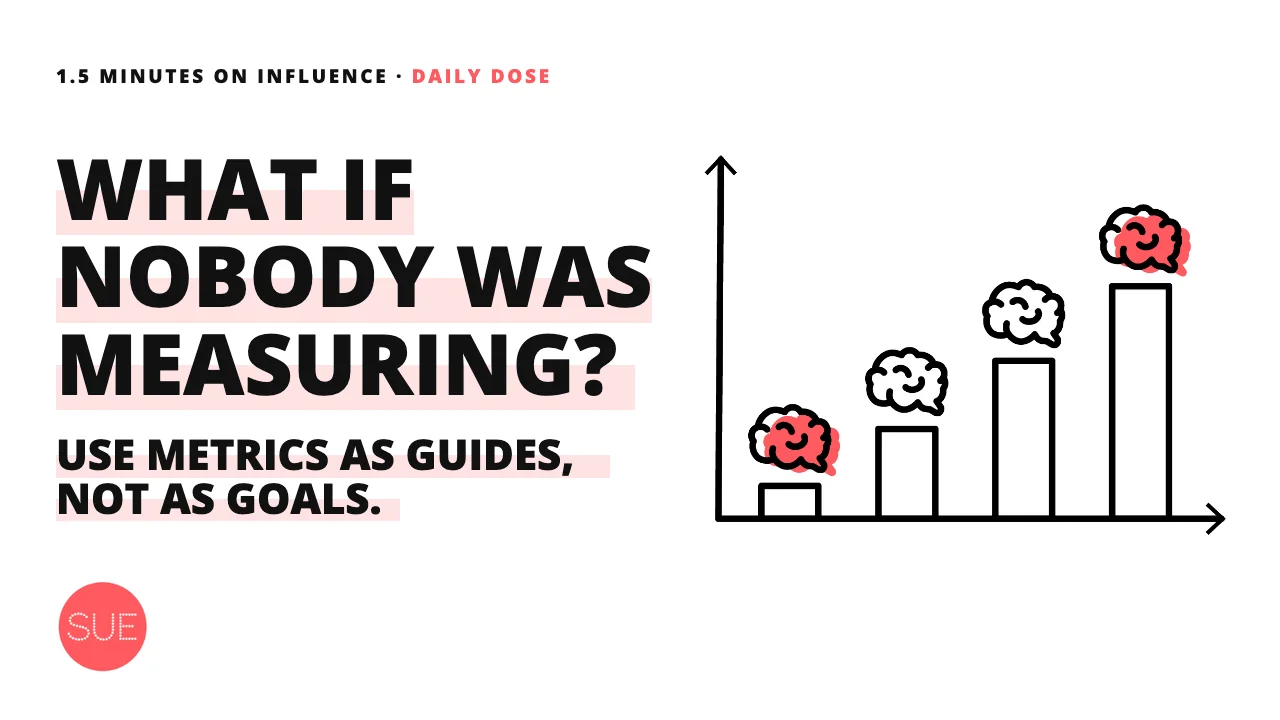
Ask yourself: “What would I do if no one was measuring?”
Define success before seeing the numbers.
Create your own metrics that align with your true goals.
Balance quantitative metrics with qualitative feedback.
The goal isn’t to ignore metrics entirely but to put them in their proper place, as tools that inform rather than direct our decisions.
Next time you find yourself obsessing over numbers, remember: the most meaningful impacts often can’t be measured in likes, shares, or even Euros.
Turns out the old saying was right all along: comparison is the thief of joy, and of value, as it turns out.
Sources
Muller, J. Z. (2018). The Tyranny of Metrics. Princeton University Press.
Ordóñez, L. D., Schweitzer, M. E., Galinsky, A. D., & Bazerman, M. H. (2009). Goals gone wild: the systematic side effects of overprescribing goal setting. Academy of Management Perspectives, 23(1), 6-16.