Thursday 9 April 2026
Hospital design: why a view of trees speeds up recovery
 By Astrid Groenewegen · 3 min read
One of the most surprising discoveries while researching De Gelukscode was how much our physical environment affects not just our mood, but our actual physiology. I expected to find that context shapes behaviour. I didn't expect to find that it shapes healing.
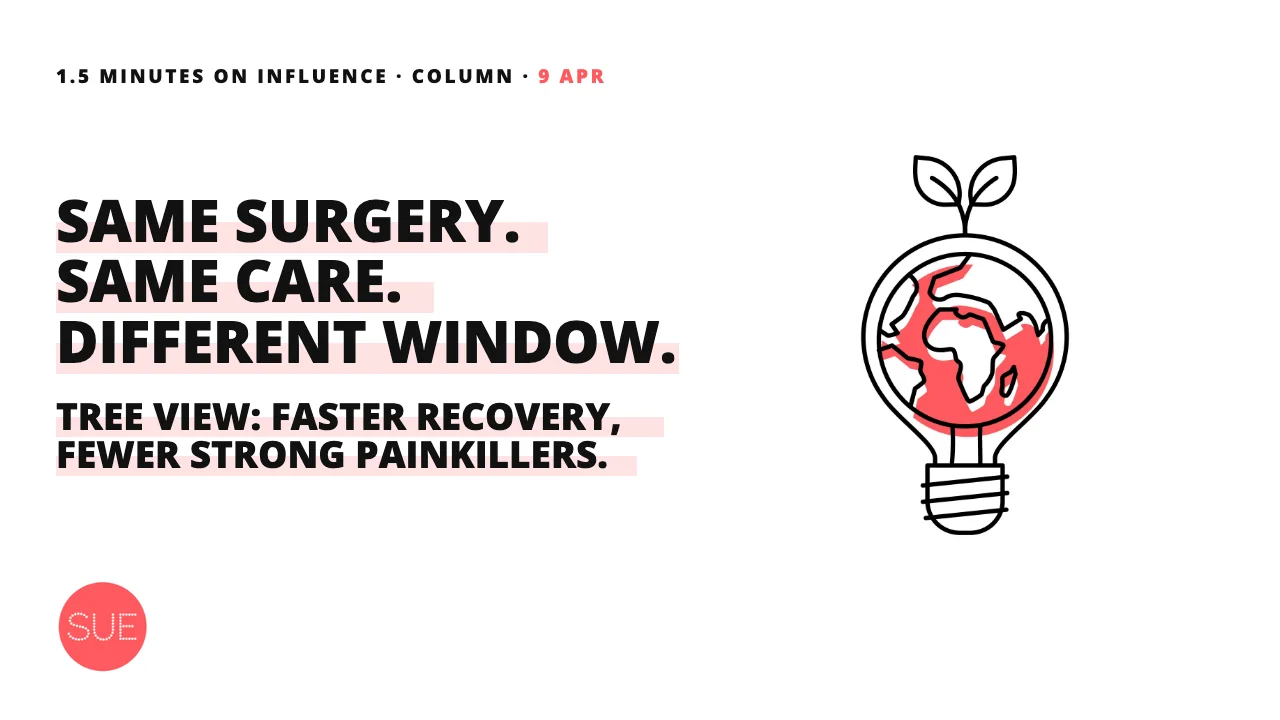
Researcher Roger Ulrich conducted a landmark study comparing patients recovering from gallbladder surgery. Some had rooms facing a brick wall. Others faced a small stand of trees.
The results were striking. Patients with the tree view recovered faster, needed fewer strong painkillers, and had fewer negative notes from nurses. Same surgery. Same care. Different window.
This wasn't placebo. This was environment directly affecting physiology.
I remember reading this study and thinking: if a view of trees can speed up recovery from surgery, what else are we getting wrong about the spaces we live and work in?
Ulrich's work launched the field of evidence-based healthcare design. Later research suggests that natural light helps patients in hospitals. That single rooms reduce infection rates. That views of nature ease stress. The building is not neutral. The building is part of the treatment.
But here's what bothers me: we know this, and most environments still ignore it. Offices without windows. Schools with views of car parks. Homes where the nicest room faces the street and the kitchen faces a wall. We keep building as if the view doesn't matter when decades of research says it profoundly does.
This became a central theme in De Gelukscode:
we underestimate how much our surroundings shape our wellbeing, and we overestimate how much willpower can compensate for a badly designed environment.
How to use this insight:
Nature isn't a luxury. It's a performance and wellbeing variable that we can design for.
If you have any control over your workspace: Face your desk toward a window if possible. If not, research suggests that even images of nature, real photographs, not abstract art, provide some of the same benefits. Plants help too, though less than views. The goal is bringing natural elements into your visual field during the workday.
If you're choosing where to live: Factor in the view, not as an aesthetic nicety but as a health variable. A cheaper flat with a park view might serve you better than an expensive one facing a wall. Consider: what will you see thousands of times a day? That repetition matters more than you'd think.
If you're designing anything, offices, schools, hospitals, public spaces: Prioritise natural light and views of greenery. If views aren't possible, bring nature inside: plants, water features, natural materials. This isn't about making spaces "nice." It's about making them functional for human beings who evolved outdoors.
If you're a parent: Children's cognitive performance and stress levels are affected by the same variables. A bedroom facing a garden isn't just pleasant, it's protective. When choosing schools, look at the windows, the playground, the presence of trees. These aren't frills.
If you're stuck in an environment you can't change: Take breaks outside. Even five minutes of walking in a green space has measurable effects on mood. If you can't change your daily view, you can punctuate your day with exposure to nature.
If you're making decisions about ageing parents: Care home selection often focuses on staff ratios and medical facilities. Add this question: what will they see from their room? A view of trees might matter as much as the physiotherapy schedule.
We spend almost 90% of our lives indoors. The indoors should earn that time.
Sources
Ulrich, R. S. (1984). View through a window may influence recovery from surgery. Science, 224(4647), 420-421. https://www.science.org/doi/10.1126/science.6143402
Ulrich, R. S., Zimring, C., Zhu, X., DuBose, J., Seo, H., Choi, Y., Quan, X. and Joseph, A. (2008). A review of the research literature on evidence-based healthcare design. HERD, 1(3), 61-125.
Barton, J. and Pretty, J. (2010). What is the best dose of nature and green exercise for improving mental health? A multi-study analysis. Environmental Science & Technology, 44(10), 3947-3955.
Klepeis, N. E. et al. (2001). The National Human Activity Pattern Survey (NHAPS). Journal of Exposure Analysis and Environmental Epidemiology, 11(3), 231-252.