Thursday 10 September 2026
New hire onboarding: why your hire goes quiet in week one
 By Astrid Groenewegen · 3 min read
Maybe you know that my husband and I founded SUE together. The fact that we still work side by side is kind of a miracle if you know the story of how we started. He and a colleague hired me to join their agency at the time. And on my very first day, they were both not there. They had forgotten I was starting that day. They are both brilliant, smart, creative thinkers, so that made me stay, but as for starting a new job, well, that could have been a tad smoother. It made me think about an interesting design question:
How do you design an onboarding that makes new people stay? And how often do we blame the new hire for not settling in, when the situation never gave them a fair chance?
A company which studied its own onboarding closely is Microsoft. The conventional approach is to load the first weeks with paperwork, policies and training modules, the formal machinery of joining, and to treat the social side as something that will sort itself out. Microsoft's own research pointed somewhere quieter. A seemingly trivial action, a manager simply having a one-to-one with their new hire in the first week, is reported to bring outsized benefits. And in a buddy programme involving 600 employees, fifty-six per cent of new hires who met their onboarding buddy at least once in the first ninety days said it helped them become productive quickly (Microsoft, Workplace Insights, 2020). What helped new hires get productive faster was small, early human contact.
The behavioural science here is about how fragile a new person's sense of belonging is, and how much rides on it.
When we arrive somewhere new, we are acutely sensitive to signs of whether we fit, and a single unanswered question or a quiet first week reads as evidence that maybe we do not belong here. Researchers Greg Walton and Geoff Cohen called this belonging uncertainty, and showed, in their work with students, how powerfully
Early signals shape whether people feel they belong
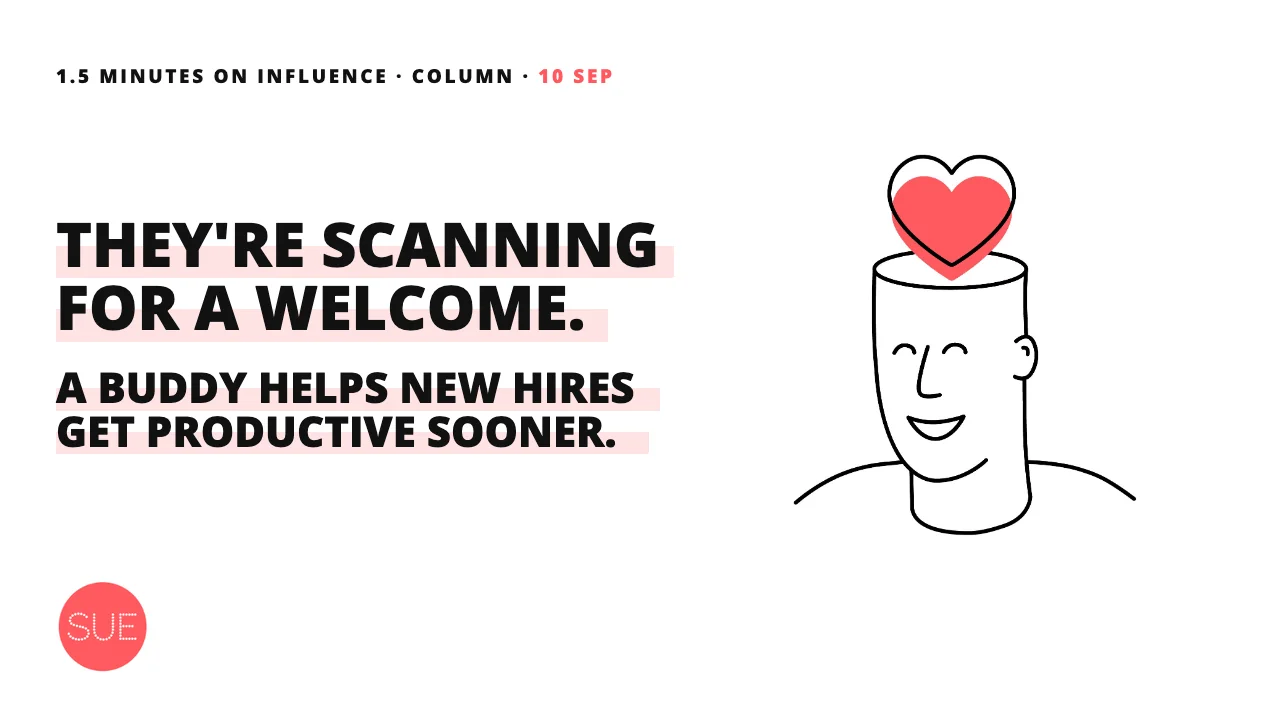
A new joiner is not waiting for more induction slides. They are scanning for whether this is a place where they are wanted. This is Behavioural Design applied to the first weeks of a working life. You do not motivate someone into belonging with a welcome email. You design the early contact, the one-to-one, the buddy, the easy first conversation, that lets belonging take hold, and the staying and the performance are more likely to follow.
So, how do you put this to work? Here are three practical moves:
Design the first one-to-one, do not leave it to chance. The single most reliable thing a manager can do is sit down with a new person in week one. Put it in the calendar before they start, so the most important signal, you are wanted here, lands immediately.
Give every new joiner a buddy, not just a manager. People hesitate to ask their boss the small, basic questions. A peer they can turn to answers exactly those, and the early contact does more for belonging than any formal module.
Engineer the easy early conversation. Belonging is built from small, low-stakes contact: a team lunch, an introduction round, a reason to talk on day one. Design those moments in, because a new person reads early silence as not fitting in.
Of course, my buddy system got a bit out of hand as it ended up in me marrying one of the partners, but I am pretty sure you don’t need to go that far to make someone feel welcome ;-).
Sources
Microsoft (2020). Every new employee needs an onboarding buddy. Microsoft Workplace Insights. Underlying science: Walton, G. M., and Cohen, G. L. (2007). A question of belonging: race, social fit, and achievement. Journal of Personality and Social Psychology, 92(1).
Microsoft Workplace Insights: https://workplaceinsights.microsoft.com/?p=853 (pilot of a buddy programme with 600 employees; 56 per cent of new hires who met their buddy at least once in the first 90 days reported a higher sense of their speed to productivity). Walton and Cohen studied minority students, not new employees.
Read the full guide:
How do you design an onboarding that makes new people stay? →