Thursday 2 July 2026
Open plan office: how to connect people without losing focus
 By Astrid Groenewegen · 3 min read
I have always been fascinated by interior design. Not in the ‘throw a blanket casually over the couch’ kind of way but what it does to how people behave in a space and what kind of collaboration or thinking it creates. I have the luxury that I get to visit a lot of offices of other companies, and I noticed something last time I stepped into an open plan office. I used to hear the complaint that open plan offices were dreaded because of the noise. But this one was dead silent. People were there but there was almost no talking. There were no signs of collaboration or sparks of energy. So, this made me wonder:
How do you design an office where people connect (without losing their focus)? And what can we take from the answers into the rest of our lives?
Before we get to the answer, it is good to know that this almost awkward silence in open offices is one of the best documented findings in Behavioural Design. The ‘funny’ thing is that two Fortune 500 companies removed the walls in their offices to stimulate the opposite: to spark collaboration on the logical assumption that fewer boundaries would make the free flow of ideas easier.
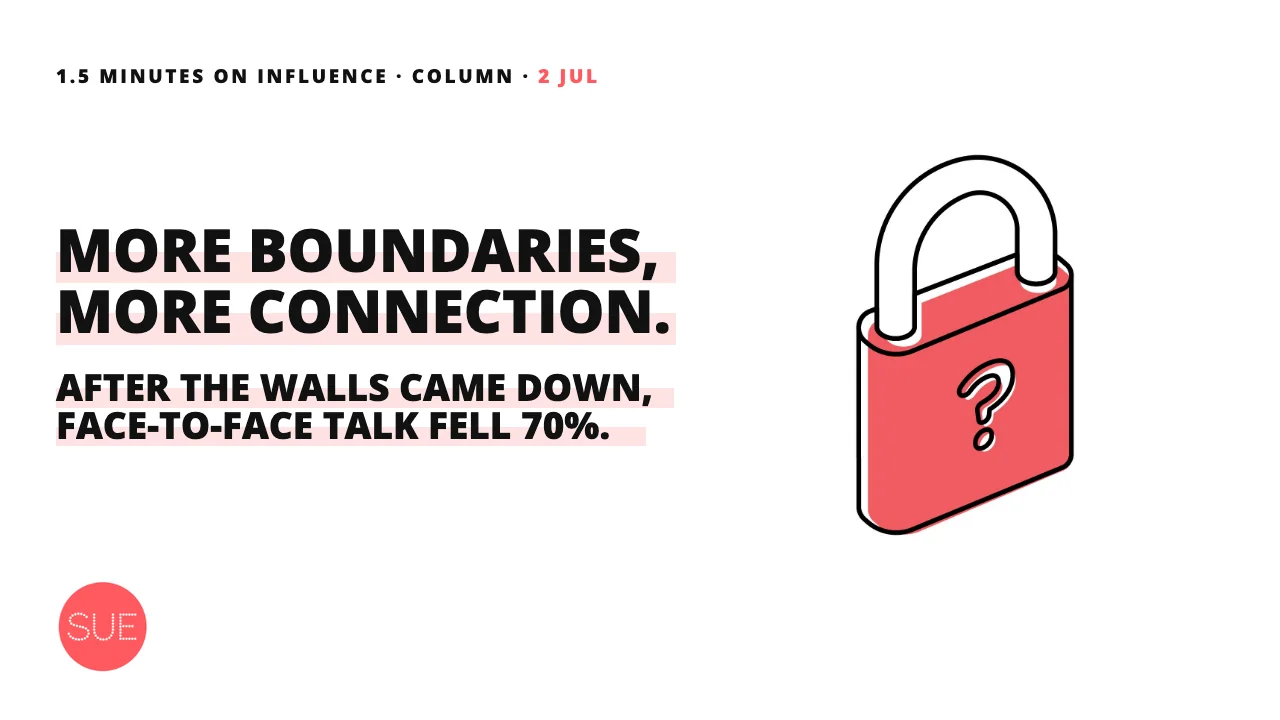
However, the Harvard researcher Ethan Bernstein measured what really happened with wearable sensors and server data, before and after. Face to face interaction did not rise. It fell by around seventy per cent, while email and messaging went up. People put on headphones and emailed a colleague a metre away (Bernstein and Turban, Royal Society B, 2018). The principle is about privacy and control.
We have a deep need to regulate when we are observed, and when that control is taken away, we claim it back the only way left to us, by withdrawing.
Strip out every wall and you do not remove the need for privacy; you just force people to manufacture it with headphones and withdrawn behaviour. The room built for contact produced retreat.
So, what can you do with this insight? When you see collaboration drop, your instinct might be to change the people. Far more often it is the room talking. Behavioural Design starts there: you fix the room, not the people.
If you want people to connect, your move should be counterintuitive. You don’t remove boundaries; you might need to add some.
So how do you design for connection rather than demand it? Here are three practical moves:
Add places to retreat, not just places to gather. People reach out from a position of safety, not exposure. A few enclosed rooms, quiet corners or doors that close will do more for connection than another open zone.
Give people control over being seen. The need is to regulate exposure, so hand that control back: a screen they can angle, a focus signal others respect, a desk that is theirs. Control lowers the urge to hide.
Read the room before you judge the person. When a team will not collaborate, walk the space first and ask what behaviour it is making easy. Fix the room, and the behaviour you wanted often appears without a single conversation about culture.
And yes, sometimes we do need to focus. So headphones can be perfectly fine. A little shake and dance behind the desk never hurt the office mood either. With enough connection throughout the day, these become a way to recharge rather than to hide.
Sources
Bernstein, E. S., and Turban, S. (2018). The impact of the 'open' workspace on human collaboration. Philosophical Transactions of the Royal Society B, 373(1753), 20170239.