Daily Dose of Influence
Opportunity cost: a gym example from a fifteen-year-old
 By Astrid Groenewegen · 2 min read
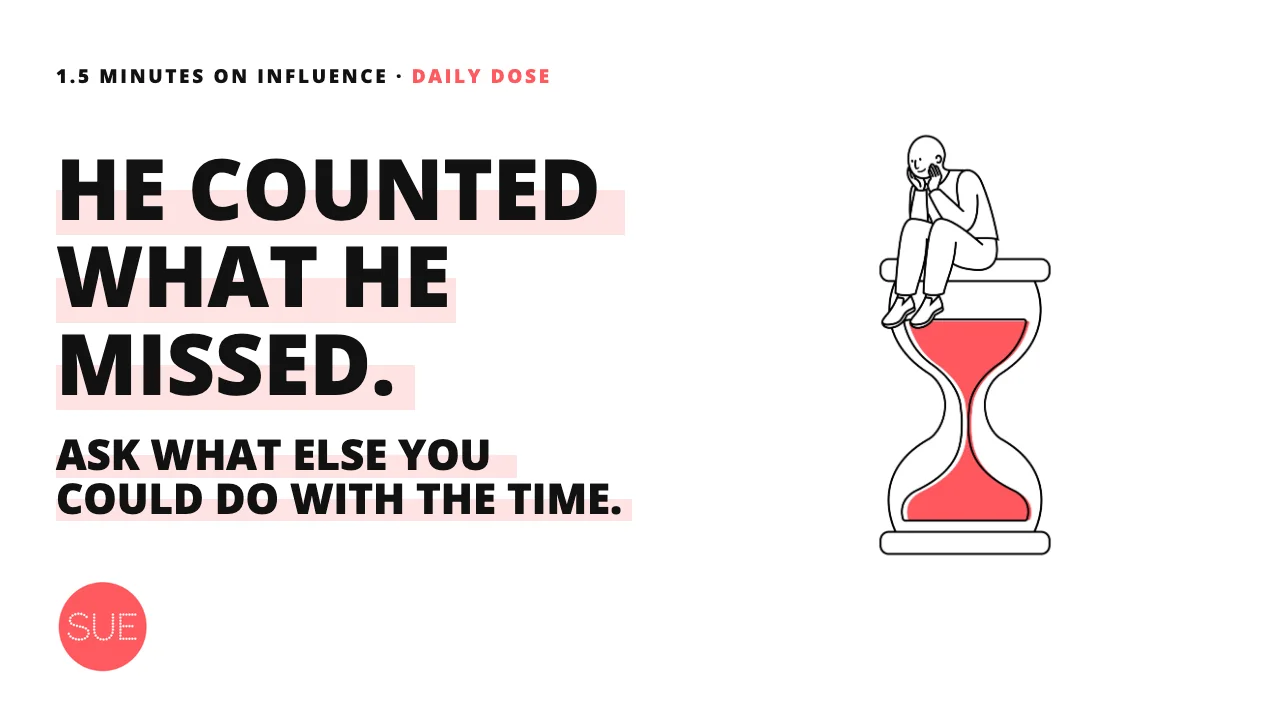
Last week, I was chatting with a fifteen-year-old about his exercise routine. ‘How often do you go to the gym?’ I asked. ‘Oh, not that much, just three times a week,’ he replied casually. I was impressed, three times a week seemed quite committed to me! But he shook his head and said, ‘No, I had so many more opportunities to go.’
His response stopped me in my tracks. While I saw three gym sessions as an achievement, he saw missed opportunities. It reminded me of something what behavioural economists call:
Opportunity costs, the value of what we give up when we make a choice.
Think of it like this: when you spend two hours in a meeting, you’re not just using that time; you’re giving up the chance to work on an urgent project, mentor your team, or plan next quarter’s strategy. These hidden costs are everywhere in our lives, but research shows we’re surprisingly bad at spotting them. Shane Frederick and colleagues found that:
We tend to neglect opportunity costs unless they’re explicitly pointed out to us, it’s like a blind spot in our decision-making.
And here’s where it gets really interesting: when Frederick and colleagues tested this (Journal of Consumer Research, 2009), they found that simply reminding people about opportunity costs changed their decisions. Participants were less likely to buy when prompted to think about what else they could do with their money.
So, what about opportunity costs in the workplace? The same blind spot applies there. Being aware of trade-offs makes the hidden costs visible.
Let's see how we can make these insights work for you. Do you want to make better decisions? Try these evidence-based strategies:
Pause to consider alternatives Before making a choice, ask yourself: What else could I do with this time or money? You won’t always change your mind, sometimes watching Netflix really is the best use of your evening, but being aware of your options helps you make more intentional choices. So, next time, before scheduling that next meeting, pause and ask yourself, 'What else could my team accomplish in this time?' This simple prompt can make hidden trade-offs visible and encourage you to prioritise tasks that align better with your team's goals.
Think of time as currency Instead of seeing time in isolation, imagine it as money you’re spending.
Flip FOMO into JOMO We’ve all heard of FOMO (Fear of Missing Out), but consider its happier cousin, JOMO (Joy of Missing Out). Rather than focusing on what you might miss by saying no, appreciate the satisfaction of investing your time and energy into what truly matters.
As my young friend unknowingly reminded me, what seems like ‘not that much’ to us might be ‘quite a lot’ to someone else. Understanding our
blind spots and recognising opportunity costs can help us invest our time and resources where they count most.
In the end, it’s all about perspective.
Sources: Frederick, S., Novemsky, N., Wang, J., Dhar, R., & Nowlis, S. (2009). Opportunity cost neglect. Journal of Consumer Research, 36(4), 553-561. https://doi.org/10.1086/599764