Thursday 11 June 2026
Organisational culture: what actually builds it
 By Astrid Groenewegen · 4 min read
The World Cup starts today, which means for the next few weeks we will be seeing a lot of orange in the Netherlands. Flags, scarves, and the occasional inflatable crown. Once more we’ll stand united in a colour that suits almost nobody, and somehow manage to all look equally questionable.
But it is interesting, this sense of shared national pride.
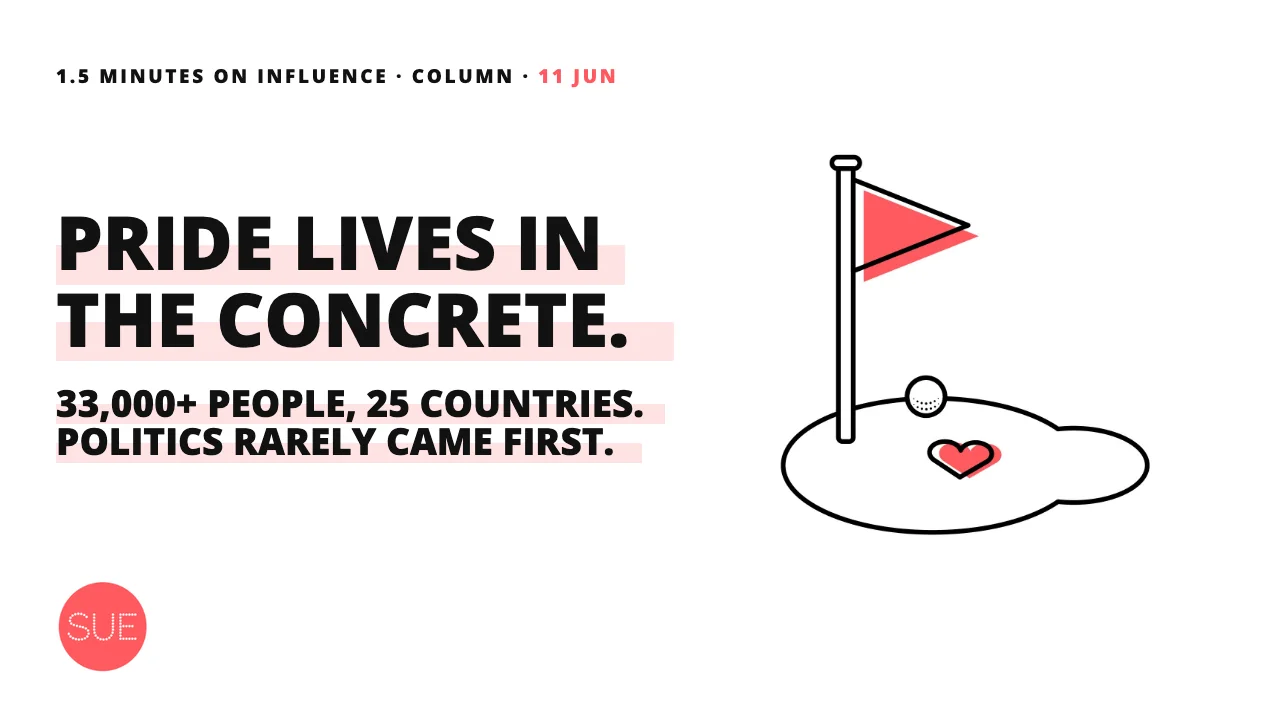
I recently came across a piece of research that I found particularly insightful on the subject. The Pew Research Center asked more than 33,000 people across 25 countries one open-ended question: what makes you proud of your country?
The researchers left the question deliberately open, wanting to see what people would reach for without being given categories to choose from. And in most countries, what people reached for first was not politics.
The Dutch mentioned their waterway management. Indonesians talked about their spices. Australians described mateship, the particular quality of looking out for your friends. Italians cited food and the Renaissance in the same breath. Hungarians were split: some proud of their intellectual output, others explicitly not proud, citing their current government as a reason.
What struck me was how often people reached for the concrete and the cultural rather than the abstract and the political. Not "our constitution" but "our spices." Not "our GDP" but "our people." Not "our military" but "our Nobel Prize winners."
Social psychologist Henri Tajfel spent much of his career studying how people form and maintain group identities. His Social Identity Theory proposes that we derive a significant part of our sense of self from the groups we belong to, and that we are strongly motivated to see those groups positively. You do not feel Dutch because of your passport. You feel Dutch because of something more textured and lived than that.
The Pew findings fit this picture. People's national pride is anchored in things they have actually experienced or participated in. Food you have eaten. People who have helped you. A landscape you have walked through. A cultural export you have felt reflected something true about where you come from. These are not abstract claims. They are context. And context, as behavioural science keeps showing us, is where identity actually lives.
What I find most hopeful about this research is the gap it reveals between what ordinary people say they are proud of and what political discourse assumes they care about. In a period when national identity is being weaponised almost everywhere, the actual humans being appealed to turn out to be proud of remarkably human things. Warmth. Creativity. Honesty. The way their neighbours behave in a crisis.
This is not naive. People are also capable of exclusive and fearful nationalism. But the baseline, when you simply ask people without steering them, skews toward connection rather than division. That feels worth holding onto.
How to use this insight:
The gap between what people actually value and what institutions assume they value is one of the most reliable sources of missed opportunity in leadership, policy, and organisational design.
If you lead a team or an organisation, it is worth asking the same kind of open question that Pew asked. Not "how satisfied are you with your work?" but "what are you most proud of here?" The answers will almost certainly surprise you. They will be more specific, more personal, and more cultural than any engagement survey would have predicted. And they will tell you something true about what the group actually is, as opposed to what the strategy document says it should be.
The same principle applies to building any kind of community, whether a neighbourhood, a company, a school, or a team. Shared identity is not built through mission statements or values posters. It is built through shared experiences, shared symbols, and the accumulated texture of daily life together.
The question for anyone trying to strengthen a group is not: what do we stand for? It is: what do we do together that nobody else does quite like us?
In a world that is very loud about identity, the most powerful identity signals are often the quietest ones. The way meetings start in your company. The food at your team lunches. The joke that only makes sense if you were there. These are not trivial. They are the spices and the waterways. They are what people will reach for when someone asks what makes them proud. Even if it means dressing in a colour so bright it practically hurts your eyes.
Sources
Pew Research Center (2026). What makes people proud of their country? Survey of 33,486 adults in 25 countries, published 17 February 2026. https://www.pewresearch.org/global/2026/02/17/what-makes-people-proud-of-their-country/
Pew Research Center (2026). Where in the world are people proud of their nations’ politics and economy, and why? https://www.pewresearch.org/global/2026/02/17/where-in-the-world-are-people-proud-of-their-nations-politics-and-economy-and-why/
Tajfel, H. and Turner, J. C. (1979). An integrative theory of intergroup conflict. In W. G. Austin and S. Worchel (eds), The Social Psychology of Intergroup Relations. Brooks/Cole.