Daily Dose of Influence
Overconfidence bias: why we think we are better drivers
 By Astrid Groenewegen · 2 min read
Last week, I found a large dent in the driver's side door of my car. I hadn't even been in the car, so I can assure you it wasn’t my doing. I consider myself a decent driver, until I came across a study that made me question that self-assessment.
It talked about drivers' perceptions of their own abilities. In a classic study by Svenson (1981), drivers compared themselves with other drivers: 93% of the American participants rated themselves as more skilful than the median driver, and so did 69% of the Swedish participants. That can’t be right, since only half can be above the median. This phenomenon is known as overconfidence bias, where we tend to overrate our own abilities in completing tasks.
We as humans all have some hard-wired beliefs that affect our perceptions, evaluations, and judgments. This brings me to an important point I want to discuss.
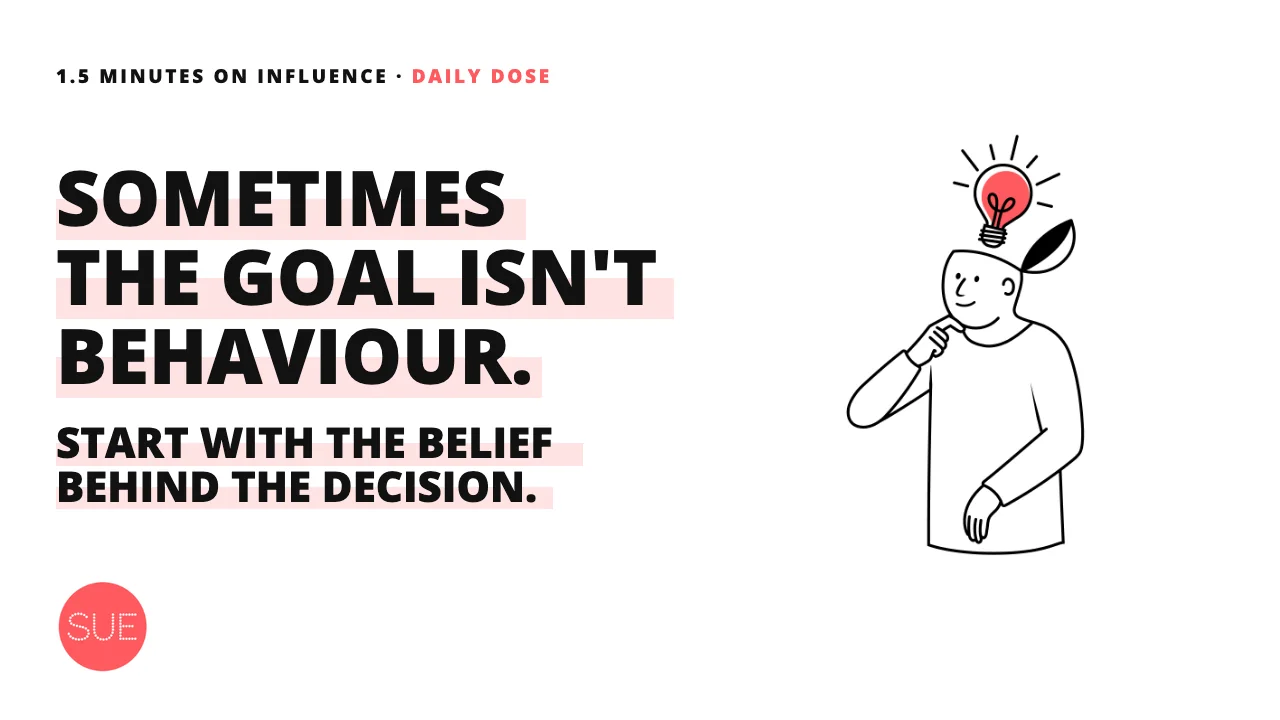
Lately, I think we’ve been overly focused on behaviour.
This might sound odd coming from someone who founded SUE Behavioural Design, but it’s a crucial insight. Groundbreaking work in behavioural sciences, like that recognised by the Nobel Prize, were not predominantly on behaviour but gave us insights on how we as humans come to decisions. And yes, the outcome of these decisions can absolutely be behaviour.
But it could also very well be that the outcome is that we decide to change our minds, shift our beliefs, or see things in a new light. Which is also a very important outcome, vital for buy-in, cooperation, or maintaining good reputations.
Sometimes, understanding the root of someone’s strong beliefs is more important than trying to change their behaviour. If they have entrenched beliefs, introducing new behaviours might be futile.
By grasping how decisions are made, we can see why people sometimes make illogical choices. This not only helps explain why your partner insists they are a great driver (when you know the truth might be different), but also addresses larger issues, like why people fail to save for retirement, exercise, or recycle.
For example, optimism bias leads us to underestimate the likelihood of negative outcomes and overestimate positive ones. Believing that the future will be better can deter immediate action. Most solutions don’t consider this bias, but if we do, we can design interventions to help people overcome it.
I am a firm believer that insight into decision-making is the most critical wisdom that behavioural sciences can offer.
The ability to understand and influence decisions is key to success for every professional, as it helps you gain better control over outcomes, whether that involves changing minds or behaviours.
PS. I really didn’t dent the car, Scout's honour!
Sources
Svenson, O. (1981). Are we all less risky and more skillful than our fellow drivers? Acta Psychologica, 47(2), 143-148. https://doi.org/10.1016/0001-6918(81)90005-6
Weinstein, N. D. (1980). Unrealistic optimism about future life events. Journal of Personality and Social Psychology, 39(5), 806-820.