Daily Dose of Influence
Pattern interrupt: why the unexpected makes people stop and look
 By Astrid Groenewegen · 3 min read
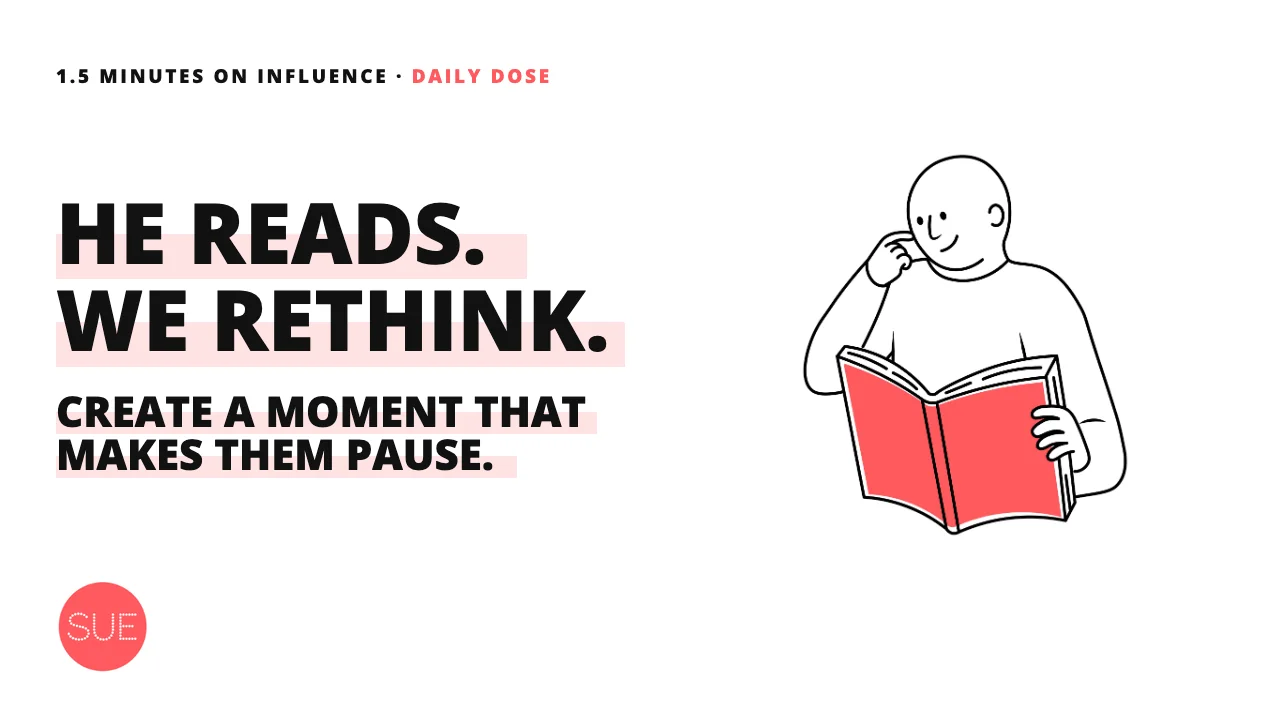
There's a man I regularly pass in my neighbourhood in Barcelona. He sits under a blanket on the street, but he's not doing what you might expect. He's not holding out a cup, not making eye contact with passersby, not even looking particularly distressed. Instead, he's completely absorbed in reading a novel, just turning pages with what appears to be genuine contentment. Next to him sits a small sign explaining he owns nothing and would appreciate any donation.
I don't speak Spanish (yet), so having a conversation wasn't an option. But isn't it fascinating how, despite that language barrier, he still manages to communicate so powerfully? Just through his posture and activity, he tells a story that goes much deeper than words.
This scene has been playing in my mind because it perfectly illustrates how our brains make snap judgments based on context. In behavioural science terms, we're witnessing what Nobel laureate Daniel Kahneman calls System 1 thinking - our fast, intuitive, and automatic judgment system that helps us navigate the world through quick pattern recognition.
When we see someone sitting on the street, our System 1 typically activates a specific set of associations and predictions based on past experiences. But this man's behaviour - quietly reading a book - creates a cognitive disruption. It triggers a different set of associations:
Reading suggests education and intellect.
Being absorbed in a book implies contentment rather than desperation.
The quiet dignity of the activity stands in stark contrast to our expectations.
This particular scene invites us to consider the larger picture of homelessness and street life, which is complex and varied. While I don't know this person's specific story or circumstances, his choice to read rather than actively solicit donations creates a unique dynamic worth examining from a behavioural perspective.
Research by Princeton psychologists Janine Willis and Alexander Todorov shows that:
We form impressions of other people, such as how trustworthy or competent they seem, after seeing their face for as little as a tenth of a second.
By creating a context that challenges our stereotypical expectations, this man (whether intentionally or not) is actually rewiring the typical System 1 response. The presence of the book serves as what behavioural scientists call a "pattern interrupt" - it forces our brain to pause and reconsider its automatic categorization.
This has fascinating implications for how we might influence behaviour and decisions:
Context shapes perception: Small environmental cues can dramatically alter how people perceive and respond to a situation.
Pattern interrupts matter: When you want to change someone's automatic response, create a moment that makes them pause and reconsider.
Dignity creates connection: Actions that maintain dignity often create stronger emotional resonance than direct appeals for help.
Silent stories speak volumes: Sometimes what we don't do (like not actively seeking attention) can be more powerful than what we do.
For anyone working in behavioural change, whether in social causes, business, or public policy, this offers a powerful lesson: Sometimes the most effective way to influence behaviour isn't through direct appeals, but through thoughtfully designed contexts that help people see situations - and each other - in a new light.
Of course, I donated. After all, anyone who can make me rethink my understanding of behavioural science while quietly reading a novel on a cold street corner in a foreign city has certainly earned it.
And while my observation is just that - an observation of a single moment in time - it reminds me that we all benefit from occasionally challenging our automatic thinking patterns and considering the powerful ways context shapes our perception of the world around us.
Sources
Kahneman, D. (2011). Thinking, Fast and Slow. Farrar, Straus and Giroux.
Willis, J., & Todorov, A. (2006). First impressions: making up your mind after a 100-ms exposure to a face. Psychological Science, 17(7), 592-598. https://doi.org/10.1111/j.1467-9280.2006.01750.x