Daily Dose of Influence
Phone addiction: why willpower will not fix it
 By Astrid Groenewegen · 3 min read
I must confess that I was a bit hesitant to write about this topic. This one-minute insight is about excessive use of mobile phones. I try to live life with a non-judgmental mindset, and I find it somewhat patronizing to have an opinion on how people spend their time.
After all, who am I to judge?
But then I came across a study that made me decide to write about this after all: it turned out to be not just a problem I noticed, but one that users experience themselves.
Even more importantly, it led me to a more profound insight that goes beyond phone use, which I think could be of value to you.
Let's start with the study. Economists Bursztyn, Handel, Jiménez-Durán and Roth found that large shares of active users of TikTok and Instagram would prefer these platforms did not exist. These aren’t just any opinions; these are from actual users, in this case college students. So, we do have a problem on our hands.
What’s happening here from a behavioural psychology perspective?
The answer lies in the social norm. If all your friends are on these platforms, liking, sharing, tagging, and discovering, and you are not, you are in the out-group. And if there’s one thing we humans dislike, it is being left out. It's hardwired in our brains that our survival rates are higher in groups. So, we tend to do what others are doing, even if it means holding each other trapped against our will.
And from this comes an important insight. Often, behavioural interventions are directed at the individual, but more and more of today's challenges call for collective interventions. Only then can we counteract the powerful force of social belonging.
In Behavioural Design, we either make the desired behaviour easier, or the undesired behaviour harder. In another article I read, it mentioned the latter as a collective intervention: schools taking away phones from kids or using special phone sleeves that block all digital connections.
The logic? Some kids may not be happy initially. But because it is a collective intervention, nobody is left out: no one has to be the only kid without a phone, and the social pressure that keeps the behaviour in place is lifted for everyone at once.
But what we can take away from this, beyond phone usage, is that we need to recognise that many of today's challenges are deeply social and need solutions that involve everyone. Many attempts to solve these challenges fail because we often view them only from an individual perspective.
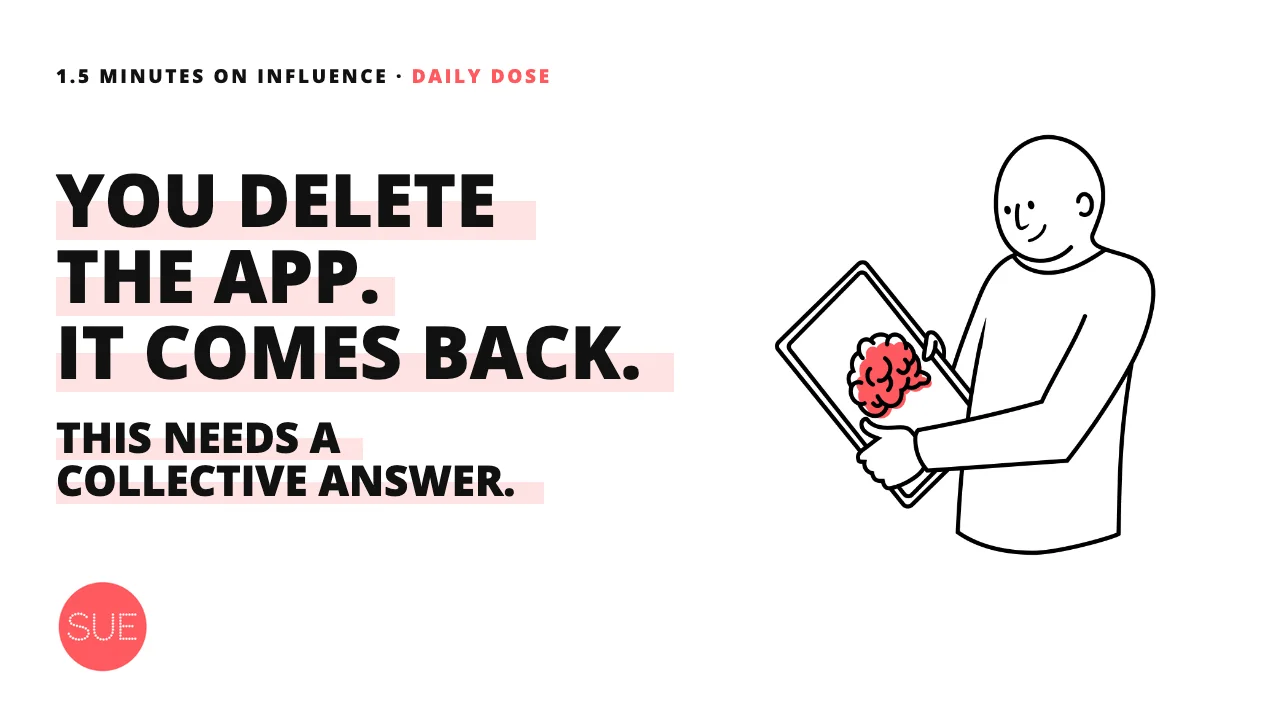
If you've ever tried deleting a social media app and found yourself back at it again after a few weeks, I hope you can now see that this was because it was an individual intervention. Your unconscious brain is longing for belonging.
Instead of focusing on personal solutions, we should therefore begin to see more issues as collective problems that require collective answers. In summary, this is a plea for giving more attention to system interventions.
Understanding the psychological barriers that keep groups stuck in certain behaviours might be the key to changing behaviours on a larger scale. Not just because we want to, but because people themselves are asking for change.
Sources: Bursztyn, L., Handel, B. R., Jiménez-Durán, R., & Roth, C. (2025). When product markets become collective traps: the case of social media. American Economic Review, 115(12), 4105-4136. https://doi.org/10.1257/aer.20231468