Thursday 27 August 2026
Premortem: the meeting that hears the doubts before the disaster
 By Astrid Groenewegen · 4 min read
I don't know if you share this particular allergy, but I really have to work hard to suppress an eye-roll when someone says 'I knew it' after things have gone wrong already. Oh, really, you knew? Then where was that insight when we were deciding? Instead of staying annoyed, though, I started wondering whether we could put that same instinct to better use and get people to name what will go wrong before the event instead of after it. Which is really a design question:
How do you design a meeting that hears the doubts before the disaster, not after?
And how can we use this for better decision-making?
I think we have all been there: a plan gets presented, everyone agrees, the project goes ahead, and only when it fails do the doubts come out. In the post-mortem, there is always one person who claims they saw it coming. But often, more than one person had doubts beforehand but they just never said it out loud. We tend to explain this as a courage problem, or a culture problem, and reach for vague fixes like telling people to speak up more.
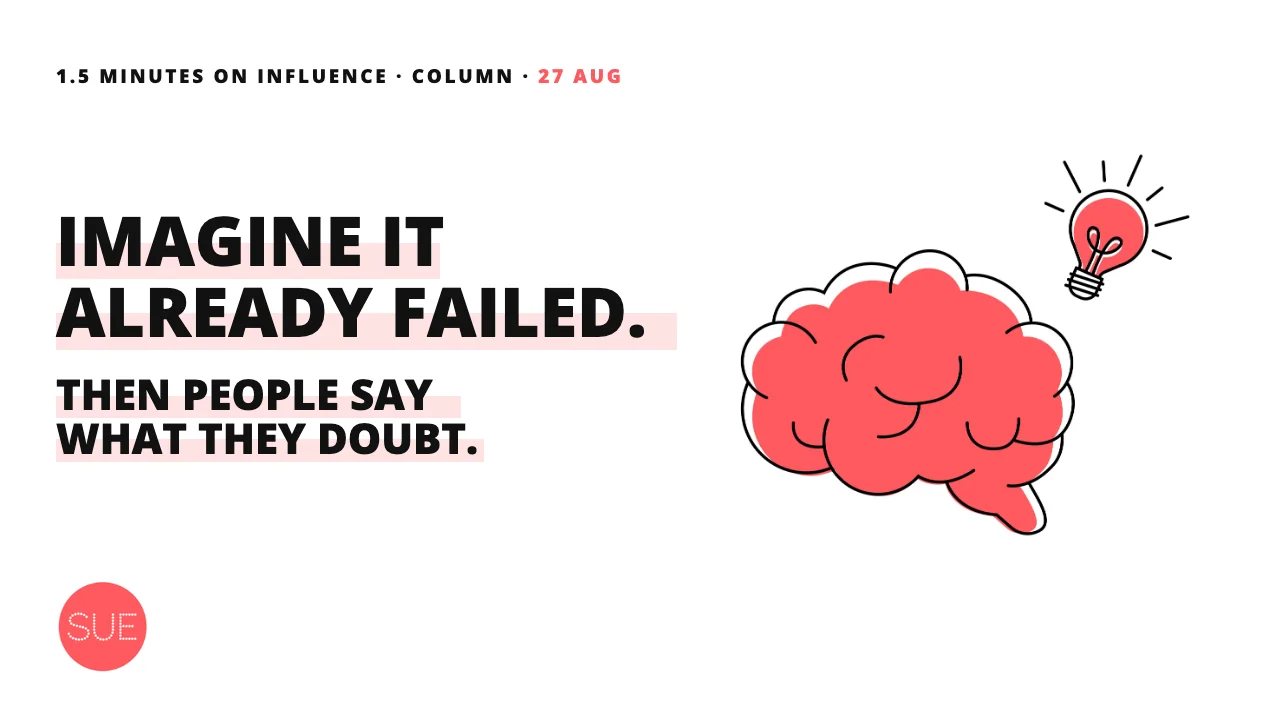
The cognitive psychologist Gary Klein found a far smaller lever. In a normal review you ask a team what could go wrong, and people answer cautiously, because naming a risk sounds like doubting the plan, or the person who proposed it. So Klein changed one thing: the tense of the question. Instead of asking what might go wrong, you tell the team to imagine it is months from now, and the project has already failed, completely, and then ask each person to write down why. He called it a premortem. It goes back to a 1989 study by Deborah Mitchell, Jay Russo and Nancy Pennington. They found that:
Picturing a plan as already failed, rather than asking whether it might fail, helps people name about a third more reasons why it went wrong. And a risk you can name in advance is one you can still do something about.
Think about what that means in a meeting. As long as failure is just a possibility, naming a risk feels like doubting the plan. But once everyone agrees the plan has failed, saying why is not criticism anymore. You are just explaining what happened. So the person who said nothing in the risk review will, in a premortem, tell you exactly where the cracks are.
And here is the part that matters most for anyone designing the meeting rather than just attending it. The fastest way to wreck a premortem is to run it with the senior people in the room. Their presence quietly collapses the honesty the whole thing depends on. The problem was never that people lacked the insight. The room was built, often by accident, to suppress it. That is the whole of Behavioural Design in one move. You do not ask people to be braver. You change the question, and the room, so that the honesty costs nothing.
So how do you build a meeting that hears its doubts in time? Here are three practical moves:
Change the tense, not the people. Before committing to a plan, do not ask what could go wrong. Tell the group to assume it is a year on, and the thing has clearly failed, then have everyone write down why, alone, before anyone speaks. The past tense gives permission the conditional withholds.
Let people write before they talk. Independent, written answers first, shared round robin after. This stops the first confident voice from setting the ceiling for everyone else, and it means the quietest person's risk lands with the same weight as the loudest.
Get the most senior person to leave, or at least to go last. If the boss speaks first, the premortem dies. Either run it without them, or have them stay silent until everyone else has emptied their list. The aim is a room where the warning costs nothing to say.
Do this well, and you get your risks early, while you can still act on them. Do it badly, and you are back to the post mortem, listening to that person who says, 'I knew it.' And this time, annoyingly, they might be telling the truth.
Sources
Klein, G. (2007). Performing a project premortem. Harvard Business Review, 85(9), 18 to 19.
Read the full guide:
How do you design a meeting that hears the doubts before the disaster, not after? →