Thursday 4 June 2026
Pricing psychology: why a higher price can make customers happier
 By Astrid Groenewegen · 4 min read
I have something to admit: I’m a bit of a food snob. Not in the sense that I like eating in fancy restaurants, but I do have a weakness for beautiful packaging. Last week, I bought a bottle of olive oil that cost three times what I would normally spend. I told myself it was because the quality was better. And maybe it was. But the honest truth? The bottle is just really, really nice. And that’s what drew me in.
But here’s what I didn’t realise at the time: the price didn’t just justify the purchase, it actually changed how much I enjoyed it. Because if that same beautiful bottle had cost the same as the one next to it on the shelf, I probably wouldn’t have valued it in the same way. Even if the oil inside had been identical.
This is one of the best-known findings in behavioural economics: Price doesn’t just reflect value. It can amplify it.
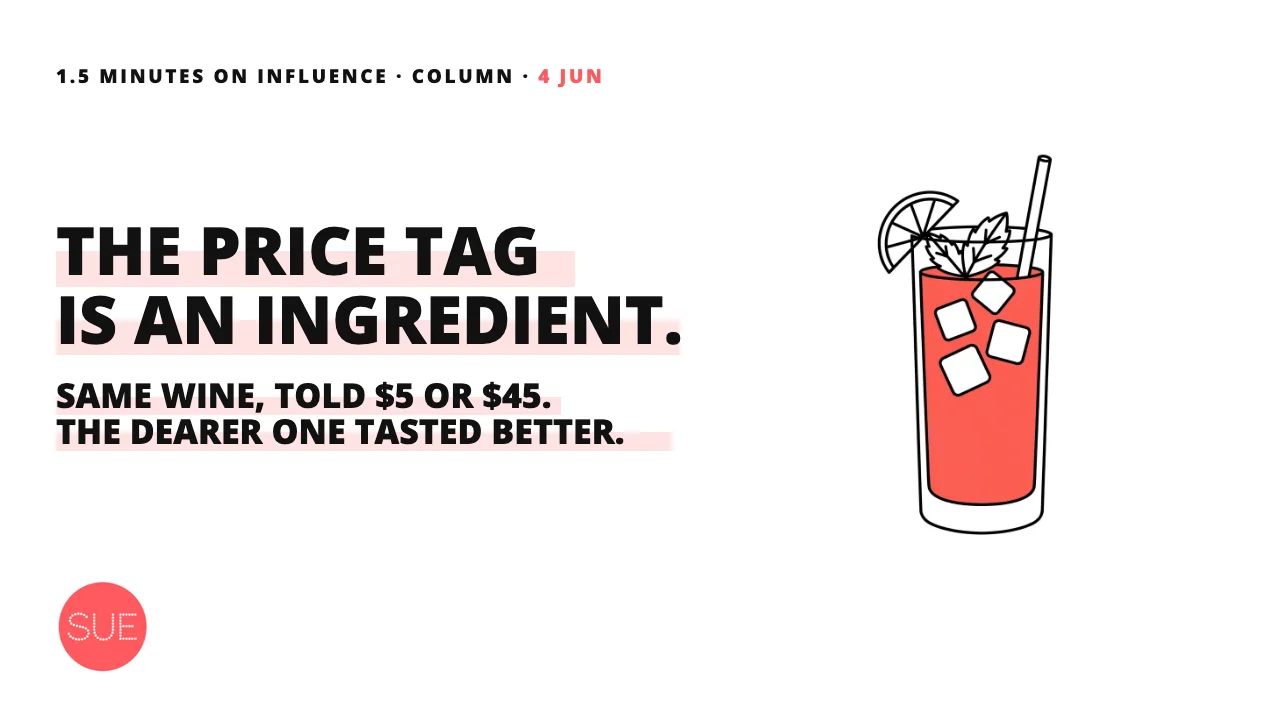
Researchers at Stanford and Caltech ran a study in which participants tasted the same wine but were told it cost either five dollars or forty-five dollars a bottle. Not only did people report enjoying the expensive wine more, brain imaging showed that their reward centres were more active when they thought they were drinking the pricier bottle. The experience itself changed. The price tag was not a label. It was an ingredient.
Economist Richard Thaler, whose work on mental accounting helped win him the Nobel Prize, has spent decades documenting how people do not evaluate prices in absolute terms but in relation to reference points. What something costs is always interpreted against what we expected it to cost, what we paid for something similar before, and what alternatives are available.
A fifteen euro glass of wine at an airport feels reasonable. The same glass in your local neighbourhood bar feels like an insult. Same wine, same price, completely different experience.
This is why pricing is one of the most powerful and most underestimated design decisions a business can make. Most organisations treat pricing as a financial exercise: calculate costs, add margin, arrive at a number. But the number you arrive at does not just determine your revenue. It shapes what customers believe your product is worth, how they feel while using it, and whether they come back.
The implications run in both directions. Pricing too low does not just reduce margin. It actively undermines perceived quality. Customers who pay less can, counterintuitively, be less satisfied, because the price has already told them not to expect much. Luxury brands have understood this for decades. IKEA understands the inverse of it just as well. The pricing strategy is inseparable from the brand strategy because price is the most immediate signal of what something is.
What I find most interesting behaviourally is how this plays out in services rather than products. When a consultant raises their day rate, clients can become more attentive, more prepared, more engaged. The higher price has changed the context of the relationship. The same advice, delivered at a higher price, lands differently. Not because the advice changed. Because the price changed what the client brought to the room.
How to use this insight:
Before setting or changing a price, ask what signal that price sends before a single interaction has taken place.
If you are pricing too low out of fear of rejection, consider what that price is communicating about the quality of what you offer. A low price is not a neutral choice. It is an active claim about value, and it shapes how customers experience what they buy.
If you are reviewing your pricing and considering a raise, think about the full effect. Higher prices can attract more committed customers, generate fewer complaints, and produce better outcomes because clients may invest more attention and effort when they have paid more. The price changes the behaviour on both sides of the transaction.
For product designers and marketers: the way a price is presented matters as much as the price itself. A price shown as a daily cost rather than an annual sum feels smaller. A price anchored next to a higher alternative feels reasonable. A price with a clear explanation of what it includes feels fairer than the same price offered without context. None of this is manipulation. It is an acknowledgement that price perception is a psychological experience, not a mathematical one.
The bottle of olive oil was probably worth the extra cost. But even if it had not been, the price would have made it taste like it was. And did I mention the bottle is really nice? That has to count for something too, right?
Sources
Plassmann, H., O’Doherty, J., Shiv, B. and Rangel, A. (2008). Marketing actions can modulate neural representations of experienced pleasantness. Proceedings of the National Academy of Sciences, 105(3), 1050-1054.
The Royal Swedish Academy of Sciences (2017). Richard H. Thaler: Integrating economics with psychology. Press release, Nobel Prize in Economic Sciences. https://www.nobelprize.org/prizes/economic-sciences/2017/press-release/