Thursday 8 October 2026
Psychological safety: the one meeting rule that changes who speaks
 By Astrid Groenewegen · 4 min read
When I started working, many light-years ago, I was always struggling with one thing: I didn’t say much in meetings. And, of course, it kept coming back in my performance reviews. But I was 22 (I told you, many light-years ago), and who was I to add to the discussion? Or, even worse, disagree with someone senior?
But I observed. A lot.
And more than once, we would leave a meeting with no real decisions, no constructive discussion and, honestly, nowhere near equal contributions from everyone around the table. Later in my career, I started wondering:
How do you build a team where everyone contributes without asking anyone to be ‘brave’? Where even the most junior person feels free to contradict the most senior?
Looking for an answer, I ended up at NASA. In the 1970s, a British physician and pilot called H.P. Ruffell Smith put experienced airline crews into a NASA flight simulator and gave them a realistic mid-air problem to solve. The problem wasn’t flying. They could all fly. The problem was the team. Captains didn’t lead when they needed to. Junior officers spotted problems but stayed quiet. Crews failed to use the people and information right in front of them. Everyone knew their own job. They just didn’t know how to work as one crew.
That study, together with a NASA workshop in 1979, produced what the industry now calls Crew Resource Management. And here is the part I find genuinely interesting, because the fix was not the obvious one. Nobody tried to make second officers braver. Alongside training, they changed the system. Speaking up became part of the flight routine: there was a moment to raise a concern and a clear way to say it. So staying quiet was no longer being polite. It meant skipping a step.
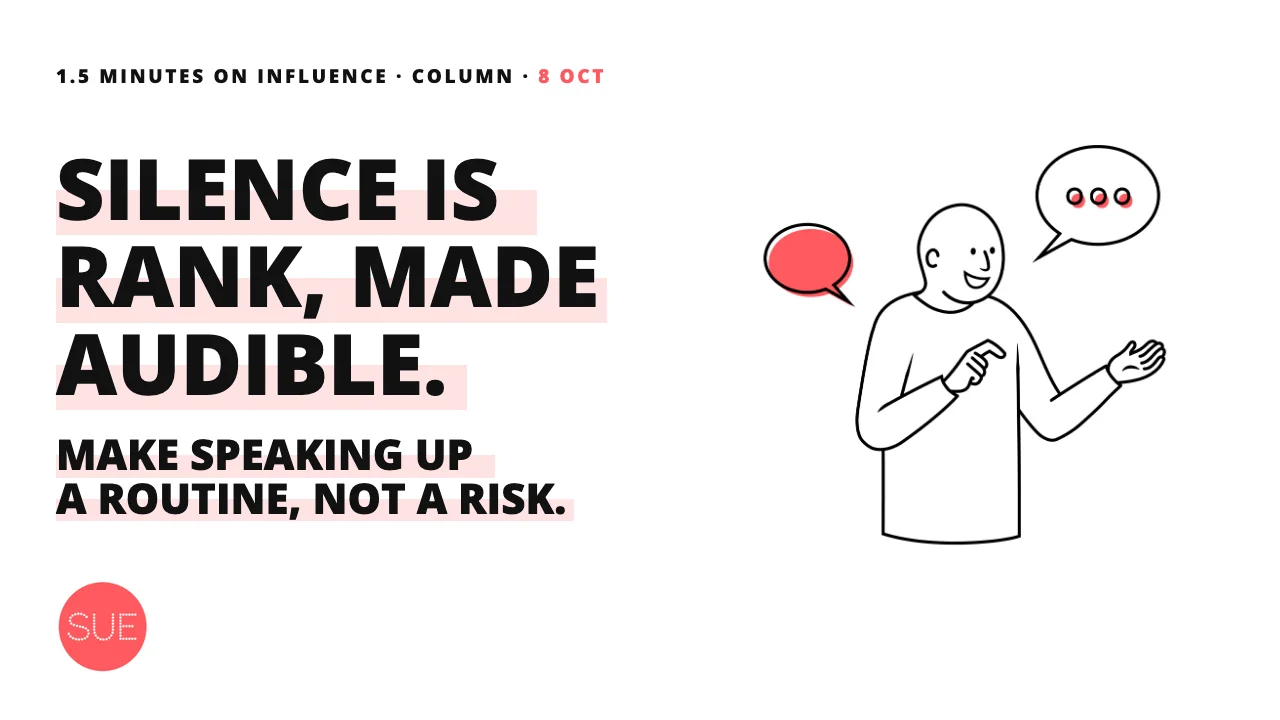
Silence is rarely a personality trait. Far more often, it is rank, made audible.
This is Behavioural Design at its purest: you change the system, not the person. Telling people to speak up still asks them to take a risk. They have to be the one who interrupts, disagrees or challenges someone more senior. But when speaking up is built into the process, the social rule changes. Now saying something is simply what you are supposed to do. Staying quiet is the unusual choice.
Nobody had to become braver. The brave thing simply stopped being the unusual thing.
So how do you put this to work, well beyond cockpits? Three practical moves:
Give the doubt a scheduled moment. Ruffell Smith’s crews were not short of judgement; they were short of a slot in which using it was normal. Add one fixed point to your meetings where the question is not whether anyone has concerns but what they are, and hold the pause long enough to be slightly uncomfortable. The pause does the work that bravery cannot.
Let the most junior person go first. Once the senior view is in the room, everything after it is a reaction to it. Reversing the order costs nothing and changes what gets said, because there is no established position yet to contradict. If you are the senior person, speaking first is the most expensive thing you do in a meeting.
Rehearse the whole thing, not the parts. Aviation also adopted Line-Oriented Flight Training: crews fly an entire realistic mission and then debrief it in detail. Most teams do the opposite. We train the parts, a feedback course here, a decision workshop there, and then expect people to put it all together for the first time when the pressure is on. Instead, rehearse the whole situation. Including the awkward moment. Because when it happens for real, you are no longer figuring out how to work together. You have already done it.
For me, the second point is the one I still need to work on. I left those days of not speaking up far behind me. Now I have to make sure I don’t take over in my urge to get to decisions quickly. I know. Things can change. I think one of the best ways to reflect on yourself is to notice what really irritates you in other people. For me, it is the monologue. Nothing is more boring (or more annoying) than someone who turns a conversation into a speech. Monologues belong on a stage, not in a meeting room. Or over coffee with a friend, for that matter. So, there are actually two meeting habits you need to design, as speaking up is only half the work. Learning when to shut up is the sequel.
Sources
Ruffell Smith, H.P. (1979). A simulator study of the interaction of pilot workload with errors, vigilance, and decisions. NASA Technical Memorandum 78482.
Cooper, G. E., White, M. D. and Lauber, J. K. (eds) (1980). Resource management on the flight deck. NASA Conference Publication 2120 (proceedings of the NASA/industry workshop, San Francisco, June 1979).
Read the full guide:
Psychological safety at work: How to design it →