Thursday 17 September 2026
Reactance: why your rule produces the behaviour it forbids
 By Astrid Groenewegen · 3 min read
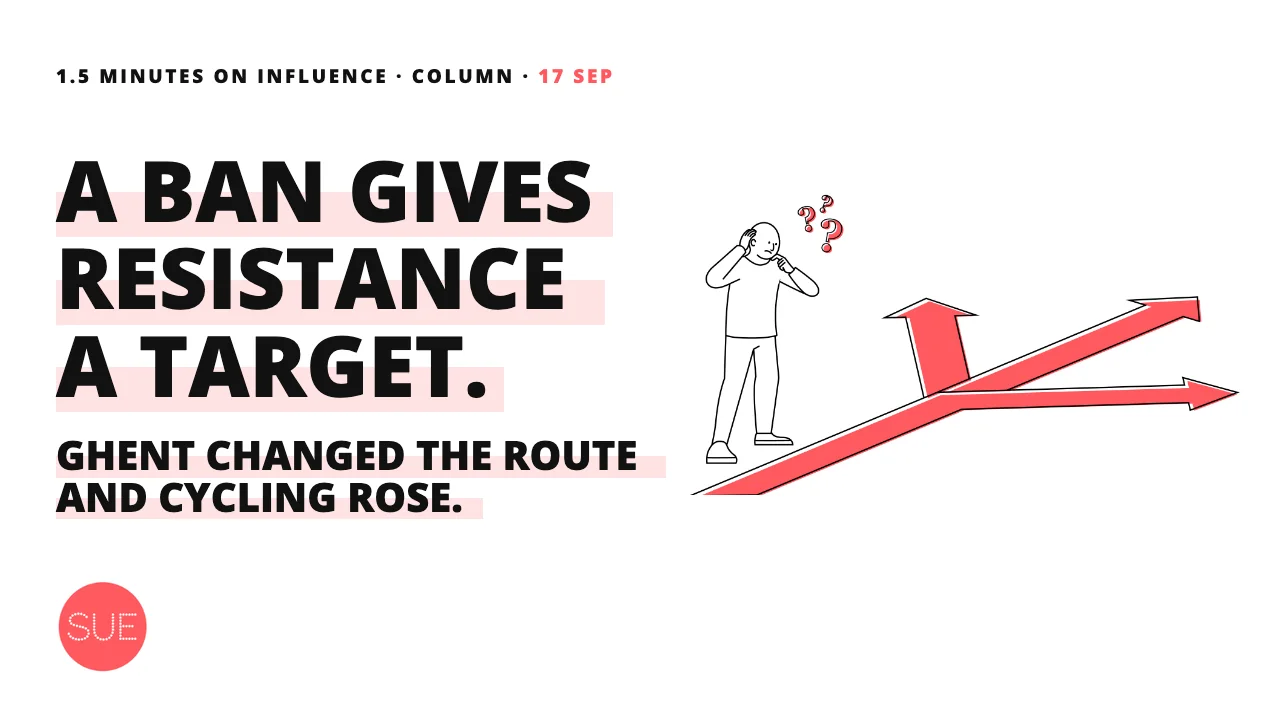
You may know that I live in the city of Amsterdam. Just like many other cities, the government is trying to limit the usage of cars in the city centre. You maybe can imagine how much resistance a flat prohibition will create, how telling people they may not do something makes them dig in. So, I started thinking:
How can you change a city’s behaviour without a flat ban? And where in our own lives could we get further by rearranging things rather than forbidding them?
And then I thought about a former Academy student who told me about Ghent, a city that changed how hundreds of thousands of people move without a flat ban on cars. In April 2017, Ghent introduced a circulation plan for its centre. The mechanism was simple and quietly radical. The centre was divided into zones, and to drive from one zone to another by car you could no longer cut straight across the middle, you had to go out to the ring road and back, a much longer way. By bicycle or on foot, you could still go directly, exactly as before. Cars were not banned from the centre. They could no longer use it as a shortcut.
The car was not banned. Its shortcut was closed.
The plan was not the only factor, but the behaviour followed the new layout. Cycling in the city rose substantially, from roughly 22 per cent of journeys in 2012 to about a third by 2018, with a strong increase in and around the centre, while car traffic through the middle fell. The city did not persuade anyone onto a bike. It rearranged the situation, so the bike became the sensible choice and driving across the centre became the tedious one. The principle is the default, applied to a whole system, and the decisive feature is that Ghent did it without prohibition. And here’s a helpful lesson for us:
When less is banned, there is less to rebel against. A ban hands resistance a target, a freedom to defend, a principle to dig in on.
The solution is to remove as much of that target as you can. This is Behavioural Design at work. Ghent did not change a single mind. It changed the layout, and the minds followed the road. So how do you change behaviour without provoking resistance? Here are three practical moves:
Make the wanted behaviour the direct route. Whatever you want people to do, give it the shortest, smoothest path. The healthy option first on the menu, the shared drive as the default save location, the good process as the one-click one.
Make the unwanted behaviour the long way round. Leave it fully allowed but add a detour. An extra confirmation, a request you must make, a setting you must change back. Friction, not a fence.
Reach for redesign before prohibition. When you feel the urge to forbid something, ask first whether you could simply rearrange which option is easy. You keep people's freedom, and you avoid the backlash a ban reliably provokes.
Of course, it is fair to say this solution will not win everyone over. Some drivers will complain. But there is a big difference between talking and doing, and in the meantime they take the ring road anyway. I would just make that alternative a bit more attractive, that’s often a missing link in designing desired behaviour. Cheap drive-thru coffee stations along the route, maybe. Good coffee tends to put people in a better mood. It has to be good, though, or they will revolt over the bad coffee instead.
Sources
City of Ghent, circulation plan (Circulatieplan, 2017). https://stad.gent/en/mobility-ghent/circulation-plan
European Commission, Urban Mobility Observatory (2019). Ghent’s traffic circulation plan, Belgium. https://urban-mobility-observatory.transport.ec.europa.eu/resources/case-studies/gents-traffic-circulation-plan-belgium_en
City of Ghent, cycling policy: modal share of cycling up from 22 per cent in 2012 to about a third. https://stad.gent/node/825607