Daily Dose of Influence
The contrast effect: why context trumps content in decisions
 By Astrid Groenewegen · 2 min read
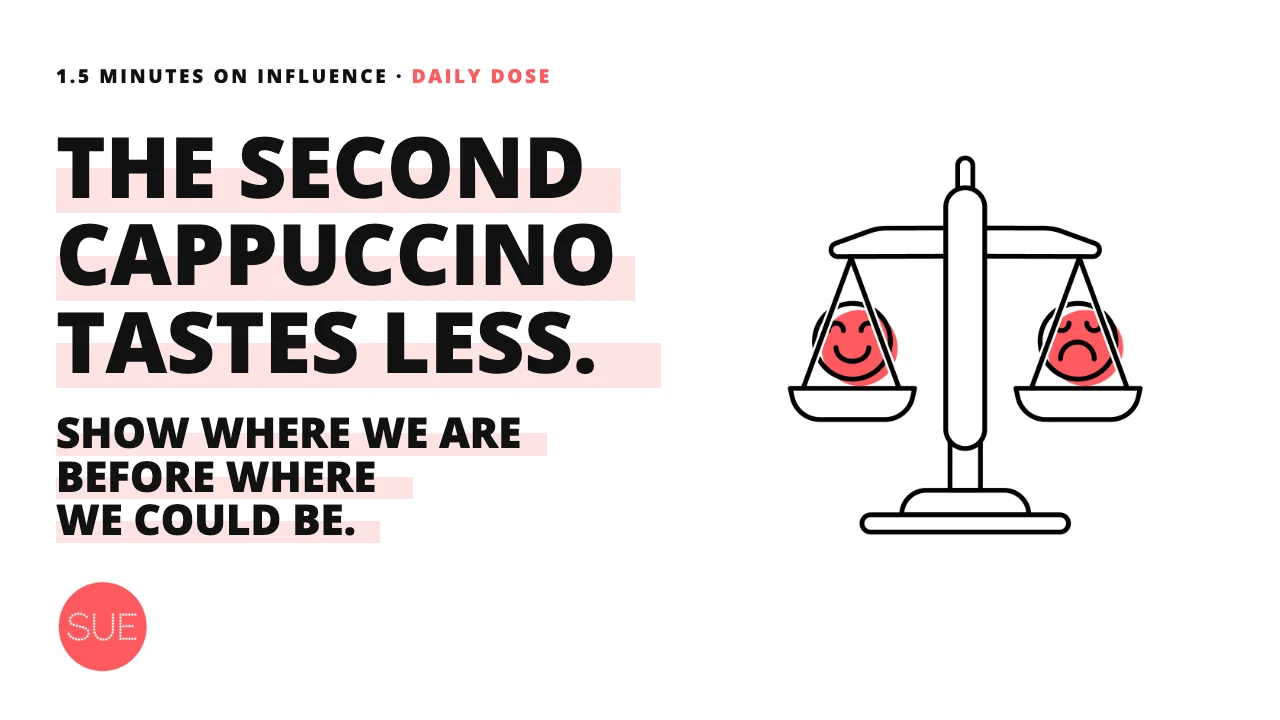
I used to be a. But about a year ago, I started having one cappuccino in the morning. Recently, I noticed something: I’ve upped my game, I now go for a second one. But there’s a catch. I don’t enjoy the second one nearly as much as the first.That got me thinking: what’s happening here psychologically? Is there a phenomenon at play that we can actually use in our work?
Turns out, there is. What I’m experiencing is what behavioural scientists call the contrast effect, and it influences far more than just coffee.
The contrast effect is our brain’s tendency to judge things not by their absolute value, but in relation to what came before.
It’s why a 15°C day in winter feels warm, but the same temperature in summer feels cold. Or why a €200 price tag seems reasonable for a suit but outrageous for a T-shirt.
But here’s where it gets really interesting: understanding contrast can be a game-changer when it comes to influencing behaviour and driving change.
It’s also a powerful tool in persuasion. Behavioural scientist Robert Cialdini describes in his book Influence how real estate agents intentionally show clients overpriced houses first. The actual target properties then seem like a steal by comparison.
The same principle applies when introducing change at work. We often make the mistake of jumping straight to our solution. It works better to start by vividly highlighting the gap between current reality and the desired future state.
So, how can you leverage the contrast effect in your own work? Here are three quick ways:
Frame the problem before presenting the solution. People need to feel the gap before they appreciate the fix.
Show “where we are now” before “where we could be.” This makes potential gains feel more concrete.
If you want something to seem reasonable, first show something more extreme. Context changes perception.
Now, here’s my question for you: What reference points are shaping perceptions in your work? Are you actively creating contrast to your advantage, or leaving it to chance?
Sources: Cialdini, R. B. (2007). Influence: The Psychology of Persuasion (revised edition). Harper Business. The real estate example is described in the chapter on the contrast principle; see also the summary at https://www.pon.harvard.edu/daily/negotiation-skills-daily/let-them-compare-and-contrast