Thursday 22 October 2026
The devil's advocate: why your team needs someone who disagrees
 By Astrid Groenewegen · 3 min read
If I could change one thing about myself (there are a few candidates, but let's stick to one), I wish I were naturally more of a ‘yes’ person. You know, someone whose first reaction to an idea is enthusiasm rather than a mental list of everything that could go wrong. Unfortunately, my brain tends to start with the objections. Not always my most charming quality, I admit.
But recently, I came across a story from the Vatican, of all places, that made me feel a little better about myself. It turns out that being the person who raises objections can be surprisingly valuable. Not just for keeping people from becoming saints, but for helping teams make better decisions.
And there is some fascinating psychology behind it.
As said, I ended up in the Vatican. In 1587, Pope Sixtus V created a job that sounds made up: the devil’s advocate. A church lawyer whose only task was to argue against a candidate for sainthood. Find ordinary explanations for the miracles. Suggest selfish motives for the good deeds. Later, the role became compulsory. No devil’s advocate, no saint.
That job existed for almost four hundred years. In 1983, the process was reformed, and the role disappeared. What followed is easy to count. John Paul II declared 482 saints, more than any pope before him.
To be fair, the same reform made the whole procedure simpler, and this pope wanted more saints. But one thing did change for certain. Objecting was no longer anybody’s job. It became everybody’s job. And we all know what that means.
When doubt is everybody’s responsibility, it is nobody’s.
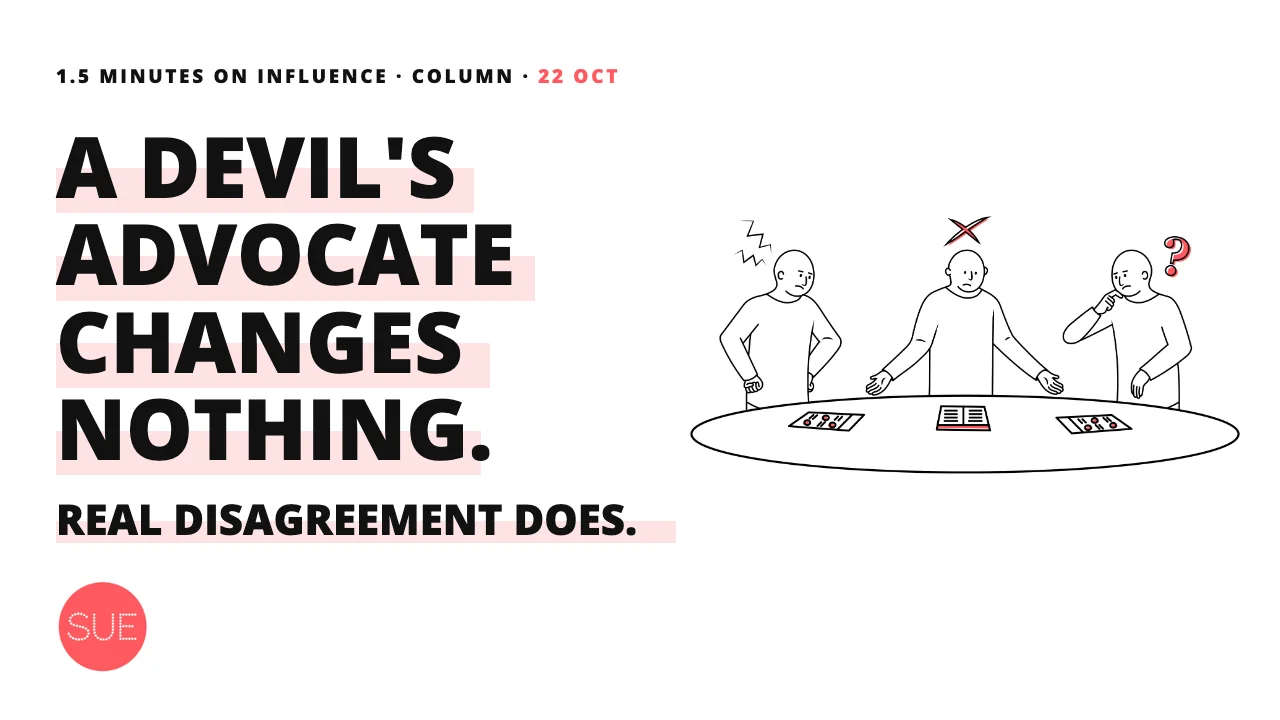
Now comes the part I find really interesting. You might think: fine, let’s appoint a devil’s advocate in every meeting. Psychologist Charlan Nemeth studied exactly this distinction. And the findings are rather uncomfortable. When someone is simply assigned to argue against an idea, people tend to defend their original position. But when someone genuinely disagrees, it can make people reconsider their assumptions and explore alternatives they might otherwise have missed.
Giving someone the job of disagreeing is not the same as giving disagreement a genuine place in the room.
This is Behavioural Design applied to decisions: you do not ask people to be more critical. You make sure the doubt has a place and an owner while the decision is still open.
So how do you put this to work, well beyond sainthood? Three practical moves:
Ask who would object, not whether anyone objects. “Any objections?” gets you silence. Find the person who truly has doubts and get them in the room before the decision is made, not after.
Look for the step you quietly removed. Every organisation has dropped a check at some point because it slowed things down. Often, that was right. But name what that step was doing. The objection it produced did not move somewhere else. It simply stopped.
Count the yeses. The Vatican’s shift only shows because saints are counted. How many proposals did your team approve this year, and how many did it turn down? If almost everything gets a yes, either your proposals got better or the friction is gone. From the inside those two look exactly the same.
So next time someone in your meeting raises an objection, resist the temptation to roll your eyes (another one of my vices, I must admit). They (read: I) might just be saving you from a terrible decision. Of course, some people (not me, obviously) are simply being difficult. The trick is knowing the difference.
Sources
Apostolic constitution Divinus Perfectionis Magister (1983), on the reform of the canonisation process.
Nemeth, C., Brown, K. and Rogers, J. (2001). Devil’s advocate versus authentic dissent: stimulating quantity and quality. European Journal of Social Psychology, 31(6), 707-720.
List of saints canonized by Pope John Paul II (482 canonisations, plus one equipollent canonisation). https://en.wikipedia.org/wiki/List_of_saints_canonized_by_Pope_John_Paul_II