Thursday 26 February 2026
The doorway effect: why you forget why you walked into the room
 By Astrid Groenewegen · 2 min read
It happens to me at least once a day. I walk into a room with clear purpose: fetch my notebook, grab my charger, find that document I printed. And the moment I cross the threshold... gone. Complete blank.
I stand there, scanning the room for clues. Then I walk back to where I started, and instantly remember.
For years, I assumed this was just me getting older. Turns out, it's architecture.
Psychologist Gabriel Radvansky has spent decades studying what he calls the "doorway effect." His research shows that walking through a doorway triggers the brain to file away the current mental episode and start fresh. The doorway acts as an event boundary, a signal to your memory that one context has ended and another has begun.
Radvansky found the effect persists even in virtual environments. People navigating video game rooms forgot more when passing through doorways than when covering the same distance in a single space. It's not about physical effort. It's about how our brains parse space into meaning.
This is Behavioural Design in action: our memory isn't just in our heads. It's distributed across our environment. The room you're in holds part of what you know.
How to use this insight:
If you need to remember something across contexts: Say it out loud or visualise it vividly before you move. You're essentially carrying the mental context with you, bridging the gap the doorway creates.
If you're designing workspaces: Understand that physical transitions affect mental continuity. Open-plan offices reduce doorways but create other boundaries (noise zones, team clusters). Every boundary is a potential reset point.
If you're onboarding new employees: The constant context-switching of a first week, new rooms, new people, new systems, creates memory challenges. Reduce cognitive load by keeping early training in consistent spaces.
If you're teaching or presenting: Room changes mid-session can reset attention. If you must move, explicitly bridge: "Before we change rooms, let's lock in the key point..."
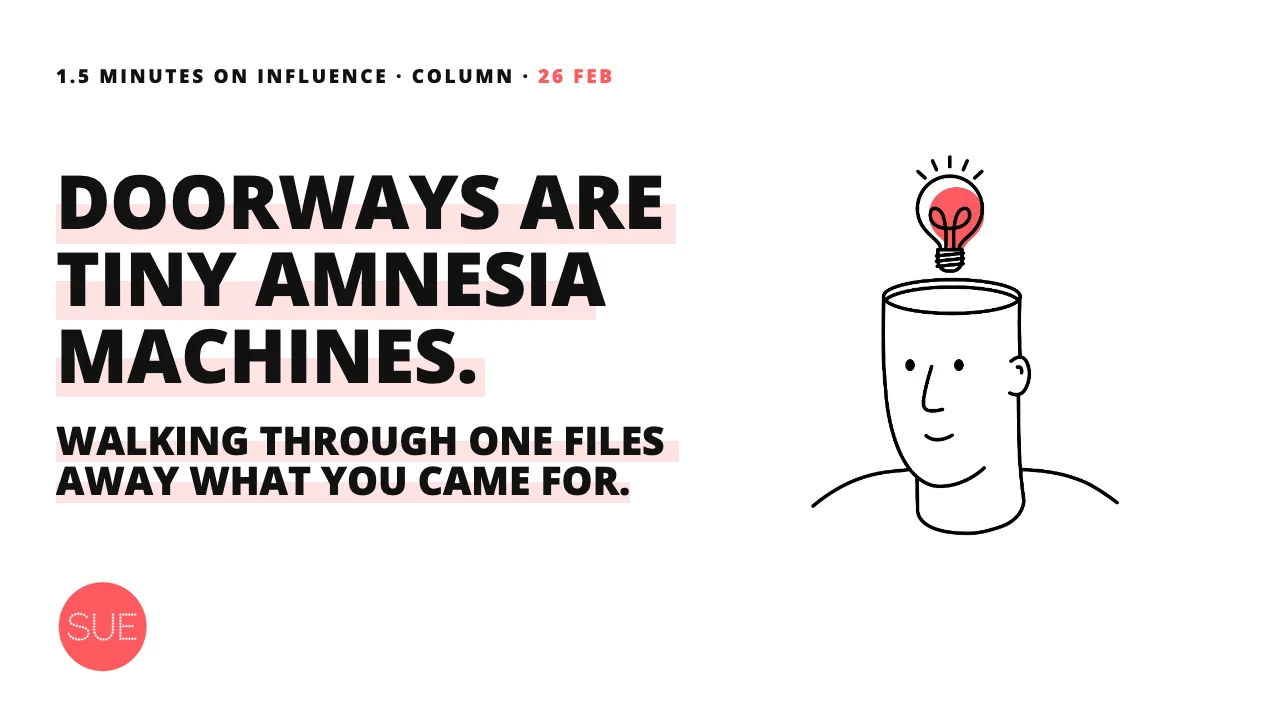
Or just accept that doorways are tiny amnesia machines, and forgive yourself for standing confused in the kitchen three times a day.