Thursday 22 October 2026
Your AI licences are bought. Nobody uses them
 By Astrid Groenewegen · 3 min read
 1:58
Film 1:58. Voice: an AI clone of Astrid Groenewegen’s own voice.
Read the text of the film
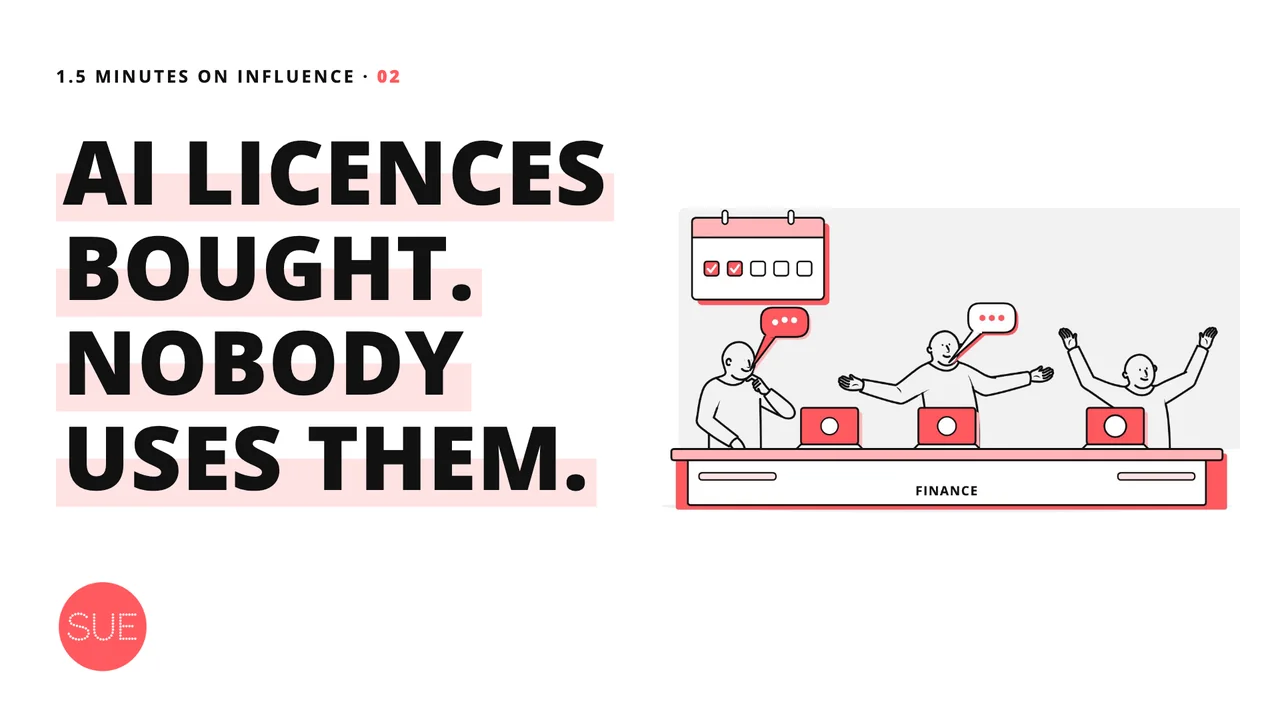
Your AI licences are bought. Nobody uses them. This is how Behavioural Design gets your people using the tool. Like most leaders, you’ve appointed an AI champion in every team. And still, almost nothing happens. A sociologist tested how a new habit spreads through a group. Damon Centola, at MIT, built an online community of about fifteen hundred people.
In one version, a person’s contacts were also friends with each other. Small, tight groups. In the other version, their contacts were strangers to each other. Then he invited people to join a new health forum, and watched the invitation travel. In the tight groups, fifty-four per cent joined. In the scattered ones, thirty-eight per cent.
Everyone had the same number of contacts. Only who knew whom was different. One invitation leaves people unsure. Is this forum really for people like me? Our Influence Framework weighs what pulls people towards something new against what holds them back. That doubt is one of the things holding them back. We call it an anxiety. A second invitation, from someone else they know, settles it.
Centola calls this social reinforcement. People act once they hear it from more than one contact. In the tight groups, that happened all the time. Look at your own AI rollout. One champion per team means most people hear about it once, from one person. Start in one team. Get three people there using it the same week. Then the next team.
One champion is a single invitation. Most people wait for the second. My name is Astrid Groenewegen, from SUE Behavioural Design, and this was 1.5 Minutes on Influence. Subscribe for the next one. And if this was useful, give it a thumbs up or share it.
A while ago I noticed something curious at a café. The barista had put a tip jar with a few coins in it next to the till. Nothing unusual there. But during a shift change it was swapped for an empty jar, and the tips nearly stopped. Until someone put a few coins back in.
An empty jar asks you to be the first. Most people would rather not be.
Organisations run into the same thing with almost every new tool. The licences are bought, the training is done, there's a page on the intranet. And then nobody uses it. The usual next step is to appoint champions: one enthusiastic person in every team who will show the others the way.
It sounds sensible. One of the cleanest experiments on how behaviour spreads suggests it's the wrong shape.
In 2010, Damon Centola, then at MIT, built an online health community of 1,528 people. Everyone got six or eight anonymous health buddies, and Centola decided exactly who was connected to whom. In one version of the network, a person's buddies were also linked to each other, the way colleagues in a team are. In the other version, everyone had exactly as many buddies, but the links were spread at random across the whole network. Then one person in each network signed up for a new health forum. Every time someone signed up, their buddies received an invitation.
A popular hypothesis predicted that the random networks would win. Random links work as shortcuts. They carry news across a population quickly, the way a virus travels.
The tight-knit networks won easily. The forum reached 54 per cent of them, against 38 per cent of the random networks, and it spread more than four times as fast.
The explanation sits in individual decisions. People were much more likely to sign up after a second invitation than after the first, and a third still helped. This is what researchers call a complex contagion. A virus usually needs one contact. New behaviour often needs several, because one person doing something doesn't yet tell you whether it's worth it, or whether it's for people like you.
In the SUE | Influence Framework© we call that an anxiety: the doubts and uncertainties about the new behaviour that keep people where they are. One invitation leaves those doubts in place. A second and a third, from people around you, start to settle them.
Centola is honest about the limits of his study. Signing up for his forum was easy. He expects real behaviour, the kind that costs time, effort or comfort, to need even more reinforcement. A new tool at work is exactly that kind of behaviour. People have to change a routine, risk looking clumsy in front of colleagues, and invest time before they see anything back.
Now look at the champion model again. One champion per team means everybody gets one signal. That's the random network. The champion is enthusiastic, nobody around them has moved, and for everyone else the doubt stays.
That doubt is where the work is. The licences are there and the training happened, so skill isn't what's missing. What's missing is the reassurance of seeing the new way several times, from people you work with every day.
So cluster your early users. Instead of one in every team, put three in the same team, doing the same kind of work, using the tool where the others can see it. When that team works this way, let the next team see them. It's slower to set up and it looks less impressive on the rollout slide. It's also how the behaviour spread in Centola's networks.
The café got its tips back the same way. Nobody put up a sign explaining why tipping matters. Someone put a few coins back in the jar.
A cold needs one contact. New behaviour needs a few.
Sources
- Centola, D. (2010). The spread of behavior in an online social network experiment. Science, 329(5996), 1194–1197. https://doi.org/10.1126/science.1185231