Daily Dose of Influence
Time confetti: the hidden joy-killer in your day
 By Astrid Groenewegen · 3 min read
I have a confession to make: this is actually the second version of this week’s newsletter. I had one finished. I read it. I didn’t like it. I deleted it. Why? Because it was written in a rush, crammed between waking up, getting my daughter to school, and squeezing in my Pilates class. And honestly, it just wasn’t good enough. Somewhere during that frantic morning, I found myself scolding out loud at all the classic time management advice: “Turn off notifications!” “Block time periods!” “Well, you’re not working this particular morning, are you?” I snapped, out loud, at my own screen.
Still grumpy, I went to my Pilates class. And that’s when it clicked. During that hour, I remembered the work of researcher Brigid Schulte and her concept of “time confetti.” And suddenly, I understood where my irritation with all that time management advice was really coming from:
Time management advice is almost always about getting more done, not about feeling better.
Our attempts to multitask aren't just making us less efficient, they're making us less happy. And conventional time management advice focuses almost exclusively on productivity, completely overlooking the emotional cost.
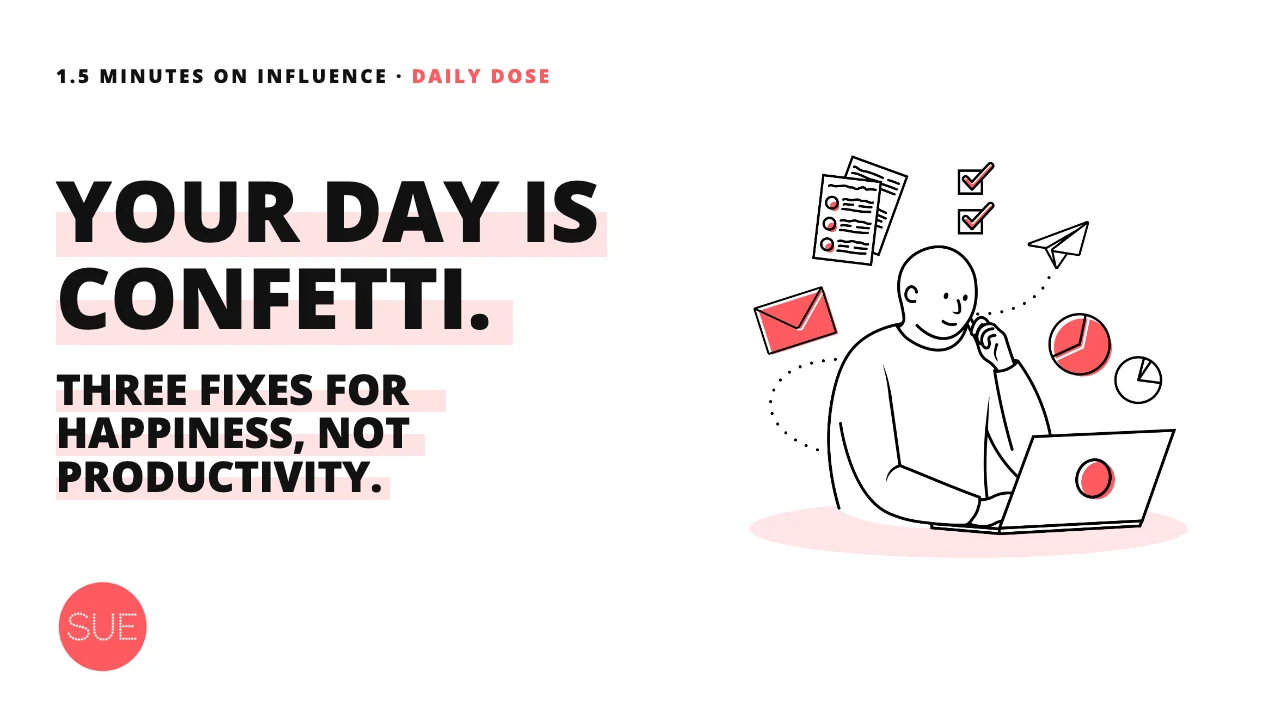
That insight hit hard enough that I came home, scrapped the first draft of this newsletter, and wrote this version instead. Schulte uses the term time confetti to describe how our days are increasingly fragmented into tiny, unusable scraps of time, but the true cost isn't measured in productivity. It's measured in happiness.
Just as actual confetti is meant to enhance celebrations but ends up as messy fragments scattered everywhere, our time is similarly scattered, leaving us with colourful but disconnected moments that don't add up to anything meaningful. We end up with what looks like leisure on paper, but doesn't feel like leisure in practice.
What fascinated me most about Schulte's research is how time confetti robs us of what psychologists call "flow state", those deeply satisfying moments when we're completely absorbed in something meaningful.
Flow is closely linked to wellbeing, yet it's hard to achieve when our attention is constantly fragmented.
Even more startling is what research tells us about these interruptions. Gloria Mark at the University of California, Irvine found that:
Interrupted work is resumed after an average of 23 minutes and 15 seconds, although much of that time goes to other work in between.
For me, that is where the cost shows up: not only in lost productivity, but in how those fragments feel.
So how can we protect our capacity for joy in a fragmented world? Here are three approaches based on the psychology of happiness rather than productivity:
Embrace "savouring practice": Savouring research, led by Fred Bryant and Joseph Veroff, is about deliberately lingering in pleasurable moments, such as really noticing the flavours of your coffee or the feelings in your body after exercise. It helps you notice the good moments that time confetti hides.
Create "joy bookends": Research on the peak-end rule shows that we primarily remember the emotional peaks and endings of experiences. Try creating brief but meaningful moments of connection or beauty at the beginning and end of activities, even rushed ones. These emotional bookends give your brain something positive to "file away" despite the fragmentation in between.
Design for absorbing leisure: Rather than trying to eliminate all distractions (which rarely works), try redesigning your leisure time around activities that are so inherently engaging they naturally resist fragmentation, like rock climbing, complex cooking, or immersive reading. These are the activities where flow tends to show up, and flow naturally repels time confetti.
For me, the most liberating discovery was realising that time confetti isn't inevitable, it's a modern condition we can resist. By treating my attention as a pathway to joy rather than just a productivity tool, I've found that even my compressed Wednesday mornings can contain meaningful moments of delight, rather than a mental party where everyone throws confetti but nobody brings cake.
Sources
Schulte, B. (2014). Overwhelmed: Work, Love, and Play When No One Has the Time. Farrar, Straus and Giroux.
Mark, G. (Gallup Business Journal interview, 'Too Many Interruptions at Work?'). https://news.gallup.com/businessjournal/23146/Too-Many-Interruptions-Work.aspx
Bryant, F. B., & Veroff, J. (2007). Savoring: A New Model of Positive Experience. Lawrence Erlbaum Associates.
Redelmeier, D. A., & Kahneman, D. (1996). Patients' memories of painful medical treatments. Pain, 66(1), 3-8. https://doi.org/10.1016/0304-3959(96)02994-6 (peak-end rule)